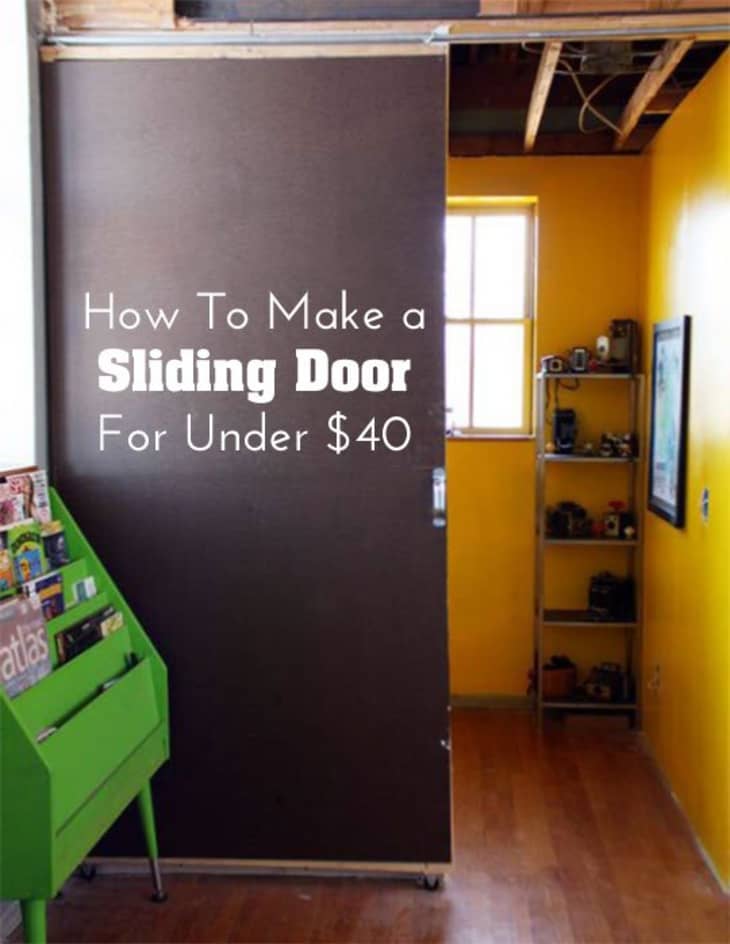
Do you know what kind of looks you get when you go to the hardware store and tell the clerk you want to make a door? They point in the direction of "Doors & Windows" and mutter something about helping someone else —that's when you know it's time to take matters into your own hands. Why would you want to build your own door you ask? Because molding and headers are so last year!
My husband and I needed a temporary door until we finished some construction and drywall work on the lofted space above our living room. Ideally we'd like to use industrial barn hardware and keep the sliding effect, but until we finish the planned construction, we built our own just in case something wild and crazy happens. Although we intend for it to be temporary, its construction is simple and easy to do for permanent places as well! Materials come in right around the $35 price point (depending on finishing accessories like handles and such) which makes it a win in the style category and for your pocketbook! Here's how we made it:
What You Need
Materials
2 plumbing flanges
1 (possibly 2) plumbing angle brackets
Length of plumbing pipe
3 "hinged loops"
2 full sheets of masonite
1 bundle of 2x2's
2 small wheels
Assorted nails/brads
20 wood screws
Equipment
Nail gun or hammer
Screw driver
Level
Instructions
1. Build The Frame
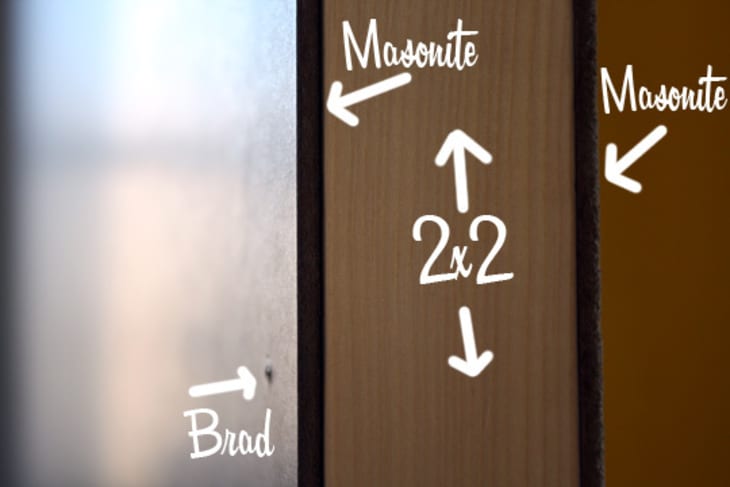
You don't need architect's plans to build a door, you just need a drill, or even less — a screw driver. Check out the photo above to see how the 2x2's were assembled (one screw joining each board). It will feel flimsy and wobbly, but that's ok. The goal is to make a structure that is the same dimension as your masonite.
2. Cover It Up
Your masonite can be nailed down to your frame, glued with adhesive, or tacked down with brads. If you glue it, allow to dry overnight undisturbed. If it was nailed, carry on to the next step!
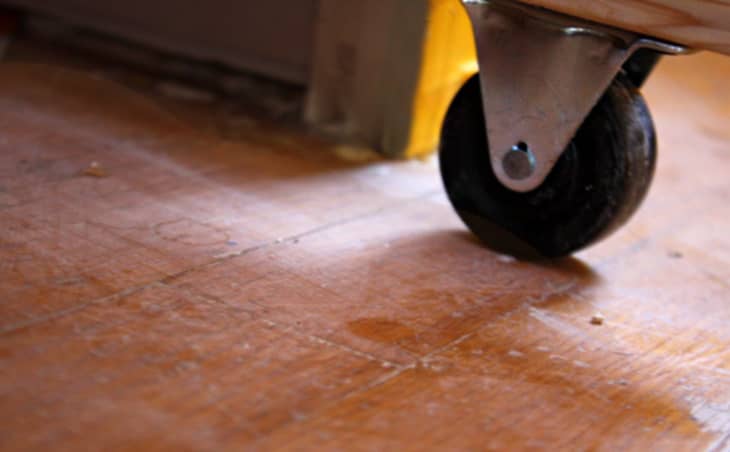
3. Add Wheels
Determine which end of your door will be the bottom and attach your wheels. We used ones that only rolled one direction. We didn't need our door having any more challenges to overcome, so side to side was all we needed — and bonus, they're cheaper!
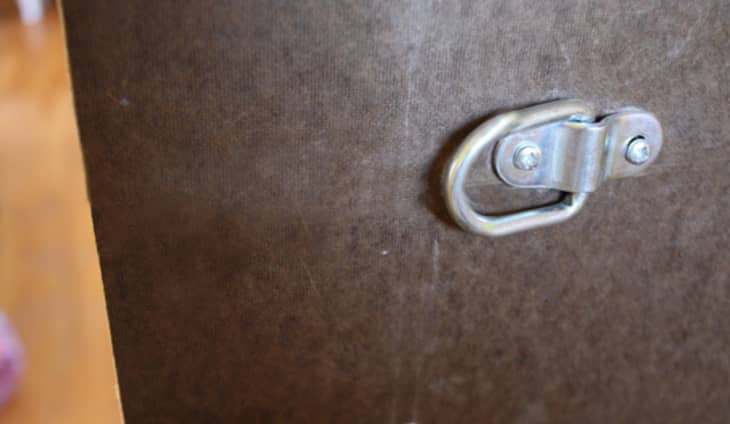
4. Add Hinged Loops
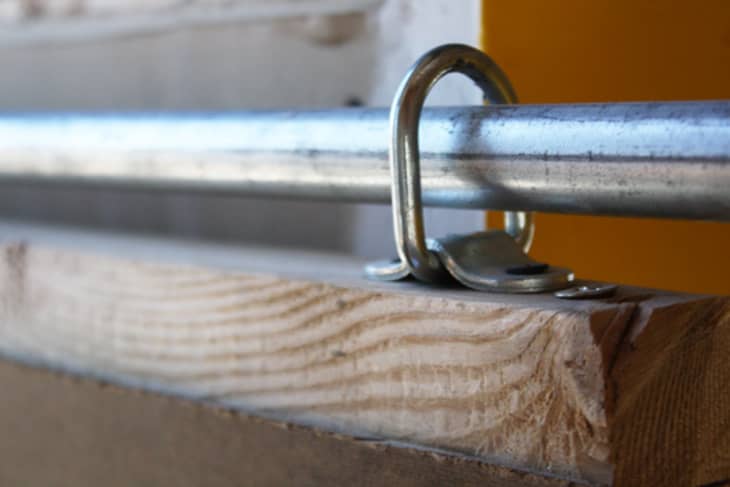
We're sure these pieces have a real name, but they're the product of wandering around the hardware store looking for something that was the right size. We finally found them over with the flashlights and tie downs and other locks. We suggest drawing a picture before you ask where they're located as you might get some puzzled looks. Attach them to the top of the door with wood screws.
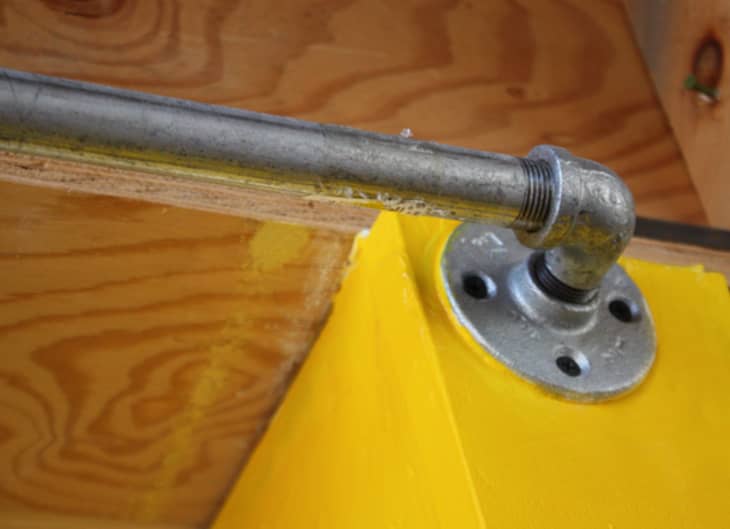
5. Add Pipe
The first step to assembling the hardware is to slide the pipe through the hinged loops on top of the door. This pipe should be cut at the hardware store and it's size will be determined by the size of your space.
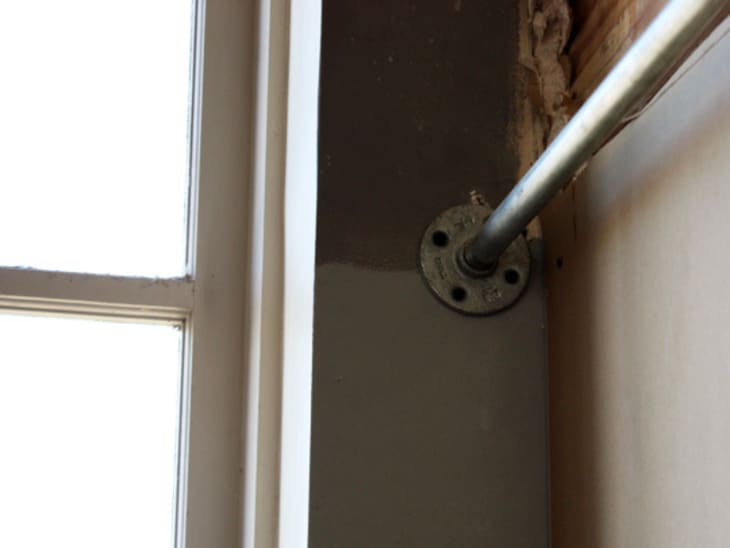
6. Add Angles & Flanges
To the end of your pipe, add any angled pieces required and flanges to the end.
7. Level & Mark
This step is best done with 2, if not 3 people. It seems like it will be easy, but in all reality, the more hands the merrier! Place the level on top of the door. Hold the door in place and mark holes for your screws to attach the plumbing pieces to the wall (you don't have to mark them, but if for any reason the door shifts, it's easier to know where things line up). You want the pipe to be just under the loops when they're fully extended up.
8. Screw Baby Screw
Attach the plumbing hardware to the wall.
9. Check Your Work
Try sliding the door open and closed. If all was square and level, things should roll just perfectly along the floor. If you like, you can add a small loop on the inside of the door. Some spaces might allow you to eliminate this step, but ours didn't.
Additional Notes:
This project works especially well on floors that are level. If your space is old and has a good dose of "character" there's a good chance they might be off slightly. You can raise the plumbing pipe inside the loops to help balance this out. Check to see how much your floor is un-level by to determine if this fix will work for you before beginning.
Images: Sarah Rae Trover


Shaw's Original Fir...
I'd love to do one of these, but as a renter, I would be concerned about damaging the (original, old) wooden floors. Presumably the door would be too heavy to hang so that it's suspended?
Since we have wooden floors in our space, I had been slightly worried about the same thing, but since the structure isn't super heavy, it hasn't been wearing on the floor at all.
As long as things stay swept and nothing gets between the wheel and the floor, you should be just fine. It's been opened and shut several thousand times since it's install a few months back and no damage yet!
mjr, you could also just install sliding closet door hardware and hang a closet door. Of course, it may be shorter than the space you are trying to partition.
Cool project, but I can't help feeling that a curtain would be an easier and cheaper way to achieve this same functionality.
Good idea @fuzzyEgg!
Thanks for the feedback @sarahrae. I have been thinking about doing 2 sliding doors that meet in the middle (because the walls on either side are narrow) for a while now, and your post got that idea back on the front burner. Ours wouldn't get nearly as much action as yours, so I'm even more encouraged by your feedback!
An alternative design that my husband and I just installed spares the floor entirely and makes it easier to use in a space with uneven floors. We stretched and sandwiched muslin between frames built of 2x2s - they're slightly shorter than the full floor-ceiling length. Then we attached them to a door track mounted on the ceiling. Voila! They can swing forward and back just a bit, but they work fine for closing off a space and the muslin provides privacy but still lets light though and looks like a shoji screen. I like this more industrial look too, though, and might try it for a future project.
@michelle123, do you happen to have a picture?
FAbulous, dear.
The first photo sort of makes it look like you painted the masonite with chalkboard paint, and now I want a chalkboard painted door.
FYI for the less motivated, you can buy a masonite hollow core door at the home center for dirt cheap. They are usually a stock item in standard sizes and drilled for hardware, but you can special order any size and without holes.
I built and almost identical door for about the same price, but i used a storebought sliding closet door/pocket door mechanism and a cheap door. I did have to build a bulkhead to mount the track on but nothing touches the floor so its cool.
http://img543.imageshack.us/i/apartment2after021.jpg/
http://img560.imageshack.us/i/apartment2after023.jpg/
Michelle123: Those look great!
Michelle those look great and seem like just the solution we've been thinking of for our attic conversion. Where did you source the door track?
Thanks, Michelle. They look great!
Fantastic!
Thanks guys! The door track came from Lowe's - we used two, one for each sliding door, and the side panels are stationary. I can't find the tracks on the store's website, but they were in the same aisle as bi-fold closet doors.
The hardest part was getting the fabric just right without wrinkles - we used double-sided tape to stick it down to one side of the frame, stretching and adjusting as necessary. Then we put down a line of wood glue over the edge of the fabric all the way around. We covered it with the other side of the frame, creating a wood-fabric-glue-wood sandwich. We clamped it overnight (and by clamped, I mean put paint cans and other heavy objects on top). The only problem is if the fabric gets dirty - there's no way to get it out of the frame to wash, so spot cleaning will have to do. We considered velcro, but the thickness of the velcro would create a little gap between the doors.
Anyway, I appreciate the positive comments and also really like the original post - it offers more privacy and is certainly easier to clean than my version.
You could also put a really low-profile rug or mat in the doorway area if you're concerned. I'm a big fan of the Microfibre neoprene "rugs", which I can never seem to resist picking up when I find them at Homegoods/Marshalls/TJMaxx (all being essentially equal....)
you could also use Luan doors if you dont have the time/desire to build the masonite doors. i understand s00ngtype's comment about curtains, but i love the industrial feel of this project.
Awesome project - and Michele123's doors. I need to do this project! Thanks for the help and inspirtation.
This is great! I was looking for a how-to on these sliding doors and I'm relieved at how relatively simple they are to install. I'm going to use one door on a track for our bedroom, as the current door swings into the bed. This is a great solution for small rooms.
Thanks!
http://milkdoordecor.wordpress.com/
I like Michelle123's too!!!
michelle123: thanks! i'm bookmarking this page!
The "hinged hoops" are called "D Rings", at least in theatre. I am not sure they have another name in hardware parlance. They came to theatre and general tie-down hardware from sailing, since most things that have to do with ropes etc. developed from sailing.
thanks for this great idea - i've successfully completed my sliding door. a few more additions (like painting). please check out some photos.
http://flic.kr/s/aHsjw2uucm
I know this is an old post, but curious about this door! Can you tell me how it is as a sound barrier? Is there something that it can be stuffed with to create more of a sound barrier (insulation, bubblewrap, etc?)
Any tips on that? I've just hired someone to help me make this! Thanks for the posting!
You could easily fill the inside with foam egg crate, spray caulking or something else that's sound absorbent yet light weight.
It could use a little dampening, but it more depends on how close your living area is to the door in question.
I just made this door and i love it! My only complaint is that it's a little loud when you open and close it. Any ideas on how to fix that?
I'm curious how you managed to keep the cost around $35. Pipe, flanges, an elbow, and two sheets of 96" x 48" masonite total $50 on their own.
I love this! My concern is the NOISE since it appears the top hinges slide along the pipe. Any ideas on how to adjust this for long term and quiet use?
Sarah_Janey: how did you solve the noise issue?
Thank you.
How did you solve the noise issue?
Excellent.