
How To Get Mouse Pee Out Of Particle Board

In a perfect world we would all have furniture made from 100% sustainably sourced materials and press board or particle board would be a thing of the past. But here in the real world that’s not always the case. We find pieces at thrift stores and auctions, rescue them and bring them home. We clean them up and have big plans for painting or making them over and then we see it, or rather smell it. Yes, that’s right: mouse pee.


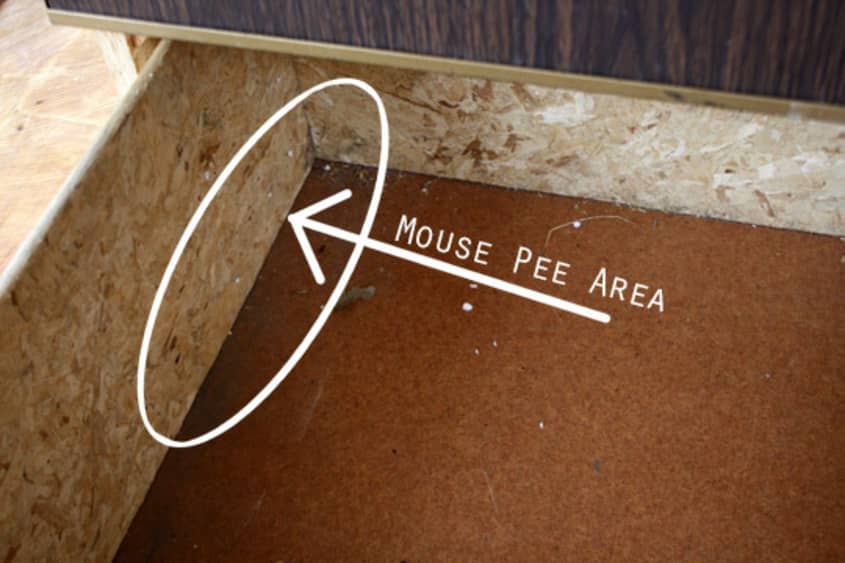


Yes, I could use the word ‘urine’ but that sounds so much larger than what a small little mouse can do. When pieces sit out in a garage waiting to be hauled off to the thrift store or are in storage for any length of time, there’s a good chance a mouse or two might take shelter in them. The result are pieces that seem ok until you get them in a small confined space and then… then you smell it. Pee.
When it comes to particle board, things are a little tricker. You can’t just take it outside and drench it in your favorite cleaner. So here’s how to do it instead:
What You Need
Materials
Bio-Kleen Bac Out
(or) White Vinegar
Equipment
2 small dry towels
Small bowl
Small bristle brush or handheld vacuum
Instructions
1. Look For Stains
Although it’s not always the case, for the most part mouse pee will stain particle board. It might discolor it or physically make the wood a different texture. Either way, that’s where you start. Not wanting to weaken the material any more than it already is, we only want to apply the mixture to where the problem occurred.
2. Dust The Surface
Remove all dust from the area that’s been attacked. In the case of these dresser drawers above we first brushed out large debris and then vacuumed them out to remove any other materials.
3. Time To Apply
Enzymatic cleaners are a great choice when eliminating urine of any kind. The un-scientific way to describe how they work is that they eat the bacteria that causes the smell and then dry up. When applying this cleaner to a hard surface (instead of, say, a carpet), you want to apply it but not “gloop” it on. A thin layer is best and if you can apply it to both sides or an edge as well, that will also help. Simply swipe on a small amount to the area that’s been damaged.
In a piece with heavy damage, you can place a towel with product applied to it over the area. Then lay a heavy object (like a dinner plate) over the spot to hold it down and let it absorb a little more. The weight of the object placed on the towel will help keep the wood from puffing up from the moisture.
4. Let Dry
You want to allow the cleaner to work naturally, so do your best to keep the piece out of harsh sun or bright lights. Normal overhead lighting is fine, but don’t add extra heat or lamps to help it dry faster. If you accelerate the process it won’t have time to work properly and will leave behind smelly residue.
5. Smell Test
Although no one will really want to complete this step, it is needed. Just give it the old smell test and see if there’s any offensive smells still lurking. If there is, go ahead and give it another round or consider sealing the piece with something that will keep it trapped below the surface permanently.
Additional Notes:
Although we prefer to use Bac Out (it seriously has never failed us), you can use white vinegar. The process is still the same, but you’ll want to use it very sparingly. Because it’s more “watery or liquidy” it can cause particle board to puff up and wreck the whole situation. We suggest using the towel method above and applying pressure for awhile before letting things dry out.
Want more smart tutorials for getting things done around the home?
We’re looking for great examples of your own household intelligence too!
(Images: Sarah Rae Trover)