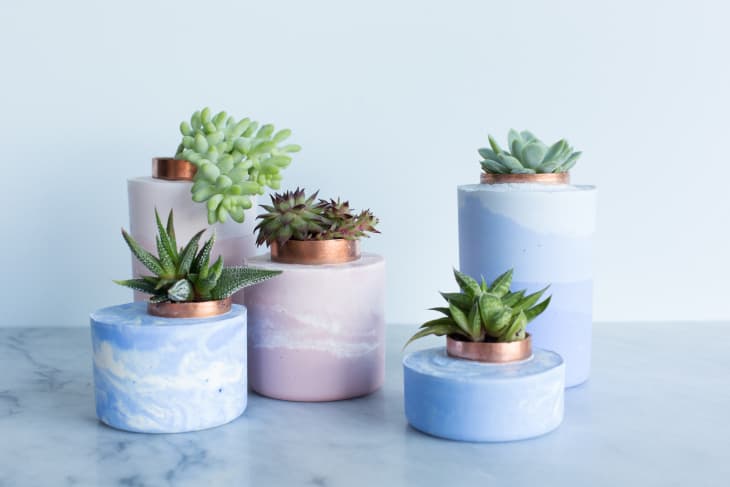
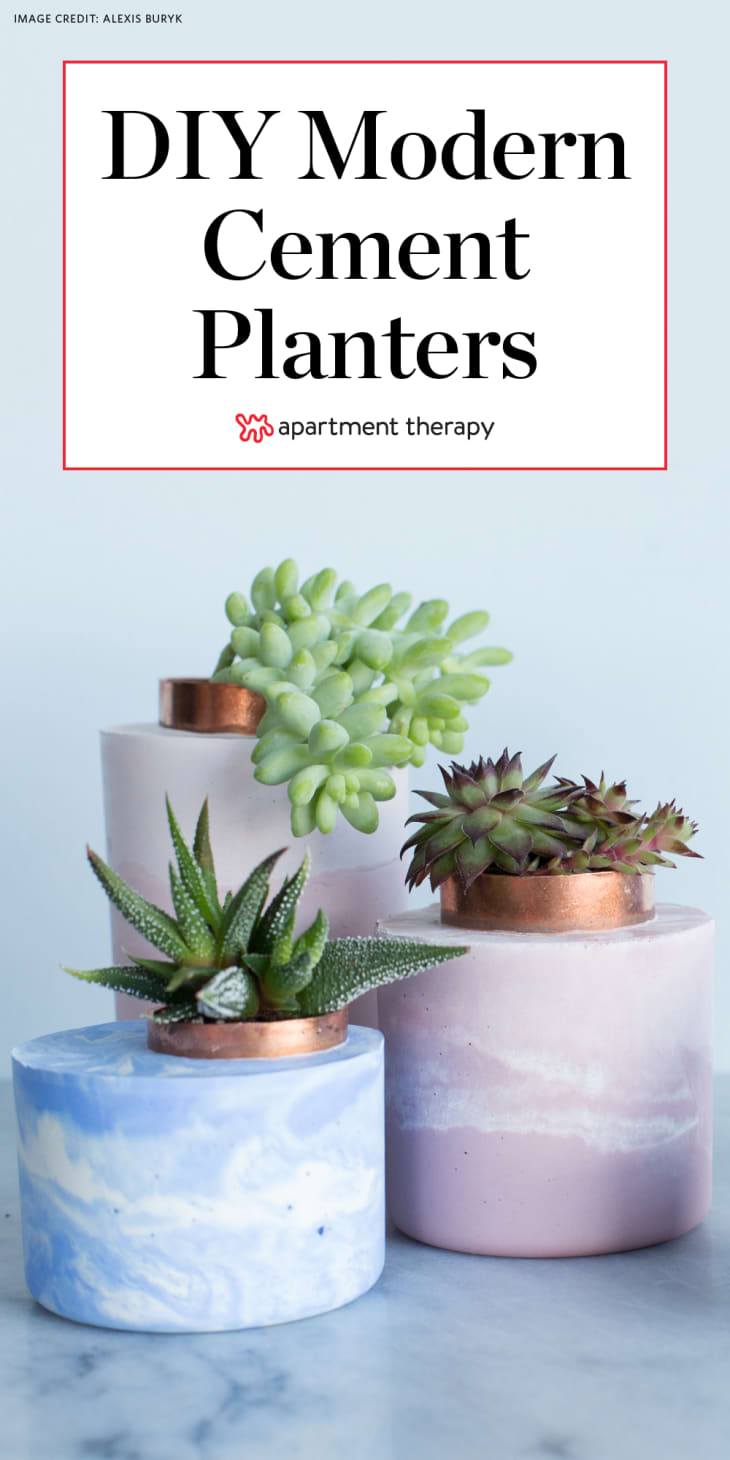
I started making these eco planters for gifts a year ago and haven't stopped. They are simple, stylish and downright lovable. Each pot is unique and has an organic, handmade feel. It is not an instant gratification project and you will have to commit, but the results are well worth it. I like to make about six at a time.
What You Need
Ingredients
Cement (it's the glue that binds the other ingredients)
Vermiculite (you can use sand instead, but the planters become very heavy)
Peat moss, pearlite, gravel or rock (add for fun!)
Materials and Tools
Gloves
Apron
Food containers
Plastic Bucket
Succulents
Shovel
3 - 9 x 12 pieces of sheet metal or plexiglass. (Approximate 9 x 12. Just an easy size to work with.)
Needle nose pliers
Scissors
Sand paper
Drill
Instructions
The ratio is one to four. One part cement and 4 parts anything else. To make six different sizes of planters shown here, we used 4 cups white portland cement and 16 cups vermiculite.
1. Collect recycled food packaging for molds. Pay attention to unusual shapes. Wash them and spread out to find proportional molds. For instance, a cottage cheese container in an ice cream container works well.
2. Combine the dry cement mixture in a plastic bucket using one part cement, and 4 parts vermiculite. Use gloves when mixing.
3. Slowly add water as if you were making dough, being sure to add the last part of water slowly. Humidity can affect how much water you need. It should be the consistancy of peanut butter. (It looked too dry to me but you will be suprised.) The mixture should clump in your fist and hold its shape. We used a drill to mix the materials but a shovel will work if you don't have one. Be sure to wash it immediately after mixing.
4. Transfer mixture to one of your recycled containers.
5. Tap the container on your work space to make sure it settles in until the top is flat and even.
6. Push a smaller container into the larger one. Remove the displaced cement mixture and put it back in your bucket. I like to put it in off center to give it that cool modern look.
7. Place the sheet metal on top and flip it over. Move the container back and forth to get the top nice and flat. Leave to dry for at least 24 hours
8. To remove the molds, tear off the outside mold if it is paper or use a knife to cut off plastic molds. Pull out the inside mold with pliers.
9. Sand the edges smooth
10. To create drainage, drill holes in bottom. Let dry for at least two days before drilling.
11. Plant a succulent!
Thanks, Sofie!
(Re-edited from a post originally published on 11.17.2010 - CM)
(Images: Sofie Sausser of Simply Sofie)


Howard Butcher Bloc...
I love this. I was just saying yesterday that I'm going to need new planters soon. Can't wait to try this!
This is a great how-to! I'd love to see more like it!
WAO!, thanks for sharing...have you try using colors?
How is this eco-friendly? I don't understand. See, for instance, "Sustainable Cement is Like Vegetarian Meatballs" at Treehugger http://www.treehugger.com/files/2007/10/sustainable_cem.php
Please do correct me if I have misunderstood!
Oh, I love these! Great idea for a project, especially since I've got an overabundant patch of hens and chicks outside that I love to pick from for indoor arrangements. Thanks!
love it...
The term "hypertufa" refers to a type of artificial stone, and is a conglomerate of the words "tufa," a natural volcanic rock, and "hyper," a prefix meaning excessively or extremely; hypertufa are extremely rock-like containers.
you can do colors...textures..line the molds with ferns, palms...rub them with dirt to make them darker.
You can also hallow out a hole in the bottom while molding if you don't have a drill to use later on...I use a small piece of pvc pipe.
The creativity is endless really...
These are pretty cool. We had a couple o' bags o' cement leftover from a job we did this summer. Maybe I'll try it. Thanks!
Agree with apartmentzombie. Cement is energy-intensive and leaches chemicals. Boo.
Amazing! Thanks for sharing!
There are alternatives to cement.
http://en.howtopedia.org/wiki/How_to_Make_Alternatives_to_Portland_Cement
Would be fun to experiment.
"To create drainage, drill holes in bottom"?
That's like car repair manuals that say, "Step 1: remove engine."
Am I supposed to just use regular drill bits to drill through what is essentially concrete? I don't see that working so well.
I would think that masonry drill bit would work well. I regularly use them to drill into cinder blocks and cement.
If you're using vermiculite, the cement should be softer and easier to drill. But yeah, makes much more sense to pour with something in place to create a drainage hole - a couple thick milkshake straws cut to the right length should do the trick.
The key is to use a relatively small amount of
Having recently spent several days making similar but much larger containers for alpine plants I can say that they aren't all that difficult to drill. Also, we added a bit of masonry fiberglass to increase their strength. When they are partially dry, you can use a screw driver or some kind of chisel to alter the width of the walls of your container - this will not be pretty so don't expect to be able to give it a nice texture. If you want a rough texture on the outside, when it is solid but not completely cured, use a wire brush. To help make sure that you can get your pot out of its mold, you might want to oil the mold with veggie oil before starting.
The reason I can say these are eco, is because I used materials that were going to be thrown away. My husband is a leed certified builder. Concrete contains recycled materials and therefore helps reduce industrial byproducts that would otherwise clog landfills.
We use a masonry bit to drill the holes when the pots have dried a couple of days. We tried using straws but it was harder to manage. I like science geeks idea to chisel a hole when the pot is still soft. Sorry I wasn't clear on that step!
Who did ya'll ever pick?
How big can these go? I need to find planters for to tropical trees.....Do you think I can find big containers for these....like 5 and 10 gallons?
**two :D
I've made similar containers that are around 3x4x2 feet, but we used custom wood molds that could be taken apart from the inside. I think that with a large enough mold - a plastic garbage can would work - you could make something big enough for a small tree. That said, the unmolding process can get tricky. Also, if you keep them outside they do eventually fall apart over the course of a few years.
We also used cardboard boxes as molds but with varying success in terms of the paper sticking to the cement mix.
I need planters for the spring so this DIY idea is a fun & affordable solution. Only question I have is where do I purchase bags of vermiculite?
try coating a cardboard mold with polyurethane, making sure that the corners are heavily coated; that's where it tends to stick.
Also, I would recommend Rockite for smaller projects; it's more liquid than cement, but it sets in a few hours. Plus, it gets really warm as it's setting, which is really fun.
Wear a mask when dealing with cement, the cement dust isn't something you want in your lungs.
Whether concrete is sustainable or not is an ongoing debate. It is certainly recyclable and natural for the most part. Its also a very versatile material and quite beautiful....We do counters, sinks and objects for the home: www.etsy.com/shop/atstuart
This is such a rewarding project, I did a few versions myself too back in 2009, same method, they turned out so great!
http://www.centsationalgirl.com/2009/08/diy-cement-planters/
Candleholders too!
http://www.centsationalgirl.com/2009/08/diy-cement-candleholders/
These make great gifts!!
I love this idea, so I'm not trying to be a naysayer, but don't use peat moss. It's a non-renewable resource, and there are plenty of alternatives for this project.
Madamhummingbird, vermiculite can be found in any gardening dept. or nursery...basically, wherever they sell bags of potting soil, you'll see bags of vermiculite as well. It sounds exotic, but it's very, very common. 8^)
Martha Stewart Living had an article within the past few months on making large planters with this method.
I have heard that you should fill them with water a few times and let it leach out before planting in them so that the container is not leaching chemicals into the plant soil.
So clever and adorable - thanks for sharing!!
These are fantastic. I have been loving the look of cement lately. It can add just the right amount of edge to a home.
Love these! I just re-discovered this article and plan to make some of these for Christmas presents.
I did similar work in college for my architecture models, if using cardboard or foamcore as molds, you can line the inside with packing tape and spray with crisco/olive oil. If you are careful you can even reuse the molds once or twice.
AHEM: These are CONCRETE planters. Remember, cement is to concrete what flour is to fruitcake. A cement planter would be messy.
Is there a way to make these durable for outdoor use? I would likely be doing a larger-scale version, but I would love it not to fall apart on me down the road....
One could use sphagnum moss in place of peat (which renews itself in the fields in 3 years - from Wisconsin, the only state to commercially manage Sphagnum moss).
One can also grab some growing moss from ones yard and stick it in the blender with some buttermilk. Blend and then "paint" the outside of the completed containers and keep them in the shade (and moist). Makes a lovely mossy patina on the outside of the concrete over time, looking like those hundred year old planters we all drool over in old botanical gardens.
You can also make molds out of glass containers for a smoother cement, you just have to take care when breaking the glass after the cement has hardened. The cement comes out looking shiny!
Couldn't you coat the molds w/ petroleum jelly or non-stick spray of some kind so you can reuse them?
Vermic is not really as common as btoddster said at least not everywhere, not here anyway. Not everywhere that sells potting soil sells vermiculite. I know because i shopped around, some places that sell potting soil don't carry it. Some carry very small bags. Home Depot has a huge bag for a little less than 20 smackers. It's basicly sold mostly as a soil ammendment for lawns. Like I said though some places carry it in very small bags so if you wanted to do a bigger project it wouldnt be cost effective to by it by the small bag. Also I've heard the process for making vermiculite they use old tires to burn to make it.
Oh wait a minute scratch that I'm thinking of perlite. Thats what I used for the project. Sorry.
Oh wait you are calling for perlite in the recipe. I find it annoying the way bloggers post ideas and then try to make it seem like they came up iwth it. When hypertufa is somethng thats been done many times in many different ways. Even Martha Stewart did a show on it. I've even seen bloggers take another bloggers idea, and make it seem like they came up with the idea, its annoying to say the least. And again how is this eco friendly.
As far as drainage holes, all you have to do is glue a plastic bottle cap to the bottom of the inside of the bottom container and sink the inside container down to that. If the inside container doesn't have a rim on the bottom, use a sander with no paper on it vibrate out any bubbles that might form. For a stronger mix, use plastic containers and mist it well with water them wrap it up in a plastic bag for at least a week. Wet curing leaves a much stronger product and you can use high strength cement for an even stronger container. Hope this helps!
Thank you CKAL! That is one of my pet peeves as well. Hearing about "cement" projects drives me batty!
I'm new to this type of project. I've been in search of 2 concrete rectangle flowerpots for my Mom's grave site and after seeing the prices I decided to try making my own. I've heard cooking spray works very well to remove the molds. I'm trying both plastic molds and glass molds.