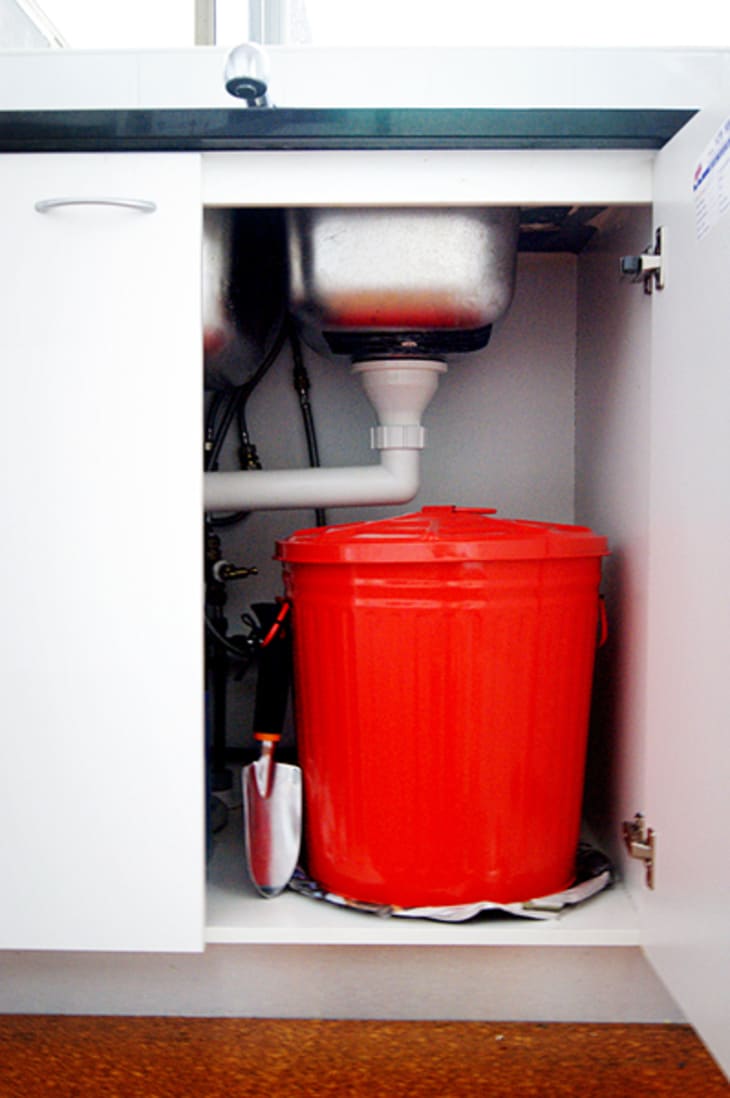
There are a lot of options out there for apartment dwellers who want to compost, and like most things it's not as simple as one style fits all. It's about finding what works best for you. Try something! And if it doesn't work for you... try something else! This is an easy indoor compost option for people who need something cheap, customizable and space friendly.
What You Need
Materials
A container to house your compost. It can be as big or small as you like.
A tray that fits under your container and allows room for spills... hopefully just dirt.
A small bag of soil.
Some old newspaper for shredding.
Tools
Depending on what container you use you will need a drill or hammer and nail or scissors.
Instructions
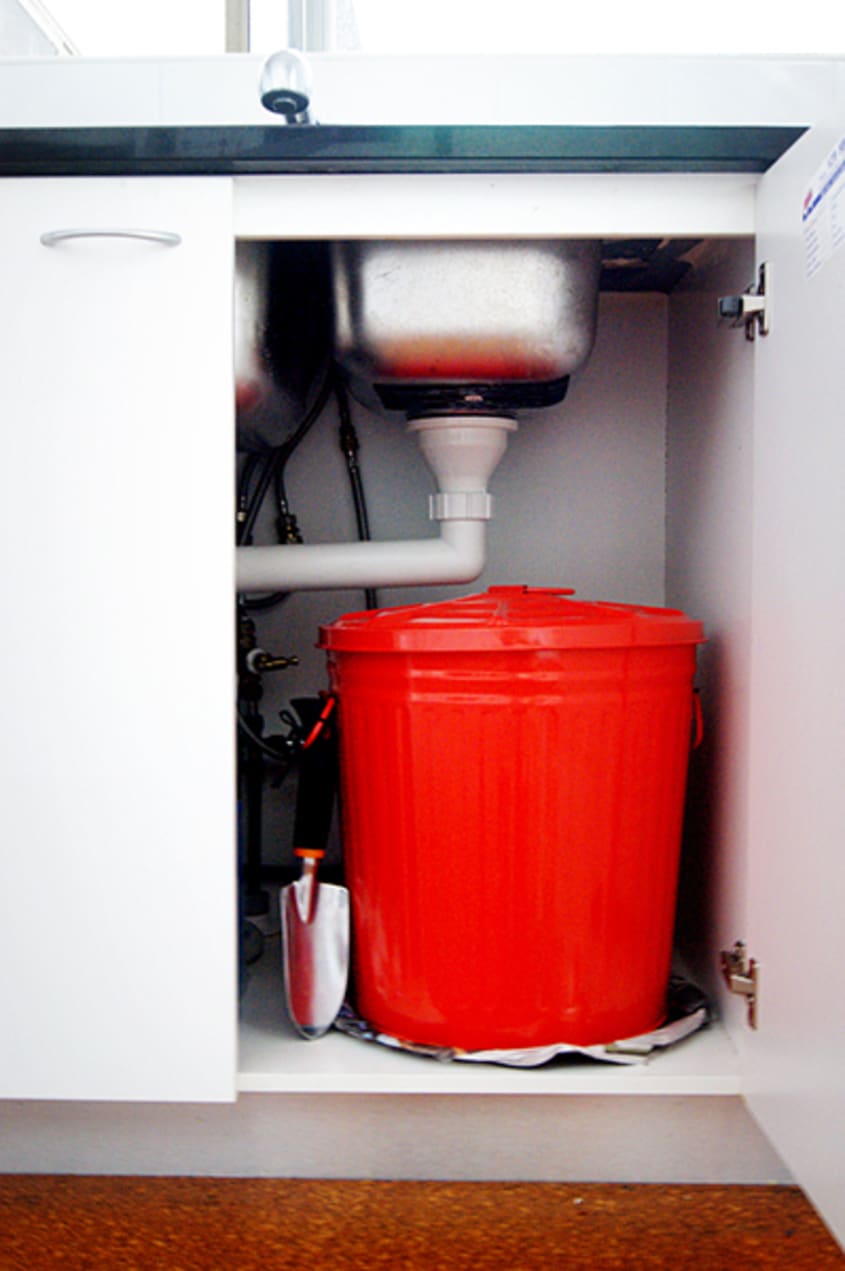
1. Choose a location for your indoor compost bin. We used the space under the sink because it was in the kitchen, locked to protect tiny hands and large enough to keep a decent family sized compost.
2. Think about what you'd like to keep your compost in. You can use plastic boxes, metal containers, garbage bins or buckets... get creative and customize it to your use taste and your space, but consider: it will need to be covered. You might need to swap it out for a new one while it composts and you'll need to store it somewhere!
3. Once you have your container you'll need to punch holes in it. What your using will determine what tools you need. We chose a metal garbage bin so we used a drill. Note: when we took the photos we only put holes in the bottom but later found that we needed a few holes around the rim as well.
4. Cover your tray with newspaper and put the compost bin onto the tray.
5. Now add dirt! Again it's about the size of the container and how much use it's going to get. We added a layer of soil about four inches deep.
6. Next step. Add a layer of dry stuff, in this case newspaper, and you're ready to go!
How To Use Your Compost Bin
1. Add your food scraps as you get them. It's an indoor bin so making them as small as possible will benefit you in the long run.
2. You want to keep the wet/dry balance so add a small handful of shredded newspaper when you add scraps.
3. Once a week you'll need to mix the compost and add a half scoop of new soil.
Tips:
1. We found that having a small scoop next to the bin makes mixing and adding a lot easier.
2. If you have the space it would be handy to have a box of shredded paper and a small container of soil beside the bin.
3. Investigate what foods can and can't be composted indoors. It saves a lot of stress.
4. If the bin starts to smell it means the balance is off you may need to add more newspaper or add extra holes.
5. You might want to have an extra bin on stand by for when your old one gets full and hasn't completely broken down.
6. Give some thought to what you're going to do with your compost when it's done.
Want more smart tutorials for getting things done around the home?
See more How To posts
We're looking for great examples of your own household intelligence too!
Submit your own tutorials or ideas here!
(Images: Sarah Starkey)


Ercol Bar Stool
This is an excellent idea! However! If you live in Texas where cockroaches are king, keep it tightly sealed in between uses or you risk infestation.
Where'd you get such a colorful trash can?
I wonder if sprinkling boric acid on the area around the bin would prevent cockroaches?
I'm going to try the compost :-)
http://forums2.gardenweb.com/forums/load/soil/msg0612121020298.html
here is an interesting link on papers to use in compost bins - discussion forum
THANK YOU! This is great!!
Awesome! I was looking for a project just like this one! But I'd put something on the tray to raise the container, to allow for better ventilation. I don't think the holes will work if they touch the tray...
It's not the exact same bin, but here's a good substitute: http://www.ikea.com/us/en/catalog/products/70140455
We have the lime one as our recycling bin indoors.
add worms and it will compost much faster!
I can swear by this :
http://www.dailydump.org/
I use this in my kitchen and it's just so easy and amazing!
Though most active in India, they do have an outlet in Florida for anyone interested.
Has any tried worm composting? Worm composting is also a fun and easy project for a home or apartment, and contrary to what you might expect, it also doesn't emit any offensive odors. You can build your own worm bin or try out a Worm Factory bin which makes it remarkably easy to get started. Because you're using worms, you'll have nutrient rich compost in half the time it'll take foods to naturally decompose.
Also check out the UrBin Grower as a small container garden that you can support with your new compost!
www.theurbanworm.com
Amazing, and something I can afford. Thank you so much!
great idea, i have had an open plastic bin under my sink all winter, with shredded newsprint in the bottom. All the vegie clippings and coffee grounds go in here. It never smells. I just keep it there and haul it out to the back compost pile 1x per week. I will try making one!
AHA! Newspaper, you say? I've had a compost pail from C&B for about a year that came with NO instructions whatsoever. I had a hard time finding information about using pails (all the info I found was for outdoor/gardening stuff) and no one ever told me about adding something to soak up the moisture.
Within a very short period I had a very dark, stinky, sloppy mess. I'll add some newspaper strips and see what happens! :)
It might be helpful to provide a link to things that can or can't be composted indoors instead of just saying "investigate". I wasn't even aware that some things might be off limits.
Investigate where?
Haven't you ever heard of Google? just type in "what to compost". It's that easy...
According to organic gardening a about page, indoor composting is meat-oil-dairy free, and dryer lint and hair are unlikely to break down well.
I'd add that animal manure, cardboard and other items that require high heat are not candidates for indoor composting.
Found a pretty cool looking indoor vermicomposter called the City Bin, made of recycled plastic in the USA. It's really cute. Looks like they have an IndieGoGo campaign going on.
http://www.indiegogo.com/CityEarthworm
Indoor composting without worms has been an ongoing project for me.
There is a lot of information out there. Dave's Garden is one place, among many, that I have found to be fairly helpful.
What I'm finding is that there are several factors to successful decomposition - aeration, size of compost, moisture, shape of compost, particle size, materials & balance (C:N).
Material balance is addressed in this posting. Size does not seem to be.
I do not think it's simply a matter of setting a bin underneath the sink, but I'm open to being wrong about that.
For decomposition to occur, the temp has to reach something like 160 degrees. Then the bacteria and fungus can do their work.
I've read on a university site that you need the compost bin/pile/whatever to be one cubic yard. When I googled, 'my compost is not heating up,' a possible answer came back again and again: it may not be big enough (volume-wise). It was the commonest explanation.
Still, I am not giving up. I don't really have the space for one cubic yard of compost (without worms). I went to the stables and got manure, and mixed it in real well, and have set aside that pile, while I have started a new one in my compost bin.
I wrapped the first pile in wire mesh, then made a skeleton of chicken-like wire over that for support, wrapped that with cardboard then finally covered the whole shebang with plastic. It's by the window (sorry, but it ain't going any place else!), and all that has raised the temp, but just marginally. The only thing - at this point - that I can think to do is wait until the end of winter at which point, ground condition depending, I will work it in outside in a place only I (hopefully) know about.
It's an ongoing learning process, indoor composting. And it remains to be seen whether or not it can be successful, without worms and $300 composting machines.
Finally, I am mindful of possible health effects too. Not something to obsess about, only to consider - there are spores involved, afterall, in successful composting. It's just that so far I have not had success!