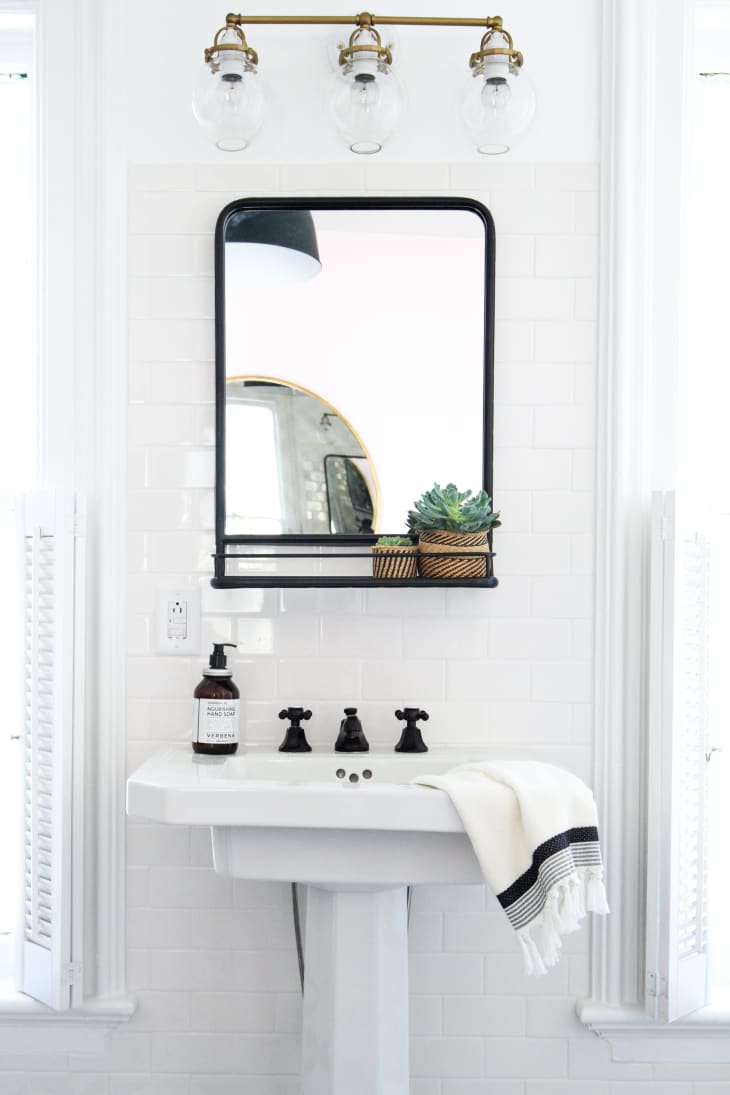
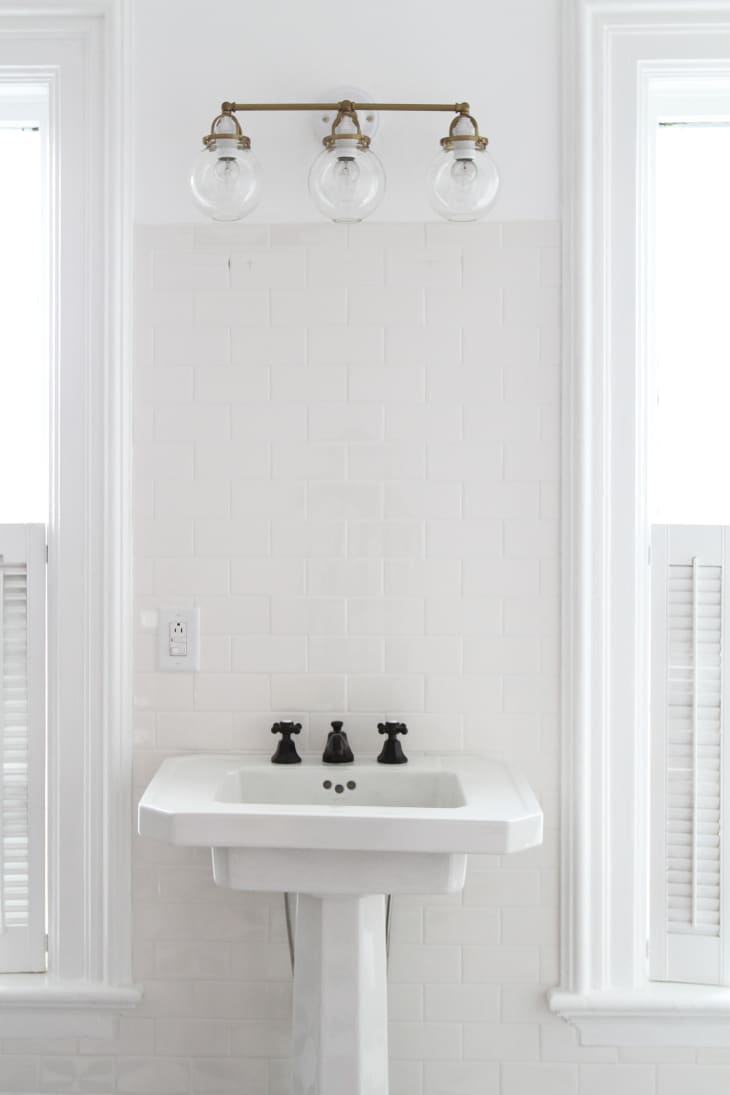
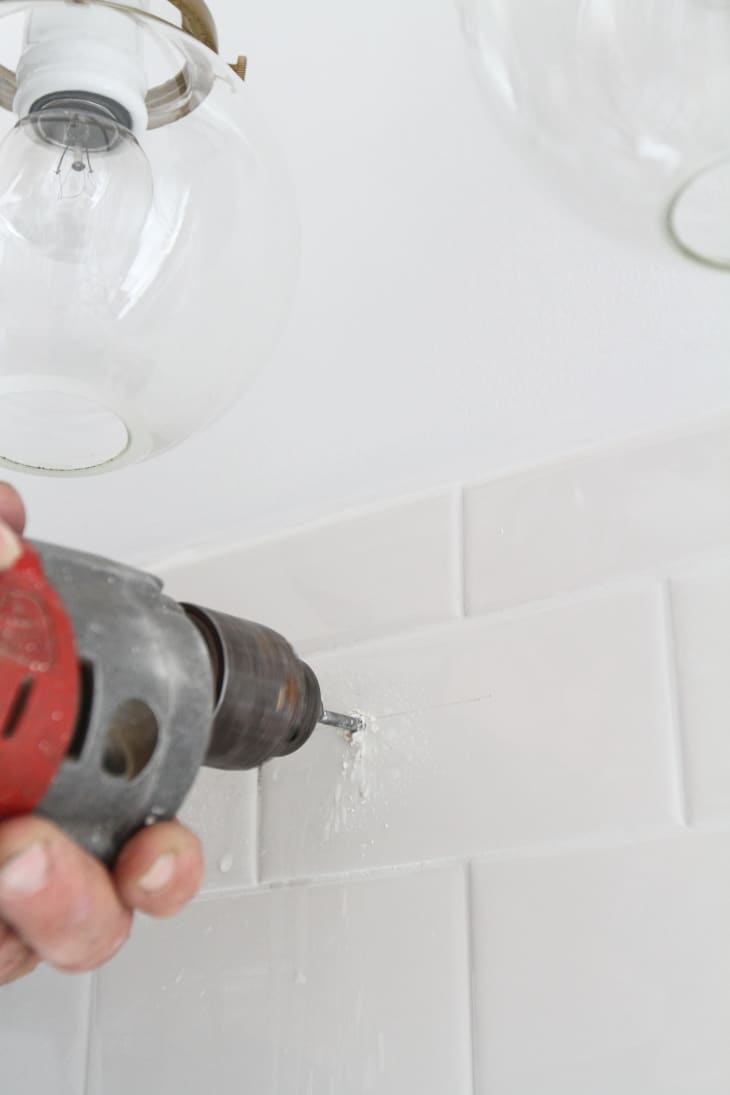
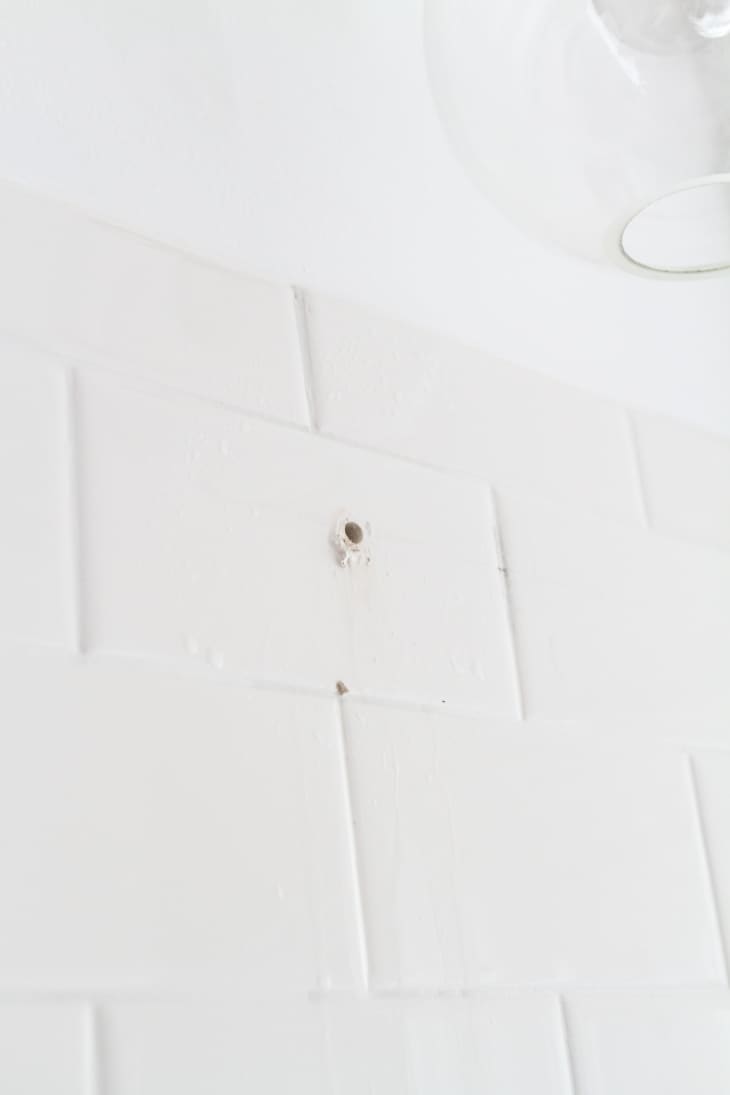
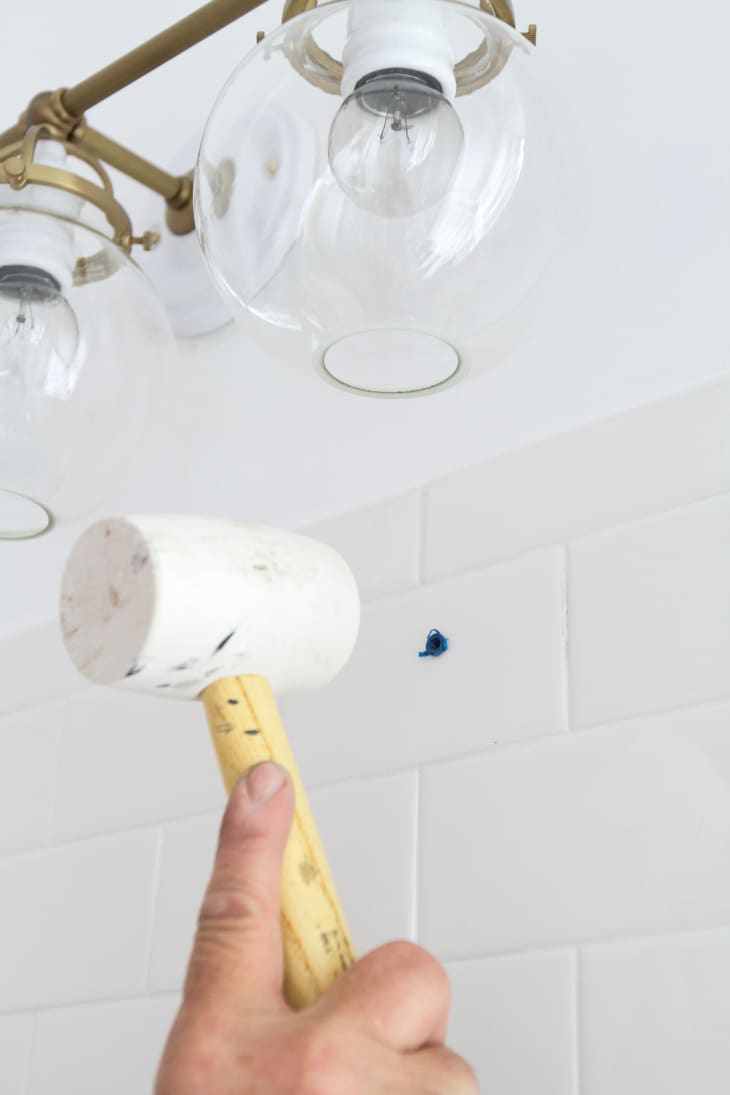
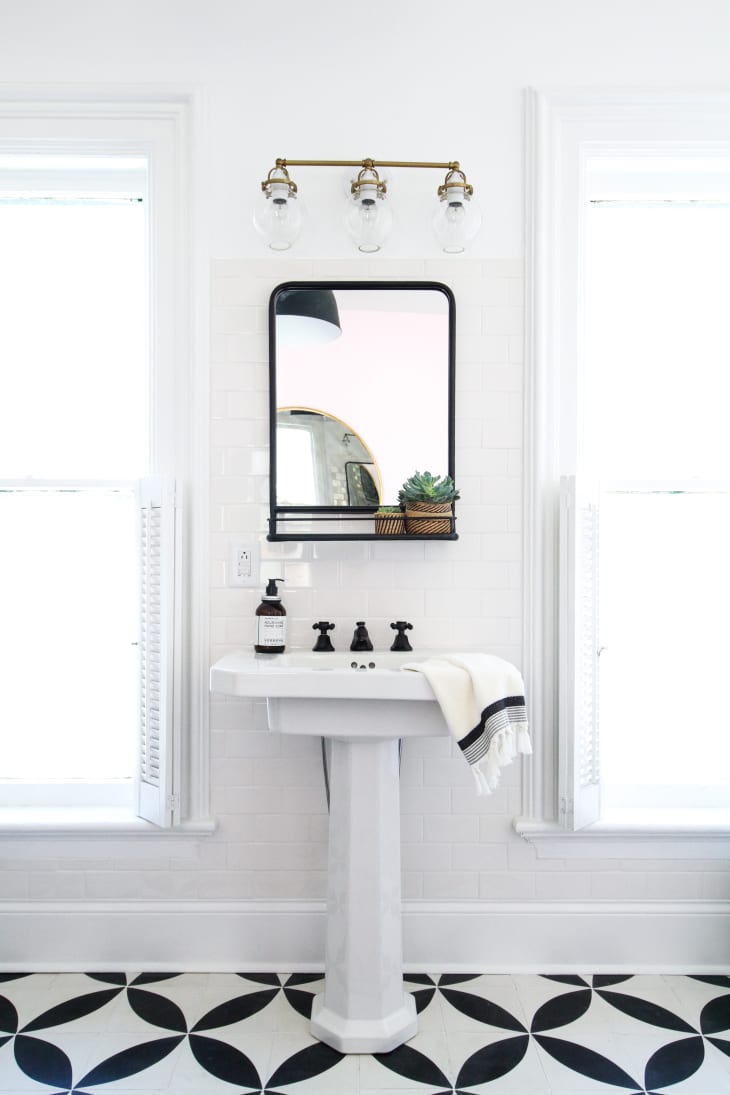
Trying to finish up over the weekend, we took on the task of mounting a glass shelf in our shower. Previously we had thought we would not be able to mount anything in tile (there had to be a secret that was beyond us), but it turned out to be relatively easy.
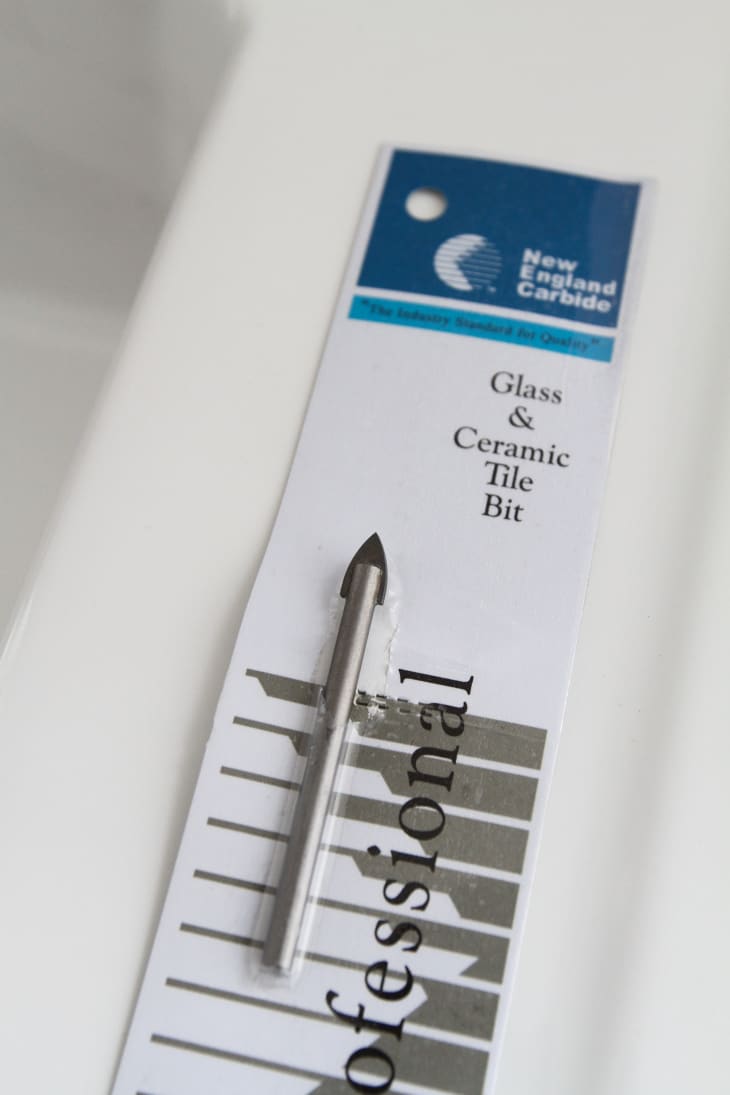
The trick is to use a MASONRY bit when drilling the holes. These sharp tipped drill bits have a way of piercing the shiny surface of tile and slowly creating a smooth hole.
What You Need
Materials
masking tape
plastic anchors
patience!
Tools
electric drill
masonry drill bit
level
Instructions
1. Prepare your tile wall by cleaning it and removing any dust and dirt.
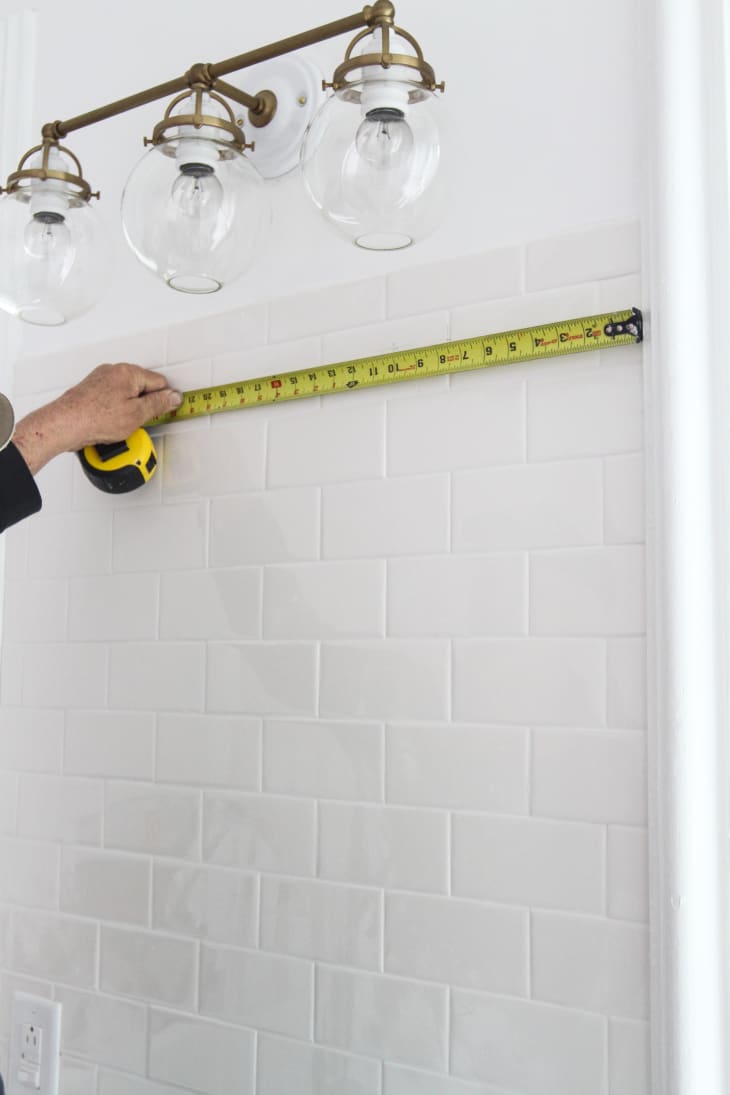
2. Locate where the hardware needs to be mounted. Be certain to measure and if there are multiple mounts, that they will be level.
3. Apply two layers of masking tape over the tile where the drill bit will be used. These tape layers hold the drill bit steady while it tries to start a hole. Without the masking tape, the drill bit will just skate all over the place.
4. Slowly and carefully use your masonry drill bit to drill your hole in the tile. Be careful not to push too hard on the tile, particularly if it's a large one, because it can crack and split.
5. Once you've made the necessary holes, simply insert your plastic anchor into the hole, mount your hardware and screw to tightness.
Want more smart tutorials for getting things done around the home?
See all of our Home Hacks tutorials

We're looking for great examples of your own household intelligence too!
Submit your own Home Hacks tutorial or idea here!
Originally published 10.2.2006 - AA


Ercol Bar Stool
he should be wearing safety glasses! careful there...
I've always wondered that! Thanks for the info.
Sorry about the slide show. Just fixed it.
That's a very attractive shelf.
A loverly shelf.
Watching the slideshow it occurred to me you must have wonderful workmen who don't mind pausing to take photos of each step. (Obviously, it's well worth it however.)
Hey Doug -
That is actually MAXWELL himself, in the flesh, making those holes for his own shelf. Good form on the drill, by the way, I bet someone has very sore triceps today. Those holes take a lot of patience to drill.
Nice work!
I installed a shelf in my bathroom and had to anchor them in identical subway tiles. I actually took more of a shortcut and drilled the holes into the grout in between the tiles. I can see how this would be very restrictive as to how you could position things, but it worked out very well with me. Especially since I didn't have a drill I had to use a phillips head screw driver and alot of elbow grease.
I know this might sound dumb, but how do you make sure that youre shelf is going to be level?
I put up two shelves lately and even after using a fancy laser level, they still ended up being crooked.
What's the trick?
Well, now I feel dumb. It must have been the look of determination or the gritting of the teeth, but I thought it was someone else. (Not used to profile shots, I suppose.)
wow, a brand new bundle of joy and still going strong!
question--if you want to install shelving on tile, but want it installed on the studs, is there a 'stud finder' that would work? or is there an alternate means of determining where the studs are behind the tiles?
thanks!
mlb
I'm kind of worried by how damn *satisfying* I found that slideshow...
belated congratulations on Ursula!
question about the shelf - will you need to put any kind of clear caulking around those fixtures that are against the tiles? i was just wondering if you thought that the water from the shower would accelerate any mildew on the tile underneath the fixture if it get exposed? does that make any sense??
it looks great, buy the way.
This is funny, as I was just mounting some wire corner baskets in my shower yesterday.
Always use the right tool for the job.
In addition to/instead of the masking tape, you can prevent drill skateage by first tapping an indentation with a masonry bit (removed rom the drill) or nail and a hammer. Creating a small depression in the space you want to drill helps stabilie the bit as you begin applying pressure.
Thanks, This Old House!
Excellent job. Nice slideshow. It helps to see the "how to" visually.
Nice job (and to think you're doing it on what is, presumably, no sleep, and certainly more important little details to take care of -congrats on Ursula). I actually would have thought that things like using a masonry bit would be old hat to some pros like you. So it's refreshing to see you take on -- and ponder the mysteries of -- what might be considered an intermediate (I wouldn't say "rookie") task.
Just to chime in with my 2 cents from having done this a few times. The masking tape is a good idea, not only to prevent "drill skate," (and kmg's starter holes generally work for me, too), but also to prevent cracking. It seems crazy to think that masking tape can prevent tile from cracking, but I've had better luck with it than without (although it's still quite possible to crack the tile you're trying to drill, as I've demonstrated to myself a few times now). So to danae -- drilling the holes in the grout lines isn't cheating. You approach is probably the safer bet, as long as your measurements work out, and your grout lines are wide enough for the screw you need. (If the grout lines aren't wide enough, then I wouldn't try squeezing an oversize screw in there, because it's likely to crack one or both of the tiles on either side.)
Another trick I saw on Ask This Old House is to set the bit where you want the hole, push on the drill and give it a few twists (without turning on the drill) until you scratch the glaze (you'll hear it). Then start the drill slowly until you create a divot. Now go for it!
BTW, this only works on ceramic time, not porcelain or granite. It's possible...but a masonry/ceramic tile bit won't do more than scratch the tile!
Looking good!
Actually, you SHOULD NOT use a masonry bit for tile. You should a ceramic tile bit for drilling through the tile, and then switch to the appropriate bit for whatever is behind the tile if necessary.
Here's an example of the sort of bit you should be using:
http://www1.uk.conrad.com/scripts/wgate/zcop_uk/~flN0YXRlPTMyMDM2NDA5ODg=?~template=PCAT_AREA_S_BROWSE&glb_user_js=Y&shop=UK&zhmmh_lfo=&zhmmh_area_kz=&product_show_id=825998&p_init_ipc=X&p_page_to_display=fromoutside&~cookies=1&cookie_n[1]=uk_insert&cookie_v[1]=OU&cookie_d[1]=&cookie_p[1]=%2f&cookie_e[1]=Fri%2c+03-Nov-2006+23%3a25%3a35+GMT
Little or no "skate", and shouldn't require the sort of effort that you seem to be exerting to get through the tile here.
BTW, the above link is just to the first place I found with a picture ... its not a site I know or recommend.
Gosh Maxwell,
Don't mean to be the OSHA inspector (had posted earlier re: dust/paint risk to SK, diapers and kitchen sink, and I ditto Karen's post re: safety glasses esp. since we're talking about possible flying splinters of broken ceramic tile), but....just wanted to caution you about having GLASS shelf in bathroom shower. Hope the installation is solid, and that there will be no accidents. Broken glass in the shower would be such a pain.
If it is a pre-packaged kind of shelf that's meant to be in a bathroom, it tends to be tempered glass, meaning that they somehow bake it after it's cut and shaped or whatever, and then it's probably pretty hard to break.
Anyone know where to find nice inexpensive (less than $50) shelves? Something without fussy details. Is glass pretty much our only alternatives or would a lacquered surface withstand the abuse of water? Thanks
From the measure-twice, cut-one school of philosophy:
If you've got some spare tiles on hand for repair or just leftovers from installing them, it's helpful to drill a test hole so that you get a sense of the tiles response to drilling and the pressure and time required to make the hole. It's also a good way to make sure that the bit size is sufficient for the anchor.
i have a fiberglass tub surround. does this work with that kind of "tile?" it's all one unit and it's probably pretty far off the wall studs. has anyone ever done that? we don't have many products to store so it's not a big deal, but someday i'd like a nicer showerhead spray thing.
Does this work the same way for a marble bath?
Billy Mays knows how!
https://www.mightyputty.com/spark/index.php?ai=42&tag=mpsc100
"i have a fiberglass tub surround. does this work with that kind of "tile?" "
No, it won't work as there is basically nothing behind the fiberglass for the shelf/hook/whatever to grip onto, and the fiberglass itself will flex, crack and break.
Even if you were lucky enough to find a spot that had a stud behind it (a 1 in 16 chance?) that 1" gap will cause the fiberglass to flex and crack between your hardware and the wood stud.
"Does this work the same way for a marble bath?"
Yes, tho you may need a different drill bit.
Where is the shelf from? It is exactly what I have been looking for.
Also, is it necessary to find the studs or does the tile itself offer enough support?
That shelf is perfect. I'd love to know where it comes from too !
We have a situation in our bathrooms where tile was installed over existing tile. Are there plastic anchors long enough to handle two layers of tile? And will a shelf or tp holder be stable when installed over two layers of tile? I'm intimidated.
"is it necessary to find the studs or does the tile itself offer enough support?"
"Are there plastic anchors long enough to handle two layers of tile? And will a shelf or tp holder be stable when installed over two layers of tile?"
Remember that you are hanging a shelf for some soap and a couple towels, not a hook for a boat anchor...
If the tile isn't falling off the wall, then it's secure enough for a little shelf. Go to your local neighborhood hardware store and tell the nice folks there what you're planning on doing - they'll help make sure you have the correct supplies.
Does Mighty Putty really work? I'm thinking about using it to hang a towel rod....
but does water seep in slowly?
I would totally opt to use mighty putty before doing any drilling...
Why don't they make tiles with pre drilled holes?
Please don't forget to drip water onto the hole your drilling. It get's hot and can cause a fire. The 2 in 1 drill guide and water drip can be bought at almost any hardware store and really helped me out.
Yes, not a masonry bit. That's for bricks. Use a tile bit, and get 3 or 4 so you always have a sharp one. i use a nailset to break the surface, drill at a low speed, and keep a spray bottle for cooling the bit. (you don't need the water drip/guide, but they do work)
I also cheat and use the grout whenever possible although it's not quite so aesthetically pleasing. As for level, it can be really tricky. Especially with brackets in which the screws fit into a keyhole slot...
my boyfriend and i are moving into an apt. this weekend, and the bathroom is entirely tile walls, with no shelving or storage whatsoever (not even a cabinet under the sink). i found these on the container store website, supposedly they can be used on tile without having to drill...
http://www.containerstore.com/shop/kitchen/magicLocSuctionCupRailSystem?productId=10025812
anyone have any thoughts? if they work, they would be a lifesaver, since i have gotten very used to have shelves in my bathroom...
This is a great tutorial, takes the scare factor out of a tile wall.
i'd like to add that this bit is amazing, i've used it for dozens of holes in tile so far, and it might be useful for those folks drilling through denser material like porcelain etc.
http://www.amazon.com/Hitachi-728023-1-4-Inch-Diamond-Cooling/dp/B000NK9G98/ref=pd_bxgy_hi_text_b
the water thing is useless in my experience, and you can get the bit separately at Lowes, for about $10.
I may be suction cup-challenged, but I've never been able to get the suction cup storage and hooks to work, even following the directions v-e-r-y carefully. For those who do - what's the secret?
An alternative would be to use the 3M command hooks - which work very well on walls, not sure if they have special ones for tile or the regular work there too? and hang baskets from them...you could even use the same wire baskets from the suction cup thing, just removing the suction cups.
Word of warning from someone who used to have a glass shelf in my shower (installed by a previous resident): over time, the mounting hardware may rust and/or corrode.
I took my shelf off just to try and tighten things up (it had been sagging) and found the cause of the sagging was because the hardware had fallen apart over time.
I don't think a lot of these glass shelves are meant to be exposed to lots of water over many years.