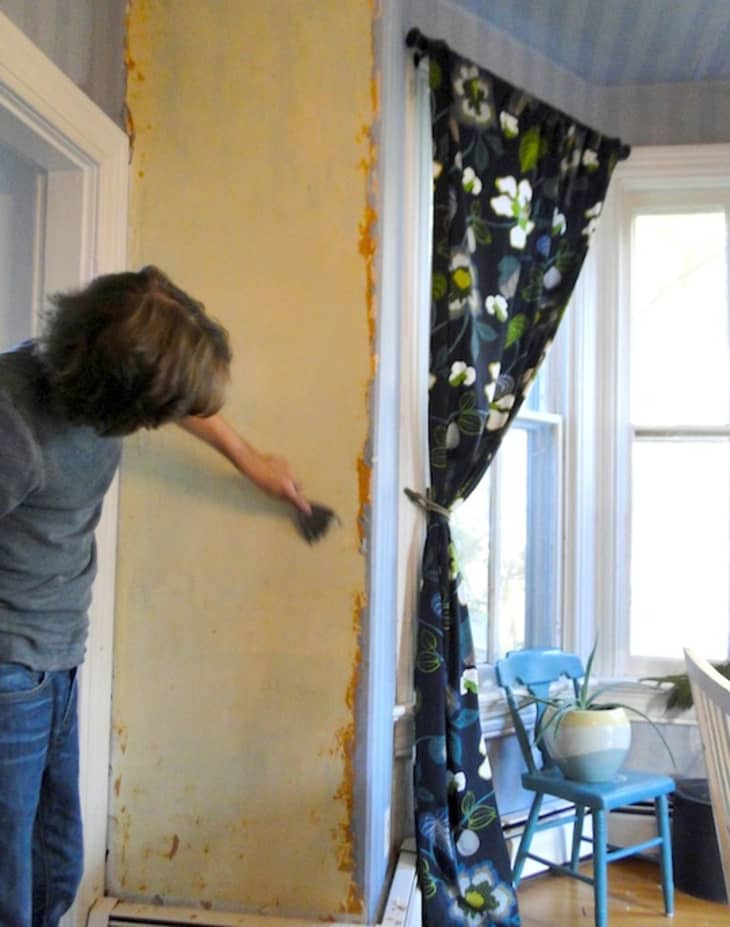
While there are many methods of removing wallpaper, I decided to turn to the experts for advice - my brother and sister-in-law. They recently purchased an old Victorian home and have since been steadily eradicating every inch of wallpaper from their new dwelling. Here's a quick guide to their tried-and-true method:
Materials:
• Pump Sprayer
• Wide Putty Knife
• Drop Cloth
• Trash Bag
• Large Sponge
• Ladder or Step Stool
• Screwdriver
For particularly difficult wallpaper these items may also be helpful:
• Scoring Device
• Fabric Softener
• Wallpaper Steamer
Instructions:
Step 1: Ready the Space
Remove curtains or drapes, artwork, and any outlet covers and switch plates. Position your drop cloth beneath the first wall to be sprayed. Shut off the power at the breaker or fuse box.
Step 2: Prepare the Solution
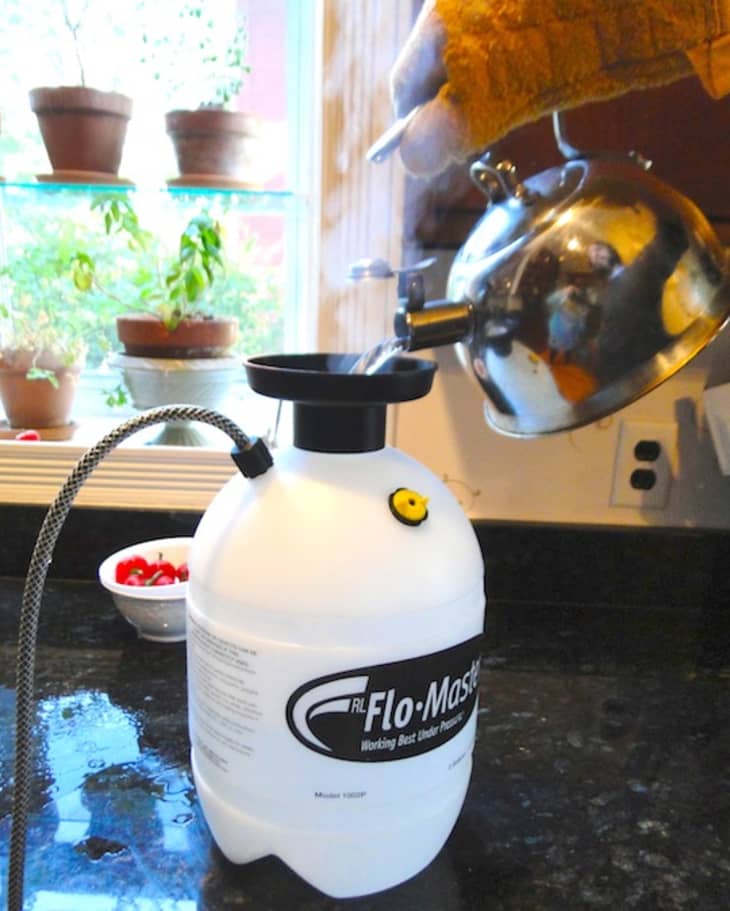
Heat water in a kettle on the stove. Fill your sprayer halfway with hot water from the sink and the other half with boiling water from the kettle. For particularly difficult wallpaper, you may also want to add fabric softener. In this case use a 1:1 mixture of hot/boiling water and fabric softener.

Step 3: Spray the Walls
If you are working with particularly difficult wallpaper, you may want to score the walls first to allow for maximum saturation. This is not always necessary, so try a test section first and save your time and your walls - score too hard and you can damage the surface.
Replace the lid and pump the sprayer to pressurize the solution. Spray the walls evenly, saturating the wallpaper. If you are only removing a small area, wait fifteen minutes before moving on to the next step, or until the wallpaper begins to bubble. If you are removing an entire room you should be able to work on the initial wall as soon as you have finished spraying the space.

Step 4: Remove the Wallpaper
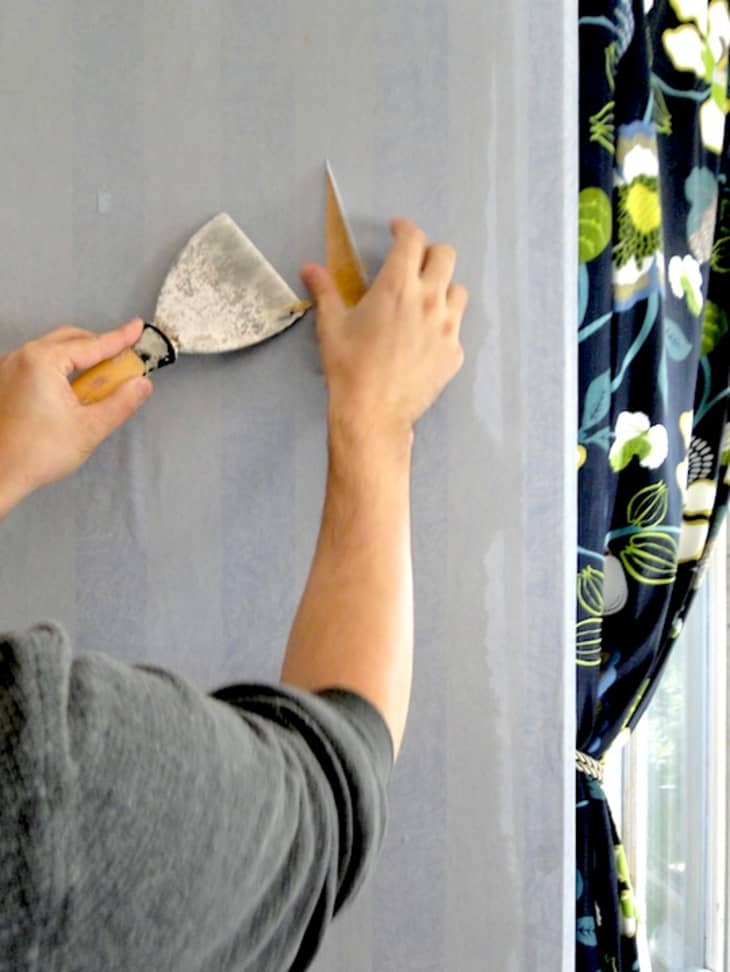
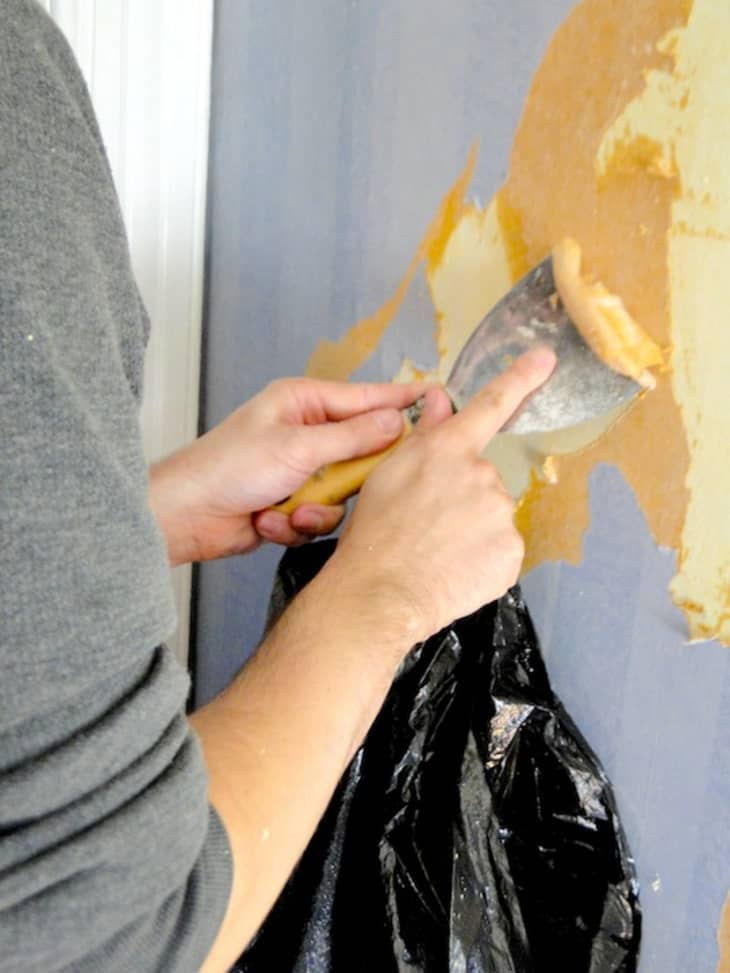
Use your wide putty knife to begin scraping the wallpaper. Start by focusing on seams and bubbling sections. Wallpaper that was recently applied to primed walls may come off in large sheets. Older wallpaper or wallpaper that was applied directly to plaster/drywall will be more difficult to remove.

Step 5: Repeat
Add more boiling water to your solution and saturate the walls again. Continue scraping. Repeat these steps as necessary until the wallpaper has been removed.*
*If you've tried these steps and it just isn't happening, you may have to break out the big guns and rent a wallpaper steamer from your local hardware store. Choose a gas-powered steamer if possible as electric steamers take longer.

Step 6: Clean-Up Residue
To remove any remaining residue, use a large sponge to wipe down the walls. Lightly spray the walls one final time with clean water for good measure. Allow the walls to dry for two to three days before taking any further action.
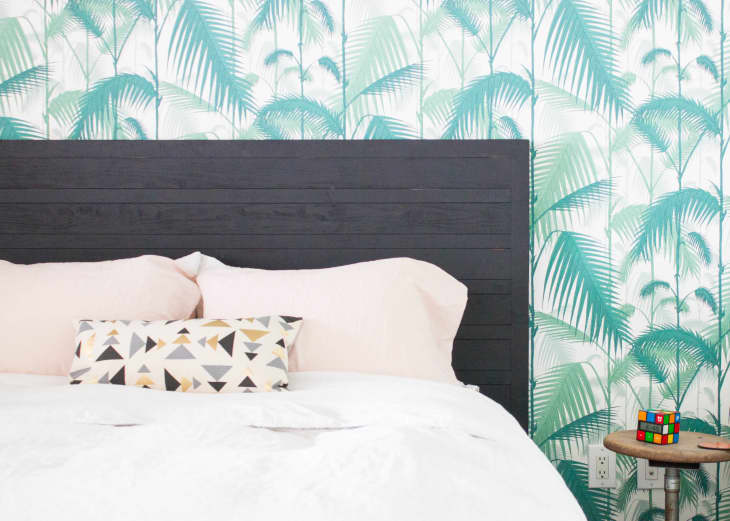
Congratulations - your wallpaper is gone. Now comes the fun part: deciding on a new wallpaper pattern or paint color. Enjoy!
(Images: Lauren Hufnagl)


Z2 iPod Dock and Wi...
One of my house's previous owners came up with an entirely different solution for unwanted wallpaper. They paid professionals to put wall texture over it. I don't want to imagine the costs involved, but ultimately I benefited from it. I occasionally find hints of the wallpaper during DIY projects--replacing the stove, ripping out the half bath cabinet...
Step 6 Clean Up Residue - Yeah this could take as much as 30 minutes per square foot, even with all the chemicals.
After working on our house for months, I think really bad thoughts about people who put up wallpaper. >:(
There were five layers of wallpaper on the CEILINGS of the bedrooms in our house. The misery. And when we got them clean, the ceilings were in great shape, no cracks. Why, why did you wallpaper oh people in 1923, '45, '54. '68 and '76?
Seriously BonnieProjects. Getting the paper off is the "easy" part, scrubbing the glue off is the part that will drive you mad.
There are also large flat steamers to apply directly to the walls which might be a little less wet. Though there are no two ways about it, removing wallpaper sucks.
I just completed a de-wallpapering project in two rooms a few months ago- horrible layers of wallpaper on 1930s horsehair plaster. Getting that first layer of exposed wallpaper off is key so that you can get at the paper that is actually glued to the wall after. A pump sprayer to go over the entire surface really saved us- we would spray an area, let it sit a bit, and then go for the scrape. The glue part really does suck and make sure to clean the scraper off frequently because that muck from the glue really dulls them down quickly.
in europe wallpaper is still the way to go. The tip above is pretty much how my parents have been removing wallpaper (one layer!! never wallpaper over). for the past 35 years.
I de-wallpapered my entire house after moving in. I used the 'Piranha Wallpaper Scoring Tool' and the 'Wagner Wallpaper Steamer' from Lowes. That steamer is the best, just make sure you lay down some towels along the baseboard to catch the drips. It's around $50 so waaaay cheaper than renting a steamer for a weekend, plus it works like a champ and you get to keep it :)
We have plaster walls and the paper came off easily from both bare plaster and primed walls, it's the glue that made the difference. The glue residue on the bare walls was such a bitch that we ended up priming right over it with very thick masonry primer. It worked, it softened the texture (sort of a vertical striping) and looks fine. I'm aware there are several products that you can spray on to help soften the glue for scraping off.
The article doesn't mention the Tiger Claw (a rolling ball with teeth) that makes tiny holes in the wallpaper which allows easier penetration of the water/steam.
I guess it is the same as the Piranha Wallpaper Scoring Tool that jess13 mentioned.
I'm in the process of removing hideous wallpaper in my bathroom, and have been using "DIF", as recommended by an architect friend. It's made removing the glue residue fairly easy, although I do wonder if it contains any particularly toxic chemicals. It doesn't have a strong smell, if that means anything.
I've just scraped off a ton of goop from the walls of my daughter's new house. It took a week of pretty much working every day. The walls had a heavy vinyl hung on them which peeled right off, but there was really thick brown goo underneath, like a layer of paint.
We used Mrs Myers all purpose cleaner in lavender with hot water. Sprayed, waited 5 or 10 minutes, then scraped all the thick goo with a plastic scraper, filling garbage bags with the goo. Sprayed again, scraped again. and again, and finally we washed the walls with clean water and more Mrs. Myers. The only thing different from removing paint, was that the goo was less toxic. It came off in thick sheets just like paint.
I Hate Wallpaper.
Just get the steamer. It's really easy to use. As another poster mentioned, you have to be really vigilent when washing the glue off the wall. Just because you can't see it doesn't mean it's not there. If you don't clean the wall really well, your paint won't adhere well or will have a weird texture.
Just over the summer I did my Mom's bedroom and had to remove a few layers of old, disgusting wall paper. It was glued directly on concrete walls. I didn't have any fancy steamers, I just used water bottle with spray and filled it up with as hot water as I could, but used also cooled water whenever I needed. I just wetted small areas of walls and moved through layers, wetting as needed till the concrete. Some parts were so well glued it was scrabbing it millimeter by millimeter (can you notice I am from Europe? ;-)). Very annoying and I am quite proud of myself I was able to finish it!
Wallpaper strippers/steamers in the UK are around £20 and will save you hours. They are great, even on (shudder) woodchip! Plus you can share with all your friends. They are not so great on ceilings though.
I'm with you, Bonnieprojects--every time I have had to remove wallpaper I have had really bad toughest about the people who put it up. What a wet and nasty process--the ickiness of the sticky residue running down your arms. Ugh.
I will never put it in a house of mine.
Step 0: First, check to see whether the wallpaper is strippable vinyl, in which case it might peel off pretty easily without a lot of the steps described here.
I don't see the logic of labeling people "experts" just because they "recently" starting doing something. And the techinque for a Victorian home might be completely different from the technique for a home built of different materials. For instance, my ~1905 home had plaster/lath that was subject to cracking, but my current 1954 home's plaster was as hard and smooth as granite under the wallpaper, so I could really douse the paper and scrape as hard as I wanted with razor blades and spatulas.
One more unmentioned bit of advice: If you peel away just the printed top surface of the wallpaper, leaving behind the more porous layer that's actually glued to the wall, don't stay in the same spot scraping away. Re-wet the newly exposed area. Saturate that porousness, and go peel somewhere else for a few minutes. When you come back, the saturation will have made the areafar easier to scrape away than if it hadn't never been doused. Even if you've scored with a Paper Tiger, your original spraying might not penetrate enough to do the maximum amount of good, especially if the printed surface is shiny or textured.
Wow, lots of wallpaper haters on here! Wallpaper is wonderful and sometimes we need to put in a little elbow grease to have something more unique than the standard painted wall. Wallpaper can add texture and sparkle, elements ordinary paint does not have. I just bought a home with one layer of paper from the 1960's on the secondary rooms' walls. It will be stripped but I will take satisfaction in doing it. I'm hoping to put grasscloth back on the hallway walls to "spiff" up a rather dull space and add a level of sophistication. Paint has its place but wallpaper does too. My two cents...
I agree with CheyDesignGuy. Sometimes wallpaper is beautiful. I have some damask in my house and I love it. Removing it does suck, but that doesn't make it the devil.
"It will be stripped but I will take satisfaction in doing it" hope that attitude can keep you going through hour five of goopy raw hands scraping at glue. If you make it through the process without swear words good for you. Sure, I've seen wallpaper that is indeed very lovely to look at, but your tastes in such a specific pattern won't likely translate if you ever try to sell. I know that when I was buying a house if I saw more than two rooms with wallpapers it was knocked far down on the list because I would add $$ to the pricetag knowing that I would be paying someone to remove that for me...
I tried the spray method at first for my 1970's era wallpaper and it just didn't work. A steamer worked much better, though I'd caution to be very careful to protect any nearby woodwork. The water that drips from the steamer is so hot it can damage trim finish, as can the steam that inevitably leaks out the sides. I was painting all of the dark (sense a theme?) 1970's era woodwork white, so it didn't matter, but it doesn't take many splatters to really have an impact if you are hoping to preserve woodwork.
We've just bought an apartment in Norway and I want to try and remove the awful fibreglass wallpaper it has everywhere. I've never seen this type of wallpaper before (I think maybe it's unique to Europe?) and just wondered if anyone else has heard of it and has tips on how to remove it? I think it's going to be more difficult than normal wallpaper as it looks quite thick and has been painted over a few times.
Heartfelt thanks to the hive mind! In two hours, stripped the old 1980s vinyl off a bathroom wall with help from this post. I still need to scrub, and the room stinks of vinegar, but hey, I have a wall again! Never would have thought it'd go so fast! Seriously appreciate the hard-won experience here.
actually if you go to a paint store they should have (or you can order on-line) these cloth sheet (almost a lite felt) to use to remove wallpaper without the hassle and mess of scraping wall paper. All you do is score the wall, dampen the sheets in soapy water, and put up on the wall. They stick right to the wall, let sit for 1 hour and keep them most with a spray bottle. Remove sheets and the wall paper will come down in long strips, just like it was put up. We remodeled a 1926 home and our local paint store turned us on to these. What a time saver and no gouges in walls from scraping.
DIF, or some other supposed enzyme treatment is the way to go.
a tip for those about to wallpaper.
Polyurethane your painted wall.
then wall paper it.
years later, it comes off cleanly, leaving a smooth surface that you can either paper again, or simply prime and paint.