
Quick History: The Bauhaus & Its Influence

We’ve all seen Marcel Breuer’s famous Wassily chair — the first to use tubular steel for a domestic setting — supposedly inspired by a bicycle frame (image 1). Would you believe this chair, maybe the most famous design to emerge from the Bauhaus, is a grandfatherly 87-years-old?




Yes, the Bauhaus turned 93 this past spring, a shocking fact given that Bauhaus design still feels incredibly fresh and current. In fact, despite the passage of time and a general fashion for maximalist luxury, the Bauhaus marriage of form and function is still the last word in taste and sophistication.
The Bauhaus was an art school, founded by Walter Gropius in 1919 — just after World War 1 — in Weimar, Germany. The main influences behind the Bauhaus were modernism, the English Arts and Crafts movement, and Constructivism. Gropius reconciled these disparate influences at the Bauhaus, where the reigning principles were unity of form and function, the idea that design is in service of the community, and a belief in the perfection and efficiency of geometry.
Imitating a medieval guild system, with apprentices, journeymen and masters (instead of students and teachers), the Bauhaus philosophy encouraged everyone to collaborate. In a radical move, women were allowed to enroll — though they were almost exclusively placed in the weaving workshop (which ironically was one of the only financially viable workshops at the Bauhaus).
To lead the first-year students, Gropius hired Johannes Itten, a vegetarian with a shaved head (remember, this was 1919!) who wore homemade monks’ robes, led the students in meditation and breathing exercises, and urged them to forget their learning and use only intuition. This lined up nicely with the Bauhaus’s early emphasis on pre-industrial methods — classes included stained glass, woodworking, weaving, and bookmaking. But also meant that very little was actually produced in those first few years — the work was handmade and somewhat primitive, a kind of scholarly exercise.
Gropius was concerned that the Bauhaus was mired in ideas instead of actually producing goods for market. He decided that the Bauhaus should generate designs for mass-production, designs that were simple, rational, and accessible to all people. He fired Itten and hired artists like Paul Klee, Wassily Kandinsky and Laszlo Moholy-Nagy, whose sensibilities reflected European modernist movements including De Stijl and Constructivism, and who saw the machine as a potential force for good, both aesthetically and socially. Bauhaus artists began creating prototypes for industrial production, their rational designs based on simple geometric shapes and primary colors.
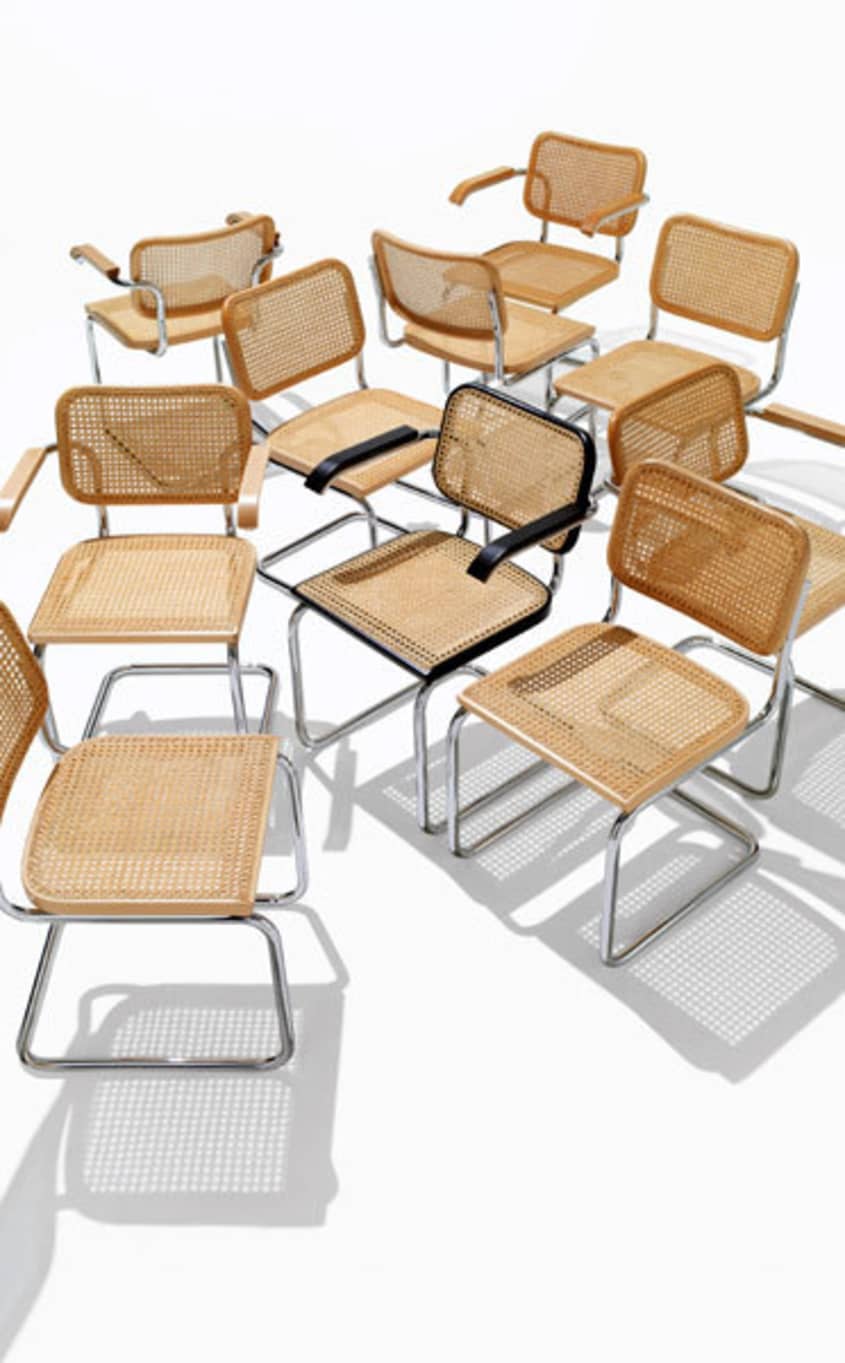
Some seminal Bauhaus designs include a 1923 model for public housing designed in a highly modern style, with light, airy and clean interiors, including a domestic kitchen designed by Benita Otte based on principles of scientific management (image 2). Breuer’s Cesca chairs (1928) expanded his use of tubular steel around the house (image 3). Then there is the geometric tour de force of Marianne Brandt’s teapot (1924), made by hand but intended as a prototype for mass-production (image 4). And Herbert Bayer’s universal typeface (1926) was a perfect embodiment of Bauhaus ideas: simple, economical of form, legible and clean, and international — no umlauts or capital letters to declare its German-ness!
The school’s new focus on technology brought the Weimar government’s disapproval, so Gropius moved the school to Dessau, an industrial town near Berlin, in 1925. In Dessau, Gropius designed the famous Bauhaus building in an industrial aesthetic, with concrete and steel and a curtain wall of glass that we now recognize as the basic components of modern architecture (image 5). Former students like Josef Albers, Bayer, Brandt and Breuer became young masters, their designs broadcasting the Bauhaus principle of the unity of form and function. Through design, the Bauhaus sought a universal language of form that would break down the barriers reinforced by the recent World War 1.
Alas, then came the beginning of the end of the Bauhaus. Gropius resigned suddenly in 1928, creating a period of political turmoil within the school. In 1930, Dessau appointed Ludwig Mies van der Rohe, an architect and designer whose famous dictum, “Less is more,” is the perfect summary of modernism (image 6). Mies was fresh from designing the stunning German pavilion at the 1929 Barcelona Exposition (which is why those chairs are called Barcelona chairs), and he bowed to government pressures, quickly expelling communist students. By 1930, the Nazis were coming into power, aided by the effects of the Great Depression on Germany’s finances (for more information on the economic state of the Weimar Republic, my favorite source is obviously the musical “Cabaret”). Less than a month after Hitler’s 1932 victory, Dessau closed the Bauhaus.
Mies briefly moved the school to Berlin, but the leftist politics and Jewish persuasion of many Bauhaus artists made it a prime target for the Nazis, who furthermore saw the school’s internationalist philosophy as “anti-German.” Several Bauhaus artists were arrested and killed by the Nazis; others fled to exile in America. In fact, it was in America that the Bauhaus artists were most successful at disseminating their ideas and designs. Black Mountain College in North Carolina was founded in part on Bauhaus principles in 1933, and Josef and Anni Albers (image 7) taught there for 16 years after fleeing Germany. Gropius and Breuer both taught at Harvard’s influential design school, and Moholy-Nagy founded the Chicago Institute of Design. Mies took Gropius’s modernist architecture and helped turn it into the design vocabulary of New York City skyscrapers like the Seagram Building, which he and Philip Johnson designed in 1957 (image 8). Florence Knoll, a former student of Mies, realized that the new skyscraper style demanded modern furniture and interiors to match, so she licensed Bauhaus and other modernist designs for mass-production. Today, Knoll is still one of the only distributors of genuine Bauhaus furniture — their success an indicator of the lasting appeal of Bauhaus design, nine decades later.
- International Style is the more general name given to the Bauhaus style — geometric, spare, rational, lots of curtain walls. It always makes me think of elementary schools, but in a good way.
- These German names? Hard to pronounce. A guide:
Breuer = [BROY-er]
Mies = [MEECE]
Klee = [CLAY]
Weimar = [VY-mar]
Dessau = [DESS-ow]
- Le Corbusier was not associated with the Bauhaus, though he was active at roughly the same time and shares some similarities as a fellow designer in the International Style.
- This is so cool: DWR is producing rugs designed by Gunta Stölzl, a Bauhaus student in the weaving workshop who was the first woman to become a master. You can buy her designs, never before issued, from Design Within Reach.
(Images: 1 Marcel Breuer’s Wassily Chair (1925), photo by Michael Cullen for Knoll; 2 Benita Otte’s Kitchen from Haus am Horn (1923), photo from a wonderful article by Mary-Elizabeth Williams in BU’s Brownstone Journal; 3 Breuer’s Cesca chairs (1928), photo by Ilan Rubin for Knoll; 4 Marianne Brandt’s Teapot (1924), photo from the Metropolitan Museum of Art’s Heilbrunn Timeline of Art History; 5 Walter Gropius’s building for the Bauhaus, Dessau (1925), from Ethan K on flickr; 6 Mies van der Rohe’s German pavilion for the Barcelona Exposition of 1929, from Yisris on flickr; 7 Josef & Anni Albers designs available from MoMA Store; 8 Seagram Building in New York City, by Mies van der Rohe and Philip Johnson (1957), from stevecadman on flickr; 9 Tables (1925) by Marcel Breuer available from Neue Gallerie Design Shop; 10 Rug designed by Gunta Stölzl, available at Design Within Reach)