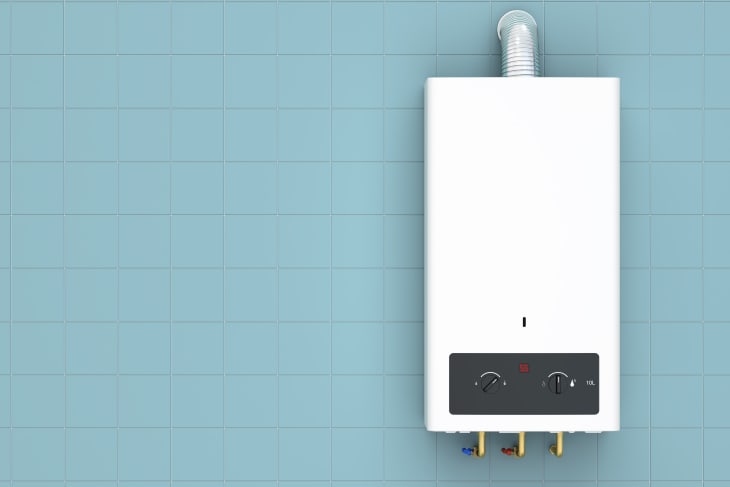
If the idea of constantly heating your water in a big tank sitting in your basement sounds mighty inefficient and wasteful to you, then a tankless water heater may be the right option for you. I've researched some of the advantages of a tankless water heater system, alongside some of the compromises that come with the compact, more energy efficient option.
PROS
There are many advantages to going with a tankless water heater. From increased energy efficiency and lowered operating costs to space savings and extended lifespan, find out more about what makes for good reasons to go tankless.
Energy Savings / Operating Costs
The first thought on tankless water heaters is generally: how much energy/money am I going to save? Well right off the bat, you're going to be spending MORE money to get a tankless water heater and all its plumbing in place. While a tankless water heater costs more upfront, your operating costs down the line should start to make up for it. What you're saving is in not having to spend money on standby heat, meaning you're not wasting money heating water in a tank that's just sitting idly waiting for someone to need hot water. Tankless systems provide that hot water on demand, instantaneously, when you need it, so you don't have to waste energy heating unused water. You're also not losing heat that's idly sitting in a tank that, while insulated, is still going to lose heat and require constant reheating. Our friendly federal government has a nice energy cost calculator.
Lifespan
While a typical tank water heater is supposed to last 10 to 13 years, tankless water heaters are estimated to last up to 20 years. If you're planning to stay in your home for a while, that's a hefty replacement fee you're saving. Even if you're not going to stay in your home for that long, it's nice to pay it forward towards the overall cost savings of home ownership.
Space Savings
Even if you weren't concerned about saving money and energy, one of the big advantages of tankless water heaters is the potential space savings. Traditional water heaters with 40 to 60 gallon capacity are generally around 60" tall and 24" wide. That bulky metal tank can take up precious real estate in a home where space is at a premium. A tankless water heater, in comparison, might be the size of a large computer, perhaps 20" wide by 28" tall and just 10" deep.
CONS
While the case for tankless water heaters might sound like a no brainer, there are several reasons why going this route might not be for you.
Limited Output
A big tank water heater that stores 40 to 60 gallons of hot water at a time will keep your showers, laundry, and other hot water needs properly satisfied for quite some time. Modern tanks reheat additional supply quite quickly as well, so you'll quite likely never run out of hot water when you need it. A tankless water heater has a throughout limit, able to supply a few gallons of hot water at all times but also at a time. So if you have a large family and everyone's taking a shower, doing the laundry and dishes at the same time, a tankless water heater might not be up to the task or suitable for your family's particular needs.
Additional Cost
While a typical tank water heater might be as cheap as $300-$400, they can price out up to $1,000 depending on options. But if you consider a tankless water heater probably starts closer to $1,000, you've got a pretty big difference in price tag. Of course, the idea is to make up for that extra cost as you use less energy along the way, but still, having to put up that money up front isn't always an option for everyone.
Instantaneous Energy Requirement
A traditional gas water heater might use 30,000 to 50,000 BTU of natural gas or propane while it's heating up your water. A tankless water heater might require perhaps 150,000 to 200,000 BTU to do the same as it heats up your water on demand. Sometimes this high BTU requirement isn't possible, as I found out myself during my own home renovation, where there's a low pressure main, so we're limited to a fairly low total BTU spread among all of our gas appliances. If you consider switching to electric instead of gas, you'll need to be sure that your electrical system is up to the task. The price of electricity is usually higher than natural gas in many areas too, so you'll need to consider the cost of energy as well.
Read More:
• Tankless vs. Tank Water Heaters, and how much money they save
• Wat Heaters - Energy Choices at the Home
MORE ON TANKLESS WATER HEATERS ON APARTMENT THERAPY:
• Location is Important with a Tankless Water Heater
• Tankless Water Heaters: Worth the Extra Work?
• Why It's Green: On-Demand Hot Water
(Images: Flickr member JohnE777 licensed for use under Creative Commons, Shutterstock)

Shaw's Original Fir...
Yeah, if you change the sacrificial rod in the traditional water heater regularly, it should last you more or less forever. Especially if you do it with real frequency.
One downside of a tankless that we discovered after the Durachio in DC over the summer.....
when the power fails...NO HOT WATER... even with gas.
I have a tankless, cross connected to my hot water radiator system so it was a lot more money. I have found a number of issues:
1) Unless you oversize it, it is hard to run more than one appliance at once. No showering with the washing machine on.
2) there is annual maintenance, flushing the unit. I was not informed of this by my vendor and after three years I had a $ 700 rebuild.
3) If you have a teenager who likes long showers, they never run out of hot water and you don't save anything.
4) if I had the option to do it all over, I wouldn't. The savings are not worth the aggravation.
I would be very reluctant to do another tankless. Besides the space savings--which was the main reason I had one installed--I have been disappointed. As another poster commented, the required gas pressure is considerable. My contractor was not a tankless expert, and the gas piping is inadequate. I've had experts look at the setup, and they want $1000s to redress it. Also, the tankless we installed (Bosch) "crashes" frequently. Meaning, if you're in the shower, and the water heater decides the inputs are unfavorable, it will shut itself off.
Finally, in my local phonebook, you can find dozens of companies that will replace or install a standard water heater. Finding tankless expertise (and I live in the San Francisco Bay Area, not the middle of nowhere), has been nearly impossible.
Another con: they have a required minimum flow to trigger the heater. If you aren't using enough hot water, it won't turn on. Translation: ours ended up being basically incompatible with the low-flow shower head we had. We'd already spent $$$ on the heater and having it installed, so we switched to a shower head that uses more water. Not exactly environmentally friendly. (That said, I still love ours.)
We have 2 tankless water heaters in parellel and they work great.
2 showers + laundry and no cold water. We also have low flow shower heads and when installed the contractor calibrated the max water temp and flow at each of the shower heads. There were tax credits that made the overall price the same as a traditional water heater, don't know if these are still availible. Monthly gas bill in the summer is always less then $20. I think the biggest issue is getting the correct person to install.
My parents live in an old Victorian in San Francisco and one of the biggest problems they had was getting hot water from the traditional tank water heater up to the bathroom on the top floor, three stories up (it could take upwards of 10 minutes for the water to heat up from when you turned the faucet on). Their solution, when they remodeled the third floor, was to have a tankless water heater installed for that bathroom only and to run the laundry, other baths, and kitchen on the traditional water heater from the basement. It has been an ideal solution for them, as the traditional wasn't sufficient for the third floor but a tankless wouldn't be enough for the whole house.
What about the venting of the tankless? I looked into it and someone said the venting is not the same as a regular WH. This true?
Regarding the limited throughPUT: A tank heater also has limited throughput. You can't take four showers and run the dishwasher and washing machine at the same time with a tank heater, either.
And Cal82, the gas pressure issue is a plumber's issue. While I feel your pain, you can't blame that on the tankless water heater.
Nope. The research I've read indicates that, when the additional installation costs are added in, these won't save enough $$ over their lifespan to pay for themselves compared with traditional tanks. And since money is a darn good proxy for carbon emissions, I think that means these things will generate more carbon than traditional.
Pro:
With the tankless, you are heating water just like Walter White, b*t*h!
We couldn't get a tankless installed in our condo because it required a higher voltage electrical connection than we had available in that area (and cinder block walls).
We are looking at getting a hybrid / heat pump water heater to replace our standard tank. Has anyone had any experience with those? We are in Hawaii with 70+ temps year-round and the highest electric prices in the USA, so we'll welcome the cool air output and any decrease in the electric bill :)
I grew up with a tankless (flash) water heater and I would totally do one in my home. I'd love to install one in my apartment. The hot water was essentially infinite--always there, ready, and waiting. Our maintenance costs were minimal and the number of times it failed were few--usually because the pilot light went out. Ours was propane powered. When it finally did fail after around 20 years, it was replaced by another one--my parents won't go back to an electric. The gas pressure was an issue on the newer one--so get that checked before you install--but my vote is WORTH IT!
I use well water (through a pressure tank) and propane. I've had contractors and dodgy plumbers do their best to sell me on a tankless heater for years, and I was going to go for it when my tank heater dies. Then I happened to get a really able and honest (yeah, I nearly fainted) plumber here for other work, and I had him take a look at my close-to-expiring tank.
The plumber said he had done tankless systems for people with well water and didn't recommend it because the tankless heater has too many small, moving parts (more $$). They gum up with deposits from the water or bits of sand from the well, and then you have expensive, regular maintenance required, involving parts replacement. He said I'd have to run a high-capacity line from the propane tank, too. Then he asked me how long I'd had my tank (more than 10 years) and how much I'd paid for it. He worked up an estimate for tank, delivery and installation. It was about the same as I'd paid a decade earlier. Tank heater for me.
I had been considering a tankless heater when mine finally croaks, & my plumber talked me out of it. Here in Indiana our water supply is very "hard" groundwater, & the average lifespan of a tank heater is only about 8 years. He told me a tankless would lime up almost as quickly, & would need to be replaced before it had paid for itself.
So I'm not getting one.
I work in mechanical design and sales in the commercial and industrial industry, where typically life cycles are accelerated and operating costs are extrapolated related to residential. Up front, I actually do sell a line of tankless heaters (Takagi, which is owned by AO Smith if anyone wants to look it up).
So that being said, the advantage of tankless heaters is primarily space savings and instant on hot water. The cost of gas will be significantly higher however; as was noted above, with no storage you require about 3x the thermal energy (BTU/hr) to generate the hot water of an equivalent water heater. 3x the thermal energy works out to 3x the gas/electricity, plain and simple. Additionally you'll find a tankless heater is required to be 100% on when a demand is generated, where by design any gas fired heater is most efficient at low fire and staying on as long as possible rather than constantly cycling. The life cycle comparisons are true here if you compare to old tech water heaters, current technology uses the same concept as tankless heaters (condensing heat exchangers) but maintains low fire longer with fewer cycles and will generally have a longer life cycle than a tankless equivalent.
These are all very low level comments, I can explain in more detail but we would be here all day. Basically we're finding the commercial market tried them and found their bills higher than modern condensing water heaters or condensing boilers and/or heat pumps with indirect storage tanks. Often one customer was trying both in two sites for comparison so we had very detailed real world comparisons to work from. I'm not saying tankless is completely bad news, if you need instant hot water and are stuck for space they're the answer, but don't expect to save money or the environment with a tankless heater.
And as for the plumber, there are a lot of great plumbers, and a lot I can't believe can keep a job. A good plumber reads the manuals for the equipment they're installing and should be able to make anything work. Do your research, hire the best, not the cheapest and you'll be a lot happier with the outcome.
I lived in Cairo, Egypt for 4 years during the 1960's, and we had tankless heaters in the bathrooms and the kitchen. They were connected to bottled gas (similar to propane, which is a heat source for many parts of the US), and the hot water only ran out when the gas did. I have wanted those water heaters ever since! Unfortunately, the tankless water heaters available here today bear little resemblance to those I remember--although the technology may be more advanced, they don't seem to work as well in addition to being much more expensive. Ours could be described as basically a gas space heater with a coiled water pipe in the middle. I'm not really sure why it's impossible to come up with something affordable along the same lines.
I'm in the L.A. area and the quote I got this year for the tankless was $4,000 with installation. This is for an 1,820 sq. foot house, not a mansion. Forget it! We bought a tank at Home Depot and my husband and Dad installed it themselves.
" So if you have a large family and everyone's taking a shower, doing the laundry and dishes at the same time, a tankless water heater might not be up to the task or suitable for your family's particular needs."
It doesn't take that much to overpower the tankless water heater. My parents used to have 2 tanks in their house (one for our basement suite and one for the 2 upper floors) which was replaced with 1 tankless. With my bathroom being on the top floor, I can't remember a single time I ever got to wash my face with warm water. It took a good 5 minutes for the warm water to reach the top floor. Also, if I took a shower and nothing else was running in the house, ANYONE flushing the toilet on any floor of the house would turn the shower ice cold-with the tanked system, it only went cold if flushed on the same floor as the shower. I absolutely hated that thing.
I looked into tankless when my water heater died, and the cost of installation is what killed it for me. I could stomach a couple hundred extra bucks for the unit, but I would have had to replace a lot of the plumbing and venting in order to accommodate tankless.
Instead I got a brand new 40 gallon tank (that my dad installed) and have never since run out of hot water. Gas bill is about $14 / month, for two of us living in a 1 bathroom house (with dishwasher and laundry). I can't imagine the tankless making a big enough difference in that to justify the cost.
I just opted to NOT get a tankless heater after a ton of research. I was tempted by the claims of magic and splendor...but in the end I couldn't cost-justify. A middle-of-the road unit and installation (including enhanced gas venting from my basement) was $3000...waaay more than a top of the line 50 gal tank installed. I am lucky that my tank is right under my master bathroom and kitchen..it seriously takes 10 seconds to get hot water. Running out of water has not been an issue--50 gallons goes a long way. Three back-to-back 10 minute showers are not a problem...
Note that the price of a tankless isn't just the unit itself. We considered it for a home we rehabed as a rental unit mostly for space saving. An electric tankless water heater was only a couple of hundred dollars more than a regular electric water heater (we didn't have gas as an option) but it can't use regular houshold wiring. The cost to add the heavy duty wiring would have been over $1000. That's in addition to the heating unit. We went with a regular unit.
We have had two tankless heaters - one in the house we built and now in the house we have rehabbed. We love them! Of course, the cost to install wasn't a factor as my husband was able to install them himself. If you have everything calibrated and installed the right way, they work like a dream. We're able to run 2 showers and appliances at the same time. Great for visiting guests taking showers - no one gets a cold shower. We chose them for the space saving aspect.
When my tiny house (approx. 525 sf) was renovated we opted for a tankless system. It was a total gut job so there was no issue with the plumbing or electrics (my house is all-electric) since they were being replaced anyway and everything could be planned to have enough power. Before the renovation, the water heater was a little half-size unit under the stairs and only had about 15 minutes of hot water which suuuuuuucked. The new unit is in a specially built cabinet in the bathroom and I can use all the space under the stairs for storage which is awesome. I think I actually take shorter showers now since I know I have all the hot water in the world so I don't have to stress about it running out.
I built a new house in 2010, and installed a tankless propane water heater with well water. Based on my experience with a traditional electric hot water heater, I'm saving at least $30-35 a month. I've successfully run the dishwasher, the washing machine, and a shower all at the same time. Payback is going to be less than five years, so even if it fails at eight, I'll still be ahead of the game. I am VERY pleased.
"One downside of a tankless that we discovered after the Durachio in DC over the summer..... when the power fails...NO HOT WATER... even with gas."<i/>
That's not necessarily an issue. My tankless gas system uses the water pressure to spin a tiny generator and spark the gas. There's no electricity required.
It's awesome. No inefficient tank, no wasteful pilot light, no electric ignition system, and my gas bill is laughably small.
We installed a tankless hot water heater a couple years ago and have been most unhappy with it. Energy conservation? It takes ages for water to heat up. I've forgotten what it's like to wash my hands in warm water. But most maddening is the all too frequent experience of having water go ice cold in the middle of a shower--our well and water pump do not play nicely with the tankless heater. Huge regrets.
Rating a water heater based on an installer's incompetence is no rating at all. Most of the info here is erroneous with the exception of a couple of responders who actually had their ducks in a row before they took off.
Not everything one reads on the internet is accurate. (I know - shock!) However, it can arm one with the right questions to ask a CERTIFIED installer. Electrical wiring, plumbing & venting (for gas units) are definitely a consideration when considering a tankless IN ADDITION TO the wh itself. This is often what makes a tankless cost prohibitive for some in older homes, especially if one is looking solely at the initial outlay versus monthly savings & how long it would take to recoup the investment. Granted, a tankless might not be a wise [financial] choice for one who doesn't plan to stay planted long enough to recoup but that fact only makes it a 'con' for YOU.
NOTE ALSO that the general prices quoted in the article appear to be for the unit(s) alone.. Installation would be added to this number along with any adjustments/corrections to existing wiring, piping or venting. It can add up fast.
And for the record, a 40 gallon tank only has a 28 gallon draw, a 50 gallon tank has approx 35. For many yrs, a 40 gallon wh tank was considered *standard* in the industry for a single family dwelling. The industry standard is now considered 50 gallons. Consequently, the 50 gal *standard* is actually a bit less in cost than a 40 gallon tank of late..
In the UK most households have a tankless boiler - usually a combi which covers hot water and central heating. To get round the shower issue many households have an electric shower that runs separate from the gas system. Where that doesn't happen everyone just uses the 'yell' method if someone turns on the hot tap while you're in the shower 'I'M IN THE SHOWER!!!!!' works fine!
Put in an electric tankless in 2004 and have been nothing but pleased with it. Wouldn't go back to a tank if you paid me. The one I got uses generic hardware store elements, so if one eventually burns out, I don't expect it to cost a fortune to replace. I was lucky that I had capacity on my electrical panel for it, though.
I don't think it is fair to blame the unit or manufacturer if you low-ball your choice of unit. A good vendor will give you guidance on how to size the thing. I followed the formula, but chose the high side when the formula came out between two sizes. I get plenty of hot water.
EdmundD - yes, that is correct, you cannot vent a gas tankless up the chimmney like a standard, you have to have a direct exhaust. The exhaust is too hot for the chimmney.
I recently replaced my water heater and researched tankless and ended up going with a hybrid electric heat pump, the new GE Geospring to be exact. It is 1/4 the price of a gas tankless and is a DIY install (for me anyway). Furthermore, I did the cost analysis it beat gas tankless heaters ($200 a year vs $220 for gas tankless). Lastly, with a family of 4 we can run it in heat pump only mode which is the most efficient option and should cost even less than $200/year to run.
"I looked into it and someone said the venting is not the same as a regular WH. This true?"
@ EdmundD: No, this is not *strictly* true. Depends on what you have now & if it meets current code requirements. Identify your current vent material, then contact your county mechanical inspector (or bldg insp) & ask what the requirement is. Codes vary by state (and unfortunately, sometimes by county, as inspectors are usually given some leeway - too much imho)
For example, here many older homes have single wall vent pipe. which was standard for decades. REPAIRS can be made to the wh without incident, however, if the wh needs to be REPLACED, the vent pipe must be brought up to code - which now requires double wall vent pipe. Any plumber who replaces a wh & leaves sub-code vent piping in place is is danger of losing his license. An honest one won't do it.
If you're gettiing estimates, this is a good question to ask as it can drastically affect the 'installed' price. One would be wise to SPECIFICALLY ask a contractor providing an estimate about the vent pipe and be sure to get it in writing. A good contractor will always check, but there are some who will quote you on the wh & include 'add-ons' on the bill with the explanation that the inspector made them do it. Don't kid yourself - that contractor knew it up front. He knew up front his estimate would be considerably below his competitor's..
A good rule of thumb: on any costly work, always get at least three estimates IN WRITING. But that alone is not sufficient (sadly). Make the contractor specifically state in the estimate that all work will be to code. Do that, and any 'add-ons' due to a failed inspection will come out of his pocket and not yours.
How I miss the days when a handshake was considered a contract and a man was as good as his word.
The one negative I didn't see mentioned with tankless is the loss of emergency water storage. After going tankless, we got two 55 gal. emergency water barrels. But that isn't a big deal.
I live in Los Angeles County in a small, 1200 sqft. 1940's house. Our old 40 gal. tank water heater took up some of our limited square footage indoors, so we wanted to move the water heater outdoors. Since we were moving the WH anyways, we had a tankless installed. After living with it for two years, I would do it again. We did hire an experienced plumber that had installed dozens just like ours, and he sized the new gas line and unit correctly for our house and usage. The tankless supplies enough hot water to run at least three hot water sources at once, which is generally the most we ever use at one time. It does have a cold water "sandwich" sometimes, but that isn't enough for me to say I don't like it. It has to be flushed once a year, but that wasn't that big of deal. I would compare that to having to do regular maintenance on a car.
Ours in stalled outside so there wasn't additional costs to update venting. Our climate isn't extreme here, so it was feasible. The total cost with upgrading the gas line, adding an electrical connection to it, new plumbing, the actual unit, the skirt to hide the pipes, but not subtracting a city rebate and a tax credit at the time, came to $2800. It wasn't cheap, but we gained 4 sq. ft in a 1/2 bath and it freed up enough room for us to be able to add a tub in the bathroom, rather than adding on a whole other bathroom. It was a real space saver.
The only real downside has been power outages. Our gas tankless water heater has a electric ignition. We have had 4 power outages in the two years, and we had no hot water for showers during each outage. It was a bummer, but I would not call it a deal breaker.
If you want to see pictures of our tankless, search for "hanbury house tankless," and there are some on my blog.
BTW...ditto to everyone taking issue with people who had poor installations. My installer was very thorough. Install included new, larger diameter supply lines to all of the fixtures in the house (just a bathtub, sink, kitchen sink, and dishwasher), proper placement in the basement so that the run to these fixtures was short as possible, AND a new larger capacity gas meter. The BONUS was that the new gas meter was installed by the Natural Gas Company...for FREE. It was part of the plumbing code or something....since the meter is technically owned by the gas company, they have to be sure to have a meter that meets the requirements of the home.
I suspect a lot of people with issues, simply didn't have their units installed by a competent person. They probably comparison shopped based on lowest price rather than most qualified.
The units are great.
I LOVED my tankless heater. Oh, the baths....they were lovely. I'm in a rental right now after downsizing and I miss it. I never did have the problems that other posters here have noted. Maybe I was lucky or it was the installation. I also never had a problem with using multiple appliances at once. It was a Bosch as well. I'll put one into my next home absolutely.
I had two tankless heaters in my apartment in Brussels: one in the bathroom and one in the kitchen. The kitchen ones can be dangerous because they are smaller and I guess they don't completely burn the fumes? Anyway, every now and then somebody would die from their kitchen heater malfunctioning (and because the bathroom ones are big, this doesn't happen). Also, you have to get them cleaned for lime buildup at least once a year.
We had a tankless heater in our house in France and hated it. Even though the house is small (1K SF), it takes forever to get hot water up from the basement. Water was never really hot--I would turn it to 100% hot water, no cold added, for showers and it was barely enough. It was a new unit, too. Washing dishes was a pain because the water never got really hot to cut the grease. Our appliances like dishwasher and washing machine make their own hot water, so that isn't an issue. The nice part was that when visitors came there was no worry about running out of hot water.
We replaced it with a tank heater and are much happier.
We also have a tankless heater that we don't love. It came with the house and we considered it a plus at the time, but it is quite finicky. As others mentioned, water pressure is a big part of the heating process. The pressure has to be just so, as does the temperature setting, which we have to adjust with the seasons. So in the spring and fall, it is not unusual for either my husband or I to be testing the water temp in the shower and yelling down to the other person to turn the temp up or down. We've changed shower heads without much luck. We've found though that our brand of heater has been discontinued and has crap reviews, so that's something to keep in mind.
Yeah, I am in favor of tank less water heater, because it have so many proses. I have replaced my old one water heater by tank less water heater.
Hi Blandwagon -- I had a tankless installed when I moved into my townhouse 18 months ago and have had 3 outages since then, most recently a 10-day outage after Hurricane Sandy. No hot water :-((((( The brand of my unit is Navien. THe reason I went with a tankless was that my set-up is on my second floor, and I felt that a tankless would be safer in terms of potential damage should a tank heater leak when I'm not home. Anything you can share regarding how your tankless system works during outages would be appreciated!!
Does your unit work during an electrical outage?
Thank you for presenting the pros and cons of tankless water heaters. Actually, I had purchased one already and it works perfectly for me. We are only four in our apartment, so I prefer to have a tankless one since the demand for hot water is considerably lower than a typical home. What made it the best option for me is that it only operates when needed, lowering the operating costs. It also saves me space in my mid-sized apartment. For those who had negative experiences with tankless heaters, I think those heaters were of lower qualities and much cheaper than what I had purchased. Here's the tankless heater I'm using.
Thanks for sharing, I just bought a tankless water heater in Denver for my new home the other day and I've heard great things about it. I'm so excited.
Hi Blandwagon or ANYONE ELSE who can help me figure out how to have hot water during a power outage. I have a Navien NR-240A tankless:
<<That's not necessarily an issue. My tankless gas system uses the water pressure to spin a tiny generator and spark the gas. There's no electricity required.>> per Blandwagon
Thanks in advance :-)
Weir,
I have a tankless water heater and am having regrets due to an increased frequency of power outages in my area. Having no heat AND hot water for days on end is not fun in frigid winter weather. I can't go with a generator because I live in a townhouse and it's not permitted in my condo complex. I'm sure a lot of people who are sitting on the fence would opt for a tankless if they weren't concerned about this significant downside. Do you have any simple solutions you can recommend?
Gofor,
We recently had a Noritz outdoor propane tankless water heater installed and I love it. We can run two showers at the same time as well as running the dish washer or the washing machine with no issues. For times during a power outage we were told to hook a lawn mower battery to the tankless heater. This will provide power to the tankless for a week before having to recharge the battery. I'm not sure if all models have this option but its something you should definitely look into if you have frequent or long term power outages. Good luck!