Tatami mats are a kind of rush flooring used in traditional Japanese homes. Made of woven rush grass around a rice straw core, they are gentle but firm underfoot, and also give off a lovely (I think) scent, especially on rainy or humid days. Increasingly rare in modern Japanese interiors, tatami deserves to be considered as a potential material in all homes. Let's take a look at its rich history.

Tatami mats have been around since at least the Nara period (710-794), when the word appeared in the oldest Japanese book, Kojiki, or "Record of Ancient Matters", written in 712. In the Heian period (794-1185), they were placed on top of wooden floors as seating for nobles. The nobility and samurai would also sleep on tatami mats, called goza, while commoners slept on straw or straw mats (like commoners in the West). It wasn't until the late Muromachi period (around the 16th century) that tatami mats were used to cover entire floors. Rooms covered with tatami were known as zashiki, which translates to 'rooms spread out for sitting.' The sizes of rooms were thereafter measured by how many tatami mats could fit there; a typical room was 4.5 mat, and the placement of the mats depended on what the room was used for.
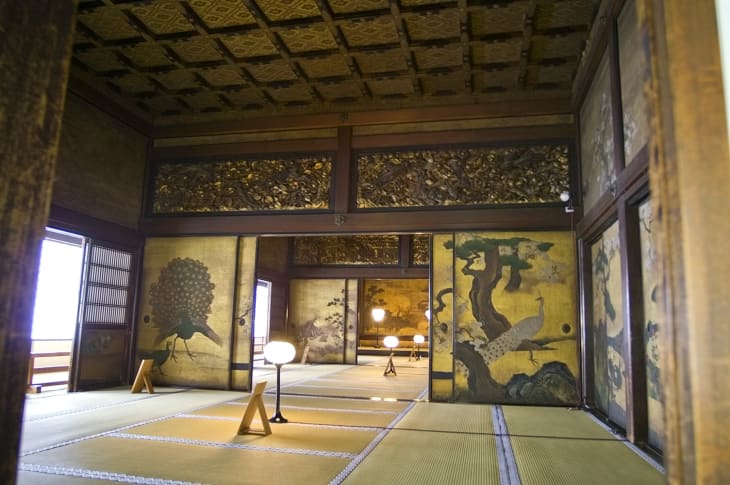
It was during this era that the shoin-zukuri developed — this was the style that we now call traditional Japanese architecture, which evolved as a kind of hybrid of the studies of Zen monks and the formal reception rooms of the military elite (see image above). Shoin-zukuri were characterized not only by tatami matted floors, but also shoji partitions, or screens made of rice paper on wooden frames, coffered ceilings, and square pillars.
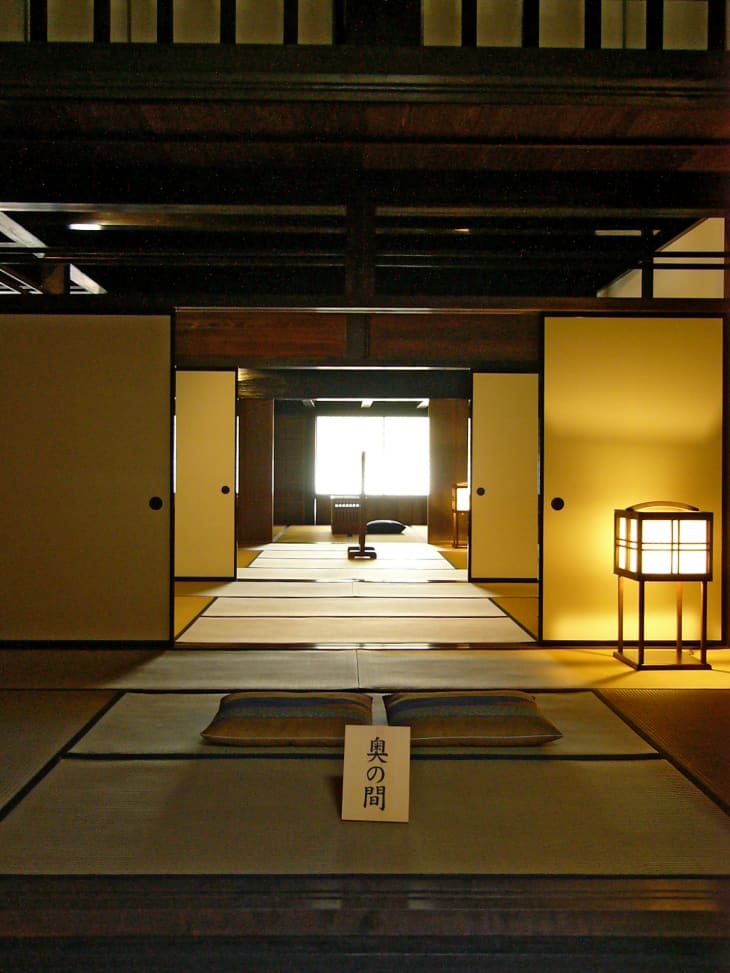
In the 16th century, the tea master Sen no Rikyu refined the Japanese tea ceremony, establishing the use of small, rustic tea rooms using rustic and natural materials, including tatami. His tea rooms were often smaller than they had formerly been, including one that is still extant (above) that is only big enough for two tatami mats. Rikyu was instrumental in popularizing wabi-sabi, the idea of finding beauty in simplicity, which became associated with the tea ceremony.
By the 17th century, tatami mats could be found in the houses of commoners, and they quickly became an integral part of every home. The mats work well with the unique climate of Japan, which is hot and humid in the summer and cold and dry in the winter, and the tatami mats evidently help regulate interior humidity. They also work with other cultural traditions in Japan, including being barefoot in the home, and sitting and sleeping on the floor.
In the last 150 years, traditional Japanese interiors have given way to more Westernized homes, and now many homes have only one tatami matted room, if at all, known as a washitsu, or Japanese-style room. (Tatami is also somewhat difficult to clean, so that is one reason for the decline in popularity). Today, some Japanese people still sleep on tatami mats with a thin mattress on top (called a futon these can roll or fold up when not in use, and bear little resemblance to dorm room futons). While these might be too thin if placed on a wood floor, the tatami mat's natural give apparently makes it very comfortable. (I've never tried it! Have you?) At this point, though, most people now sleep on 'Western-style' beds.
Despite the decline in usage, tatami is still a part of Japanese national identity, and has made its way into various proverbs, including "strategy planning on tatami," meaning all talk and no action, and "even if a room has 1,000 tatami, a person only needs one to sleep on," meaning don't take more than you need.
In the West, tatami mats are probably most familiar to anyone who has been in a martial arts dojo — where the mat is given a special, almost sacred, status — but the look, feel and even smell of tatami makes it a material worth considering for any home.
Do you have tatami mats in your home? Have you ever slept on one? Please weigh in below!
Images: 1. Wikipedia; 2. Met Museum; 3. Wikipedia; 4. Cal State; 5. Wikipedia; 6. Josh n Jax n Japan; 7. Elle Decor
Originally published 11.25.11 - JL

Nomade Express Slee...
When I visited Japan as a child I fell in love with tatami mats. My whole family agreed that futons on tatami mats was the most comfortable sleeping arrangement we'd ever had. I agree that they smell wonderful, and I also love that because of their delicate nature and inability to withstand heavy furniture they necessitate simple and uncluttered rooms.
My grandmother had an old traditional home on a farm in Japan. I spent my early years there as well as a few summers when I was older.
I love how the entire room becomes the sofa, where you can sit up for conversation or lie down for a nap. It absorbs sound, stays cleaner than carpet and is more welcoming than hardwood.
Thanks for the trip down memory lane. I had forgotten how much I love the smell of that farm.
"Increasingly rare"? We went to Japan on our honeymoon and know several friends and relatives who live there and I've never been in a Japanese home (traditional or high-rise apartment) that didn't have some tatami mats. Maybe the people we know are just old-fashioned?
I've always wanted to do my bedroom with tatami mats and a futon, but as of yet have not had the opportunity. I do wonder about the cleaning...
I currently have a japanese-style platform tatami bed+japanese-style futon (sort of). Before this (which I bought after I started living on my own), my bed for at least 10 years was three tatami mats stacked on top of each other+a couple of thin blankets+fitted twin sheets (they are a bit smaller than a twin mattress, though there being 3 helped make up the proper depth). So.... yeah.
I never really bothered to clean them, and haven't cleaned the ones on my bed yet, but I guess I would just wipe it down with a microfiber cloth to pick up dust and lint. But then, it's not being used as proper flooring, so it's obviously less of a problem.
Hm... I also lived in japan for a year on exchange... in the dorms we slept on futons, but the platform of the bed was not tatami. I think it had a carpeted feel to it, but I don't really remember.
I always thought a tatami mat was flat – like a rug – until I went to Japan. They’re actually very thick (3 – 4 inches?). This thick surface makes a good base for traditional futon bedding. But it would be a bit challenging to incorporate tatami into Western style rooms due to the level change. You’d have to cover the whole floor area, and even so you’d have a step up at the doorways. I’m assuming that in Japanese construction, the subfloor of a tatami room is lower so the mats sit flush, but I really don’t know.
Arroyo--in washitsu rooms, you normally have to step up to enter--the subfloor is not lower.
I miss sleeping on tatami!
Tatami is pleasant to sit on and is aesthetically pleasant too. Now that I think about it, I quite miss tatami. :/
Not the fleas and bugbombing the apartment though. Nobody mentions the fleas. blehhhh.
I slept in a ryokan in Kyoto in the 80's on tatami mats, and a futon, and it was very comfortable. Also a nice esthetic. I also saw them in the Imperial Villa and they were beautiful.
i think japanese culture is one of those few that incorporates "old" tradition into "modernism"...LOVE their simple, yet deeply skillful products embedded in everyone's daily life!
My apartment has a washitsu and I absolutely love it. Sleeping on a futon mattress has worked wonders on my back problems. Also, nothing is more glorious than napping on the tatami mat with a nice breeze coming in through the windows.
How do you go about cleaning? Now I'm curious.
also curious about cleaning - and if you need .5 of a tatami as mentioned in the article? I assume you can get other sizes made?
I spent part of my childhood in Japan, and when we finally bought our 880 sq ft house in California, the one thing I really wanted to do when we made a small addition was to add a tatami room.
I now have a 4.5 mat tatami room with sliding doors that overlook a veranda or engawa. The room is small (9x9 ft) but so pleasant and is the most heavily used space by my family. I'm sitting at a low table typing this right now as my 4 and 6 year old play Lego next to me. Every evening, they clear away their toys. When my parents visit they always insist on sleeping in this room and it becomes their guest quarters (despite the fact that we have a spare room!). For an intimate evening with friends, we sit around and play games or have dessert. Ideally, a 6 mat tatami room would be even better but since this was our budget, I'm very happy with it!
How to clean: Vacuum often. As a child in Japan I also recall having to wipe the tatami down with a damp towel (barely moist) but certainly the mats must not get wet. California's climate is so dry that I'm not as worried about mildew, so my mats are set directly on a hardwood floor (and boxed in with a removable wood edge so they can be turned if need be). Traditionally they are on a raised frame so that air can flow beneath them. If you have a tatami mat, you should ideally have some kind of wood border or edge so that you don't step on the exposed edge, which can break or collapse since it is made of packed rice straw. Hope that helps!
As long as everyone is telling their nostalgic romantic tatami stories, I might as well share mine ... I was living in Yokohama with a roommate during grad school, and I arrived home one day after a long weekend in inaka to find the house smelling sweet and fresh and slightly musty, like just-cut hay. That was odd, as we were grad students and the place normally smelled like instant noodles and beer. When I went in my room, the smell got stronger, and there was a soft buzzing noise. I finally traced it under the bed, where I discovered the earthquake a few days earlier had knocked my ... er ... massager onto the floor, where it turned on and quietly bored a 2" hole in the tatami.
When i was teaching in Japan my apartment had a washitsu room. I slept in it when I first got there and it was quite comfortable. Sadly the room had no windows so I ended up usually sleeping in another room with a hardwood floor and my back often hurt, but at least I could get a nice breeze in my room.
As far as cleaning went, I just vacuumed it.
I had the pleasure of sleeping on futons in Tatami rooms and it was without doubt the most comfortable and restful sleep I've ever had. It did help to wake up to a killer view but regardless. I don't think I'll ever forget that.
Cleaning is generally just vacuuming. Some Japaense vacuums have a tatami setting, but generally the floor settings works just as well. Every so often, you may want to deep clean, which typically involves wiping it down in the direction of the rush weave with a damp cloth. And every so often, tatami do have to be resurfaced.
As for sizes, the basic rule is that a full tatami mat is 2:1 length to width. Half mats are 1:1. Other sizes are no doubt possible, but harder to get. The standard tatami mat is what is called a "Kyoto" size wich is about 75"x37.5. There are other sizes like the "Edo" size or the "apartment" size, which get progressively smaller.
Mats are generally about 2" thick, and usually the sub-floor is sunk below the floor by about that much. However, increasingly people are using one or two tatami mats as area coverings, as opposed to having a dedicated room. In that case, the mats just sit on the floor (they are sufficiently heavy that they won't go anywhere).
As for increasingly rare in Japan, I don't think so. I have yet to visit a Japanese home (modern apartments and condos included) where there was not at least one tatami room.
I wish sizes could be given in metric - surely there are enough of us from foreign to make is worthwhile?
Really, washitsu are not increasingly rare in Japan. Almost all my japanese friends have a washi room in their homes, even the one who lives in a very small apartment. In fact the apartment is mainly a tatami room with a little kitchen in a corner, the only area with hardwood floor.
I would like to have a room like this, to practice for my tea ceremony class!
This is how you clean a tatami mat.....although can vacuum clean it you really shouldn't. My grandma used to use green tea leaves from the tea pot after it was brewed. Squeeze any excess water out of it, sprinkle it on the tatami mat and sweep it with a broom
I have never experienced a tatami, but o how I would love to! Never been to Japan either. :-(
This is a wonderful article though, very interesting and it's nice to see some foreign influences here!
We grew up with a washitu room in Taipei and my brother slept in that room (until 5 or 6) on the tatami. It was also our game room, as well as the winter family room where we were under the heated blankets and ate dinner. I miss it!
Terrific post and I learned a lot from the comments.
I once read that large English country houses in the 1800's were spread with tatami-like mats in the summer as a cool alternative to wool carpets. I don't remember if they were placed over the carpets or if the carpets were removed for cleaning. Perhaps the matting was really the sisal that is so commonly used these days in England. Does anyone know anything about this practice and what might have been used?
I studied and spent a year in Japan, as well, and have always loved Japanese architecture and design. Now I have a great Western house-friendly alternative to sleeping on a tatami mat floor--a bed that uses a tatami mat inlaid in wood, with a futon mattress on top (http://craneandturtle.com/index.asp). And you get that tatami mat smell!