(Welcome to Sarah, who's trying out for a spot on our editorial team. This is her second post.)
I've been trying out some green cleaning tips to get rid of those icky "lock them under the sink" chemicals and I found a new favorite. This tip for cleaning your silverware is quick, easy, uses things from around the kitchen, and it works! Yay!
What You Need
Materials
1 piece of aluminium foil
1 litre of water
1 tablespoon of baking soda
A saucepan big enough to hold your silverware
Tongs to pick hot silverware out of boiling water
Instructions
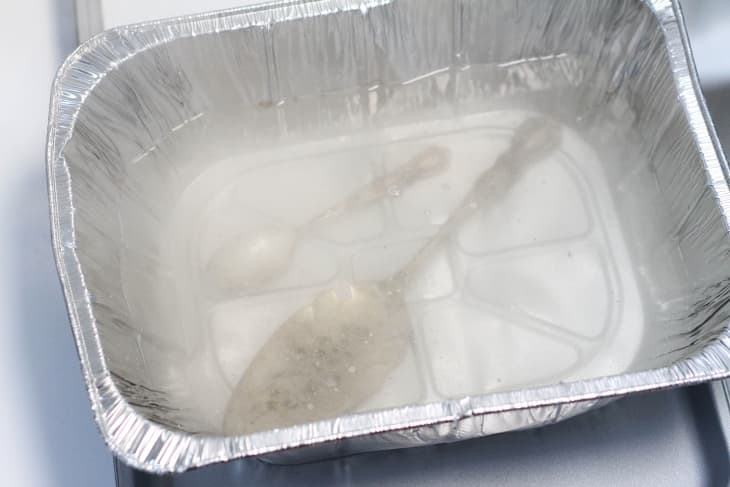
1. Put the water, baking soda and aluminium foil into a saucepan.
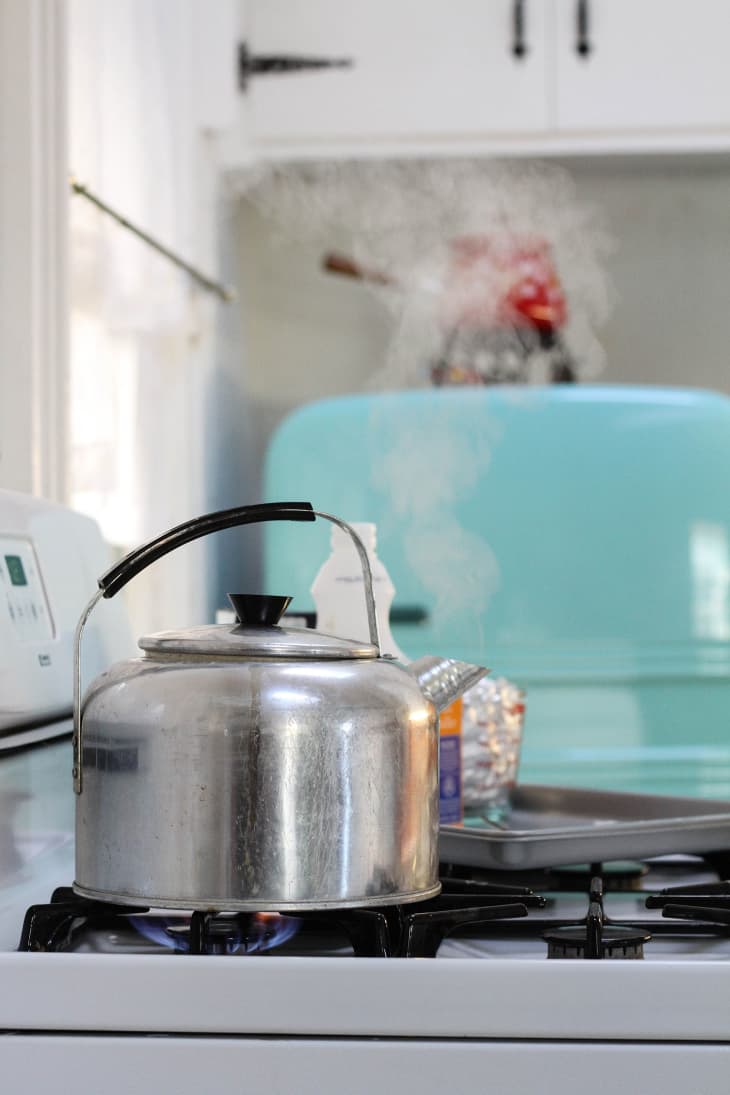
2. Bring to the boil.
3. Place your silverware into the saucepan, only a couple of pieces at a time. This should only take about 10 seconds but if they are really tarnished they may need a bit longer.
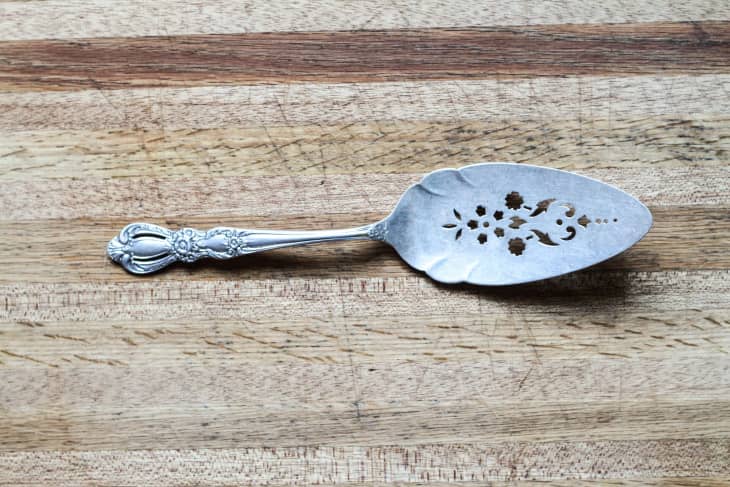
4. Use your tongs to fish out your silverware and marvel at how shiny it is!
Thanks, Sarah!
See Sarah's 1st tryout post here.


Sheex Bedding
Yes, this does work. However, do be aware it removes every last spec of tarnish. So if you're used to that trace of tarnish in the deep crevices highlighting the design, just know that will go away, too.
Please do not do this with valuable silver or any silver you care about. It will leave it looking flat and dusty white, and it will tarnish again quickly.
Toothpaste with a dry cloth works too!
Toothpaste is abrasive and can harm silver.
Museums use powdered chalk, a soft cloth, and elbow grease.
You can avoid having to polish silver by washing it regularly and storing it well wrapped in flannel, so polluted air can't get to it. It's the sulfur in the air that causes most tarnish.
Also keep it clean of salt and acid (such as lemon juice and fingerprints), and never use rubber bands to hold your spoons together--rubber contains lots of sulfur and will damage the silver.
If you use your silver regularly and wash and dry it after use, you may never need to polish it.
Sarah, love your writing style! But nooooooo! This is the same idea as those submerging systems for silver cleaning. Clean like a whistle, yes, but you lose all the pretty in your antique silver when you do it, and it looks kind of cheap and fake.
what a good way to get different ideas on natural cleaning! Since I'm npacking items which have been stored for over 10 years, I tried you method on silverware and found it worked well.
If you want to leave the tarnish to highlight the pattern, its just a matter of timing.
I shared your post, and thought you might like to see the comments:
Lindy Learmont Hain Yes, I tried the same method last time and it worked so well and no nasty fumes!
13 hours ago · Deb Hicks Use it all the time, even on my silver jewelry :o) It gets into all the cracks and crevices and no messy cleanup xx
no no no! This will ruin fine flatware!
No, this is a very bad idea!!!! Do not even think about boiling hot water. Just use the hottest water that comes out of your faucet, baking soda in a jelly roll pan. Let it sit for only 15 minutes.
What is going on here is the tarnish [silver sulfide] is being reduced back to metallic silver and is replated to the surface as a non-smooth silver deposit. The luster is obscured by the replated silver. This can be restored by a good polish with silver polish and elbow grease. The dark tarnish within the pattern that gives the accent to the pattern is indeed removed. I have tried this method and it indeed works but I don't care for the results.
It's hard to beat the results from a high quality silver polish and effort. Semichrome does a great job. Always finish off with a good buff with a clean, soft, polish-free cloth.
Phoxx points out the advantage and disadvantage of this method. For those who don't follow, when you buff a piece of silver to remove tarnish, you're basically scraping away a layer of metal. With this method, however, you are chemically replacing tarnish with silver. You may find that combining this technique with some old fashioned polishing gives better results.
I heard you can also store a small piece of aluminum foil with your silver in an air-tight container to slow tarnish. It seems to work on the one ring I tried it with.
Idid this recently with a ring I had found (legit, fished out of a gutter), and it worked so well I couldn't believe my eyes! I didn't have to do a thing and it came out looking brand new.
You actually need to use boiling water though, I did it with the hottest tap water and it didn't work the first time. The second time I used boining water and it was great. I only needed to leave it for about 10 min and that was enough.
As others have said, do NOT do this with any silver you actually care about. I use the Hagerty's brand of silver polish and find it the most effective and long-lasting.
If you use your silver regularly it won't need polishing very often. If you save it for a special occasion, store it in black tissue paper or specially made anti-tarnish bags.
One: Why all the attacks?
I have a HUGE collection of heirloom silver and this is the method I have used on every piece small enough. They come out beautifully! They are NOT dull or flat at all. I have also found that it takes MUCH longer for any tarnish to accumulate than when using commercial polish...
And MOST importantly, they are not scratched or worn away by abrasives. I have to say that from experience, I strongly disagree that it ruins your silver.
Two: You DID forget the salt though. The chemical reaction you need to remove the tarnish won't occur without the salt. (It's called electrochemically cleaning. Go google and learn more!)
Three: The water should not be boiling.
Otherwise, this was a great post, especially if it makes anyone go out and research how terrible TOOTHPASTE is for your silver! Any silversmith would cringe if you told him you used silver instead of this method.
Go ahead. Go ask him.
I did a post about this technique on my blog after I became responsible for my husband's families huge collection of silver.
@goodcanary: Thanks for the sane response. Yes, include the salt. Yes, the water should be boiling; this is a chemical reaction that works better with higher heat. I might not want to let knives or serving pieces with stainless steel blades sit in boiling water, since the glue holding the blade into the silver might melt. You might like to put those in a separate glass or stainless or enameled bowl (no rust from chips in the enamel, though, as this would stop the chemical reaction) and then pour boiling water over them instead of leaving them to boil over direct heat.
Also, if this didn't work for you, try again with a borosilicate or Pyrex bowl. Make sure it's completely clean by washing with soap and water, rinsing well, then rinsing with some rubbing alcohol and wiping completely dry. This prevents any contaminants from stopping the necessary chemical reaction.
eesh. I hate that you can't edit your comment.
I meant, Any silversmith would cringe if you told him you used TOOTHPASTE on your silver instead of this method.
and "family's".
My roomate in college told me to rub wet charcoal on tarnished silver, it seemed to work well. Is this in good practice? It was just charcoal from a fireplace.
I asked a professional silversmith for more information on this method and this is what they had to say:
We do not recommend the process especially with silver-plate as it cleans by galvanic action which the interaction between metals and chemicals. It works; however, the chemical process stays in the cells of the metal and keeps on working and corroding the metal long after it has been rinsed off. Sterling silver is safer to use in this process than plate as silver plate is a combination of metals which is a bad mix for galvanic action.We still recommend a good silver polish above and beyond anything else.
Museums and respectable authorities have a history across time of wrecking pieces because 'knowledgeable' people have little underlying grasp of physics and chemistry. Galvanic action only occurs when there is a solution permitting the two metals to act such as a salt solution in water, it cannot continue without a solvent!
Now metal plating bonds two dissimilar metals to one another - one of these processes is for galvanic protection, such as zinc plating (galvanizing) where the anode - the more reactive metal is attacked first before the least reactive metal, usually the iron it is protecting. The higher the reaction potential of the metal, the more that metal will corrode. The other use for plating metals is decorative, like the silver we're discussing. In this case the silver with a very low reaction potential is plated over brass which contains zinc with a higher reaction potential. Similarly, chrome plate covers steel on car bumpers - it's aesthetic only and does not protect the steel except by covering the steel completely AND having a very low reactive potential. Once the chrome is breached the iron will corrode quicker than if there had been no plating at all - in this case the iron is sacrificing it's self to protect the chrome!
Another example of galvanic action is the nails in the lemon battery where you put an iron and a copper nail in a lemon (acid solution) and draw off electricity. The reverse action is where you do the same thing but pump electricity into the circuit and you get metal being plating instead.
In the case of silver plate, we have decorative plating but silver is actually a 'noble' metal and is not actually that reactive.. however it does react to oxygen and sulfur very easily and this causes the tarnishing we see. By reversing the corrosion process as described in other posts, we are using a very reactive metal in a salt-bridge with the silver to re-plate the silver back onto the flatware.
In plating metals you don't want a solution that would actually attack either metal, so bicarb soda is perfect for the silverware.. but you do need it to allow the electrons to flow, once they begin flowing the aluminum corrodes and it takes the ions from the silver tarnish - and the silver which is released from the silver sulfide or silver oxide corrosion then sticks it's self back onto the silverware. This process is not simply harmless, it's actually putting the silver back where it came from.
The only other methods to clean silverware aside from galvanic re-plating involve abrasion or 'polishing' or worse, acid stripping. No matter how gentle the polish may appear, removing any tarnish involves abrading or rubbing off a portion of silver. Usually Canuba or another hard wax is involved to create a fine finish, but it still removes silver. Again, any method of polishing removes silver and that is not ideal. Acid stripping etches and strips some metal - that is extremely bad, while galvanic cleaning replaces silver back to where it came from and you can't really get better than that.
Wikipedia has a fine article on conservation and restoration of silver objects which emphasizes this better.
My husband is livid with me for ruining our pan using this method!!!
How can I get the baking soda stains out of the stainless steel pan, inside and out?
Next time, please specify what kind of pan (teflon, stainless steel, etc.) to use. I would definitely NOT choose the stainless steel surface.
I used a stainless steel pan to do mine in as well, but it didn't leave any stains. I just washed it after in the sink with regular dawn dish soap. You might however try & make a paste with Cream of Tarter and a little bit of water, run it on the pan using a tooth brush. I have found that Cream of tarter is pretty amazing for all kinds of things. I actually use it to polish the silver (I used a soft tooth brush to apply and then just wronged with water and dried) after dipping it in the boiling water/baking soda/tin foil solution. It make the silver amazingly shiny, so do not use if you want some of the antique look.
I want to do this on a small scale for a ring that got tarnished after using silver polish. I used a silver polish cloth and that has worked ok but it's hard to get the side of the ring that touches my finger. Can I do this on a smaller scale and in a bowl?
This can certainly be used with silver you care about. It needs to be wiped down afterwards because of the powdery stuff on the silver. When you polish silver, you remove the silver that has tarnished--you lose some of it. This actually reverses the chemical process that tarnishes the silver. The sulfer compound that is on your silver likes the aluminum foil better, so if you've got silverplate (even antique--especially antique), you aren't rubbing off any of the plate. If you like the idea of rubbing off your silver, then do it the old fashioned way. But at $25 an ounce, if you'd prefer to actually keep the silver instead of sending it down the drain, this is a very good choice. It does get tarnish out of the crevices, as mentioned below.