Inspired by the January Cure, I decided to tackle the moldy caulk along my bathtub this past weekend. After a couple hours spent removing the old caulk and applying new caulk, my bathroom feels a lot cleaner and brighter.
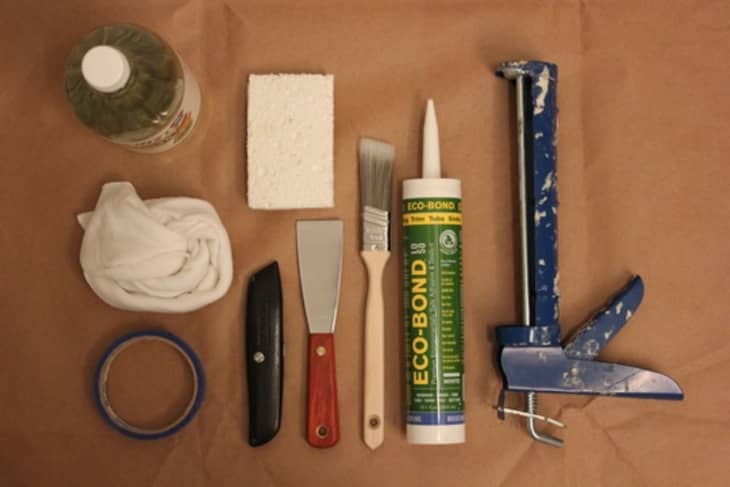
What You Need
Materials
White Vinegar or Mineral Spirits (I used White Vinegar)
Non–abrasive Sponge, Lint Free Rags, or Paper Towels
Painter's Tape
Caulk that is intended for bathroom use (I used a low VOC caulk)
Tools
5–in–1 Painter's Tool or Putty Knife (I used a 1.5" Stiff Putty Knife)
Utility Knife
Caulking Gun
Paint Brush (optional)
Instructions
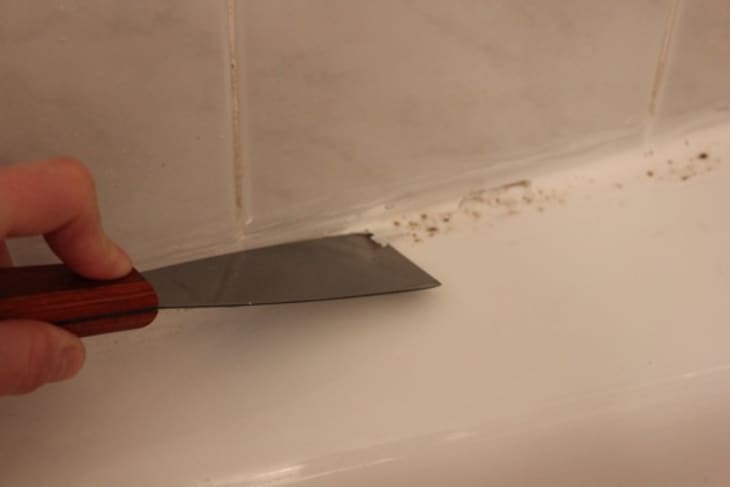
1. Remove existing caulk with a sharp tool.
I used a putty knife, but a 5–in–1 painter's tool or a utility knife would work, too. Note: test a small area to make sure you do not scrape the bathtub.
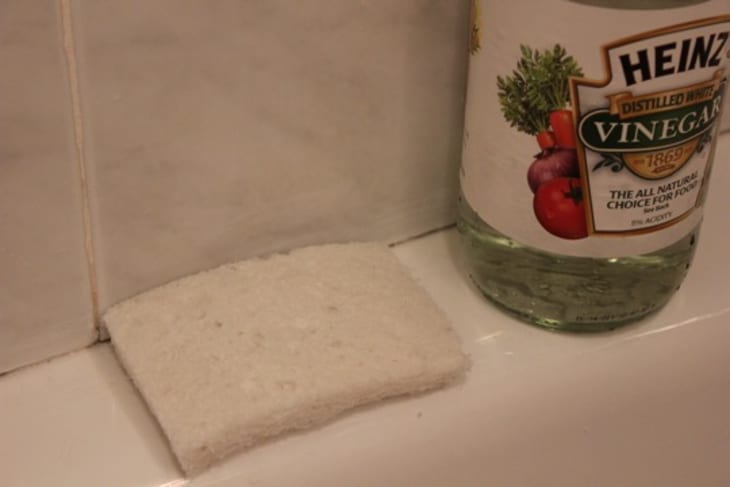
2. Clean the surface to remove all traces of caulk and mold.
Many people recommend using a combination of mineral spirits, liquid caulk remover and/or bleach to remove the caulk residual and any remaining mold; I found that using my putty knife to remove the residue, and a soft sponge with white vinegar to clean and prepare the surface was sufficient.
3. Throughly dry the area to prevent future mold outbreaks.
I used a lint free rag to wipe down the area, and then let it dry out overnight. You can also use a hairdryer to speed up the process.
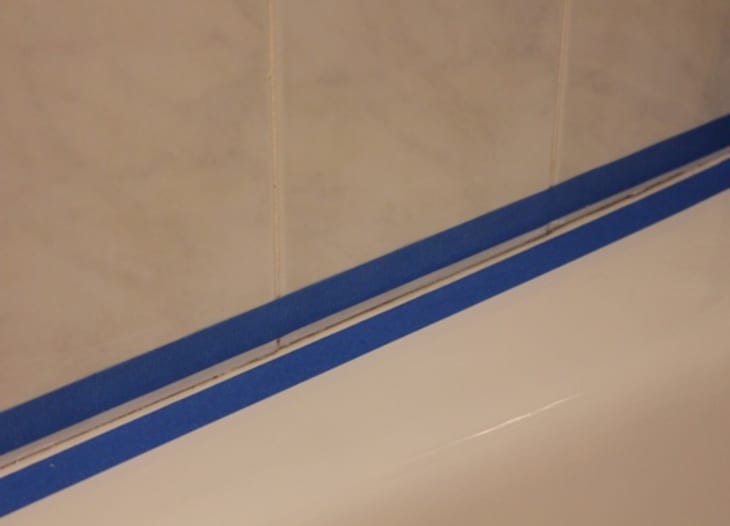
4. Tape off the area that you are planning to caulk.
I placed the tape about 1/8" on either side of the seam. It helps to achieve a straight and smooth line, and it makes cleanup faster and easier. Note: do not skimp on this step; it is worth the time and effort.
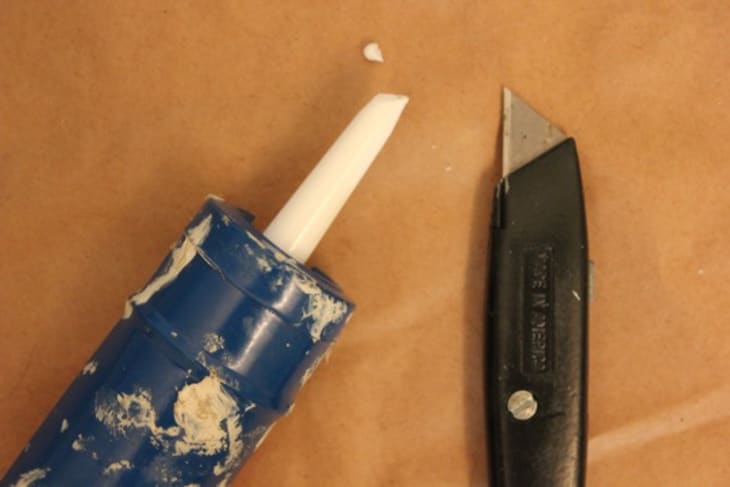
5. Trim the tip of your caulk at a 45 degree angle.
The opening at the tip should be about the same size as the joint (area between the blue tape).
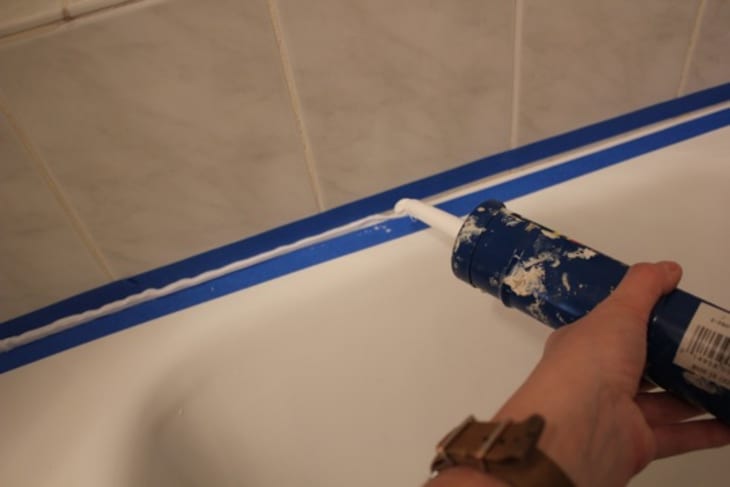
6. Load the caulk into the caulk gun, and apply steady pressure as you move along the tub seam.
Note: When I started I made the rookie mistake of going too slow, and the caulking material started to pool. You want a pace that gets you an even, steady stream. Too slow and the of caulk piles up; too fast and the caulk stream is too thin or it breaks.
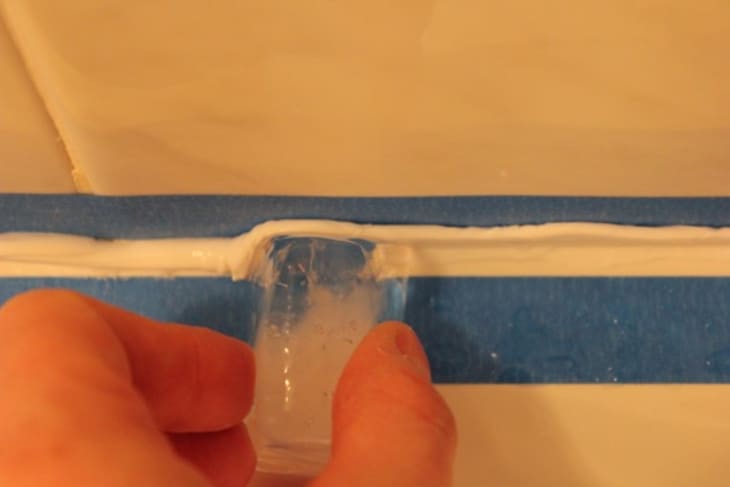
7. Smooth the finished line of caulk with a dampened rag or paper towel, a wet finger, or an ice cube.
Your goal is to have a concave and even surface when complete. Note: I used an ice cube and it worked wonders. Run it along the joint to smooth the surface and squeeze out the excess caulk. The caulk will not stick to the ice, and the ice will melt to the shape of the joint to become the perfect shaped tool.
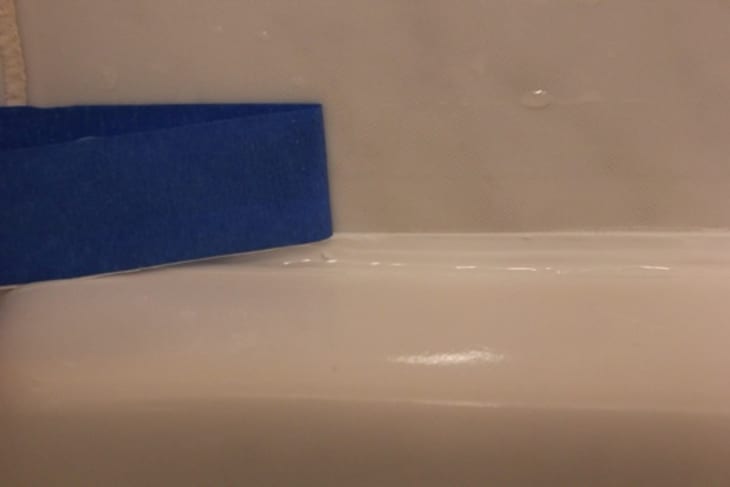
8. Carefully remove the tape and fix any blemishes that are left behind.
Wait 24 hours for the caulk to cure before using the bathtub.
Optional Step: If you want to paint the caulk, make sure to use a paintable caulk and allow it to dry for at least 24 hours before it is painted.
MORE CAULKING ON APARTMENT THERAPY:
• Learning To Love Caulk: 5 Eco-Friendly Options
• 10 Eco–Friendly Substitutions For Glue, Caulk, and DIY Tools
• Renovation for Renters: 10 Ideas for the Bathroom
(Images: Kate Legere)

Sheex Bedding
you forgot the most important thing which is to FILL THE TUB WITH WATER FIRST!!! that way it will be slightly weighted when you apply new caulk. if you do not fill the tub prior to caulking, the first bath will most likely create minisule gaps between caulk and wall/joint and then MOLD!!!
fill tub, caulk, let caulk dry (like a day), then empty tub!
I've never heard of filling the tub with water, if you think about the physics then yes it does make sense. However, if you use a silicone based caulk which is flexible this step could be skipped.
http://www.dap.com/product_details.aspx?product_id=25
Yup.. fill the tub with water. Also, if silicone was used previously, you must ensure that ALL of the silicone caulking is removed as nothing will stick to it.
Never heard of the ice cube trick.. a wet finger works just fine and you can feel how the spread is going (even, uneven).
Ha! Two people already beat me to it! FILL THE TUB with water first. That is all.
All caulk breaks down eventually. Why not give yourself the extra flexibility of applying it when the seam is a little stretched?
This is very timely for me! The tub that needs caulking has tiled walls with 6x6 tiles for which we used mortar tinted a pale beige, instead of stark white. I've been hesitating in recaulking because I don't know how to find the same shade - or are tile mortar and caulking are the same thing?? Or if it's OK to have white caulking and just above it, the tinted mortar.
I do note you say you can "paint" the caulking but that doesn't sound easy. Maybe put some tint in the caulk? I find the "helpers" in the Big Box store don't know how to do anything and have given me some very bad advice. I keep going to the friendly neighborhood hardware store and give them all the business I can.
Painter's tape!!!!!!!!!!!!! I do ours every year or so and can never get an even line and it looks sloppy. Thank you for that tip! And the ice cube...have to try that. I usually use my finger. I bought a tool that was supposed to do it but my finger worked better than the tool. Though the caulk always leaves my finger dry and hurting for a few days. Great post!
Yes, these are great tips for a dreaded task. thanks!
Thank you for sharing this! Caulking the tub always seems like such a daunting and scary task. I'm going to try it!
commeca: Grout and caulk are not the same thing. There are a fair number of caulks that are in shades other than white (almond, for example), so you might be able to get reasonably close.
Post-bleaching and pre-caulking I wipe down the whole area with rubbing alcohol to make sure it's bone dry.
I never thought to use tape when caulking. D'oh.
Perfect timing as I am doing this now. I need to do this about every 6 months, no matter how hard I try to dry everything after using the tub, it still gets grubby. I find that a paring knife works better than a putty knife as you can get closer and the blade is narrower. I also paint the caulk, as a quickie clean up if its old. Plain, old latex housepaint (for indoor or outdoor) works just fine and it cleans it up in a pinch.
Anyone know if you can re-grount the tiles, too? After 16 years in one place, this is what would REALLY make my bathroom feel cleaner.
DodieGoldney, you can definitely re-grout. My house is 60 years old and we've done it both ways: 1) buy a grout-digger-out tool (it is specifically made for this purpose) and go to town. Home Depot/Lowe's etc. has them. This is time-consuming and a bit of physical strength is needed. You don't need to get it all out. Or, 2) the lazy person's way is to simply re-apply a thin coat of grout all over the existing grout. Both methods have been very successful for us. It did not fall off/out and makes icky tiles look new again. Also, if you are really hesitant to re-grout, you can paint your grout. I've done it with a small artist brush and simple latex paint. It takes some time and I do it over a period of a week, an hour here and there. And it lasts. A steady hand helps but I find that my freehand works just fine. Don't be so concerned about being perfect, unless your eyes are 2" from the tile, you can't tell. After you re-grout/paint, make sure you wipe down your tile with a dry cloth after each shower. Takes one minute and helps tremendously in keeping down the mould growth. This is the key to keep grout and caulking looking good. Most people are just too lazy to do it, though.
Somewhere I saw a post that recommends using a plastic spoon to smooth the caulk. You would run the bowl side of the spoon evenly along the caulk line, and against the 90 degree angle formed by the wall and the tub (whew! harder to explain than to draw a picture!).
thanks for the reminder I need to do this , one day...
What are the procedures for re-caulking a shower (no bath tub)? Do I assume filling the shower isn't necessary? Or, because of the weight of a person standing in the shower, one should somehow fill the shower area with water to create additional weight so the caulking doesn't create miniscule gaps?
As jess13 pointed out, if you use a modern silicone sealant (which you should be), they remain flexible for 10 years plus they make them with antimicrobial properties. If your tub was installed improperly I guess this might be a problem. Perhaps this was done when the fiberglass tubs came out and people weren't setting them correctly in mortar.
Also, I don't think I've ever seen Mike Holmes fill a tub before caulking.
you should remove the link to "10 eco friendly substitutions..." It is out of date, links are no longer valid, some products discontinued and the article was poorly researched and just thrown together in the first place. Not the old AT standards!
Commeca-- Grout and caulk are two very different things. Grout is not flexible, like caulking, although most grout manufacturers also make a sanded and unsanded caulk to match it's grout colors. You may not find this at a big box store, but try your local tile stores. If you are having a hard time, try TEC's line of caulk and match to your current grout. They also make a 100% silicone sealant to match some of their grout colors, which I would recommend in any wet area, over the siliconized caulks, which is not 100% silicone.
DodieGoldney: I'd like to add on to what lolagirl suggested. As a #3, you could get grout whitener, which is essentially a paint-like coating which soaks into the surface of grout but easily wipes off of tile. I did this in 2 bathrooms and after nearly a year it's still holding up well! Details here: http://whoisamelia.blogspot.com/2012/03/bathroom-misadventures-part-2.html
Thanks for a very useful post!
Questions: can you recaulk only a portion, or do you need to do the entire way around? For example, let's say most is nice enough, but there's small section that appears to be cracking because it's too thin? Or another small piece that appears to have a little mold growing underneath?
Also, am I the only person who can't scrub through mold? How do others do this? Is it just hours and hours of elbow grease? Or is there a special ingredient they're using? (And besides the usual vinegar or baking soda or bleach,)
Thanks in advance for any tips! Have a nice day.
theptarmigan -
If it's mold along the edges of the tub (not wall tiles)...I use a cotton coil (used for perms - I have seen them at Walmart and Sally's beauty) dipped in bleach, then wrap it along the edges of the tub that have mold. Let it sit for an hour or two, then remove the coils. 100% mold is gone! No elbow grease and it literally takes 5 minutes to do.
Hmmm, it sounds good to fill the tub with water. By doing so the tub becomes a litter wet and when we use the tub the caulk doesn't comes out of its place because of its strong application at the joints.
The reason we recommend filling the tub first is to add weight. Modern tubs are usually acrylic and can flex when the weight of a person is added. You want weight in the tub or shower so that the space where you are going to caulk is at it's widest point. Filling the tub is just the easiest way to add that weight. While silicone creates a flexible joint, it is NOT elastomeric. It can't adjust back and forth for people of differing weights. The theory behind it is if the joint to be at it's widest point when you silicone it, it's less likely to stretch and separate on occasions when the tub or shower pan flexes more than usual. Note: It's important to remove every trace of the old silicone as the new silicone will not bond well, if at all to the old silicone.
Silicone caulking should not be considered as a permanent thing. Bathrooms have issues that other rooms don't - moisture, humidity, poor ventilation just to name a few. If you make cleaning and re-siliconing part of your annual bathroom maintenance, like resealing your tile's grout, you'll be able to keep check and hopefully prevent future issues.