Have you ever been in a home that just feels right? One where chairs pull out easily from the dining table and conversation can be made without shouting across the living room? Well there are reasons for that, and they probably have a lot to do with spacing and placement. Following a few simple guidelines will make a world of difference in the functionality of your home's layout.
In general I believe that design rules are meant to be broken, but not when it comes to proper height and furniture spacing. When these basics are out of whack even the most delicious assortment of furnishings will seem off. Let's run down the basics...
Dining Room:
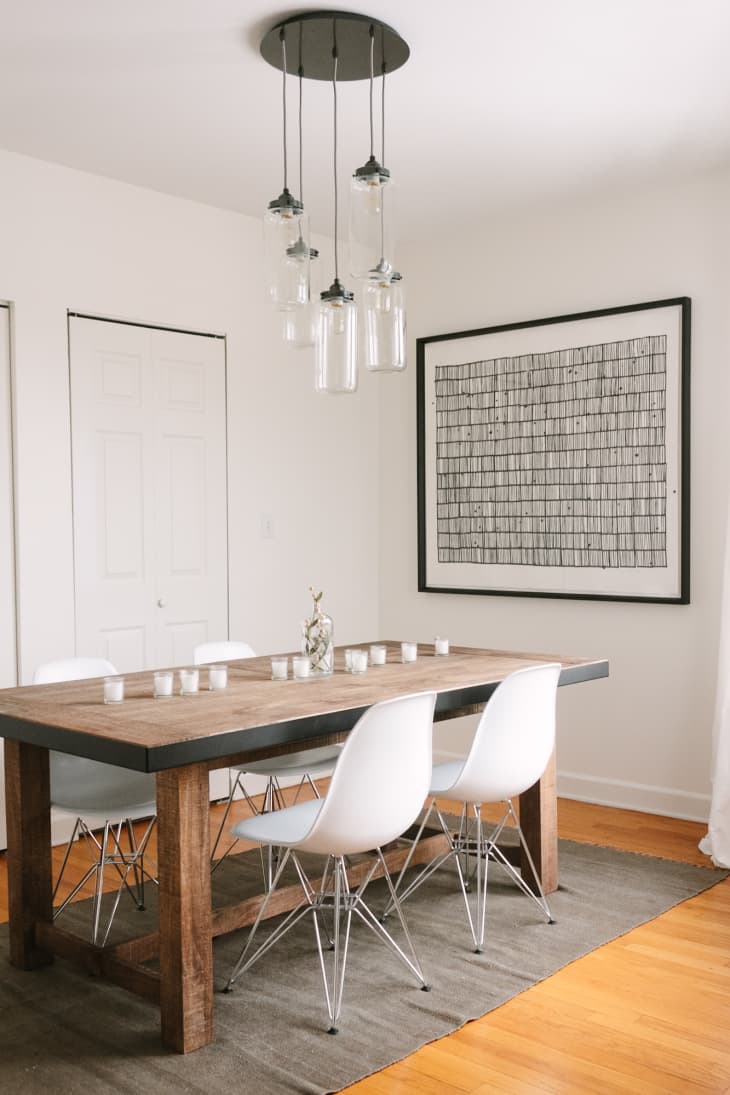
• Distance between the walls and the dining room table: Ideally, provide at least 36" between the dining table and any walls or other furniture on all sides to allow seats to slide out easily.
• Distance between a dining table and an entrance: Provide around 48" between the table and an entrance to allow people to enter and exit the room with ease.
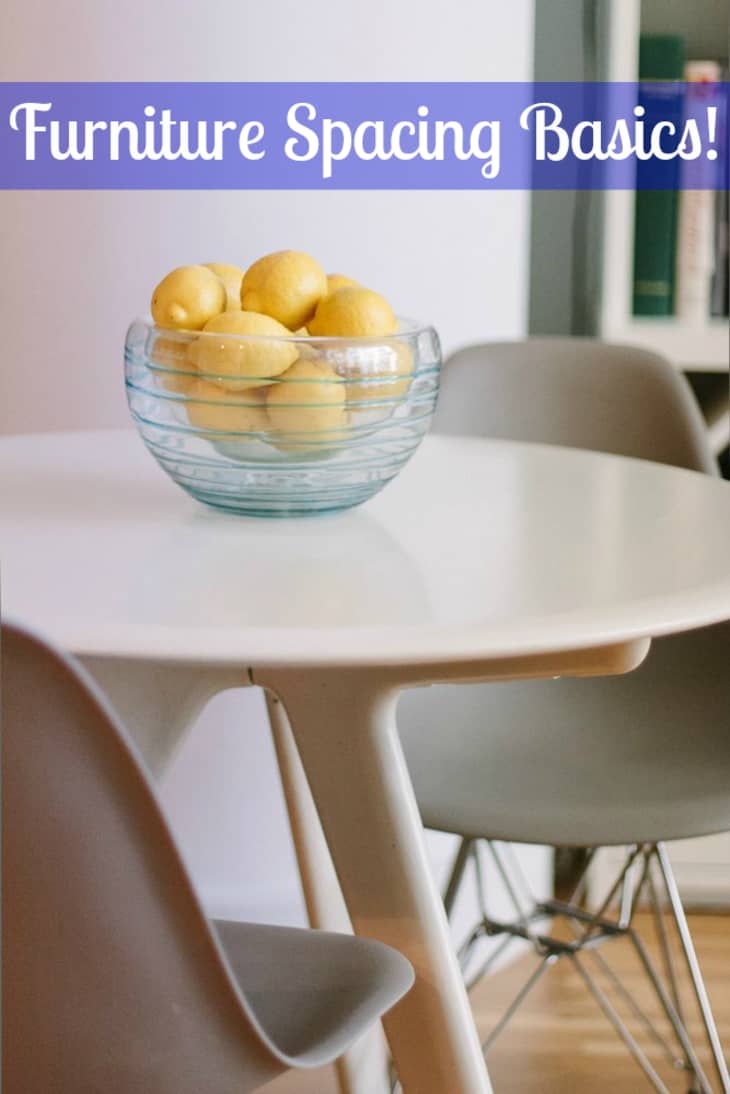
• Vertical space between a dining chair and dining table: Chairs and chair arms should be able to slide under the table with ease. Leave about 7" between the chair arm and apron of the table.
• Distance between chandelier and dining table: This is one of the more flexible topics. Low hanging lighting sets a more modern tone, but even so, it should never interfere with the ability to make conversation— no need to duck your face down to the table just to see your dinner guests. However, a light hung too high will detract from the cohesive feel of a room as well. A good rule is to hang lighting between 24"-32" from the table.
• Area rug and dining table: A rug should span about 36" wider on all sides of a dining table to allow chairs to pull out easily without catching.
• Space between dining chairs: Ideally provide about 24" between chairs to prevent hitting elbows and to allow people to slide chairs in and out without any collisions or bruised knuckles.
Living Room:
• Distance between a sofa and coffee table: Allow around 18" between the table and sofa edge to give enough leg room but to be able to set down drinks or reach appetizers without straining. Coffee table heights vary greatly, but a good rule is to keep the table height and seat height within 4 inches of each other.
• Distance between seating furniture: Aim to provide between 3.5' and 10' between seating options to help conversation flow without crowding a room.
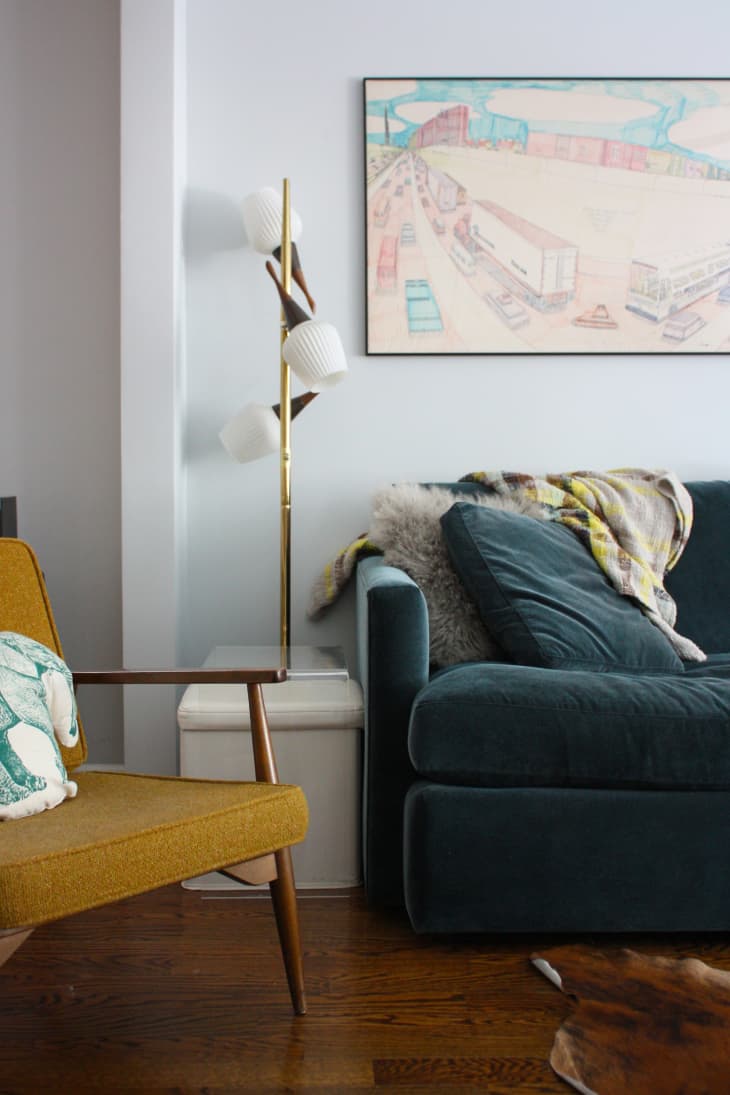
• Side table and sofa height: In general, an end table should be approximately the same height as the arm of your sofa or chair. This allows guests to set down or reach for drinks without straining, and it also lends a more cohesive feel to the room.
• Distance between tv and sofa: There should be about 7' between the tv and seating options.
• Area rugs and furniture: Too often area rugs end up feeling like bath mats. To keep your area rug from feeling random, at least the front two legs of a sofa or chair should rest on the rug.
• Distance between room-size rugs to walls: Allow about 24" between the wall and room-size rug in a large room, and between 12"- 18" in a smaller room.
What other furniture spacing basics would you add to the list?
Image: Rodellee/Rodellee's Sunny Southern California Style House Call


Sprout Side Table
This is perfect! I'm sending it to my friends and family right now.
Yes, but there is also the "Goldilocks" principle. I am tall and I am usually warm, so short, squishy sofas with huge (or small) pillows are torturous to me. No matter how good the sofa looks, if my butt sits lower than my knees, I'll be crippled while sitting and I'll have to spring like a (crippled) frog to extricate myself from the furniture. And if I have to fight or rearrange loose and sloppy pillows I'll be overheated and irritated. Room scale is visually important, but furniture fit is critical, so sez Goldilocks. This usually equates to good quality furniture. Therefore, I love consignment furniture stores :-).
Does anybody else find it amusing that the rug in the above picture does not go under the couch?
The picture above doesn't show the sofa resting on the rug, and it looks fine...
Ha! I noticed that too and it does indeed look fine.
I'm confused - in the dining room, you're saying that ideally you want 24 inches between each chair...two whole feet...? I could then only fit 1 chair on each side of my table...and 7 inches between the arm of the chair and the underside of the table seems a bit much as well. Am I reading this wrong...?
I think setup in the picture looks fine because its a sectional sofa. Placing the legs on the rug would have looked awkward. Also, the rug is large enough that it fills in the area between the L-shaped couch nicely. With a standard sofa, I tend to agree that placing the legs on the rug grounds the room, and connects the elements.
These guidelines are meant for a home much bigger than my tiny one bedroom apartment... But a nice resource nonetheless. One day, perhaps!
@HeraHere I have the opposite problem. I'm 5'2" and my husband is 5'4". We spent months trying to find a couch that we could actually sit in without our feet dangling a good 4-5" off the ground! Reminded me of that old SNL skit by Lilly Tomlin: http://www.youtube.com/watch?v=NxJFrWUlqmE
@Gentry I wondered the same thing about the chairs. That's a LOT of room between chairs! I'd have to portion kids into different rooms around my house :-)
i think they mean 24" of space per chair- or another way to say it would be 24" from center to center of each chair.
Tanya Ott I feel your pain. I not only find most couches too high, but also too deep. If I may ask, where did you end up finding a couch for short statured people?
Hey, they're guidelines, not hard and fast rules. I've been having a hell of a time deciding on what size rug to put in my recently rearranged living room (I gave up for now and bought a 5x8 cheap broadloom from Building 19), this will be a good place for me to start.
Absolutely disagree with the idea of resting "at least the front two legs of a sofa or chair" on the area rug. A rug that looks like a "bath mat" will look that way because it's too small for the space and/ or not relating to the furniture placement in the room. The one in the picture looks good because it defines the coffee table space and allows a nice border of wooden floor in front of the sectional. ... Were that sofa sitting right on the edge of a rug, it would look hideously badly placed. Actually, I'm not sure why this particular photo was chosen to accompany the article, since it doesn't illustrate any of the points therein !
Can two sofas (one of them 2/3 the length of the other) set at right angles share a side table between them? If so, how much space should there be (if any) between the pieces? They each face a side of a very large coffee table, on which most people put feet, not drinks.
How about guidelines for bedroom furniture placement? It kills me when I see nightstands 1 to 2 feet from the bed.
Agree that must be a typo on the two feet between chairs.
That rug in the photo is just too smalll - It should be larger so at least the front legs of the sofa are on it and those seated can't kick their feet under the edge of the rug...
...and 7" clearance for chair arms under a dining table is ridiculous: Tables are 28-30" high, and chair seats are @18" high - a dining armchair with 25" high arms fits under a 28" high table non-aproned table just fine...
...and 24" space between chairs is obviously a type - I'm sure you meant to allow 24" per chair.
Thanks for these tips! Sending to my mom! :)
-Teresa
The 7 ft guideline for TV viewing is useless. With today's large flat screens, it's not a one-size-fits-all rule. Distance placement is better judged with screen-size in mind and personal vision needs.
Tanya Ott, I have the same problem. What did you end up buying?
I would love to have four feet between the dining table and an entrance but it's just not possible in my teeny-tiny house. I know I've broken quite a few of these proper spacing basics in my house but I've worked hard to get properly-scaled furniture and arrange good flow.
And along the lines of what @TanyaOtt said, I'm a short 5'4" (read: more like 5"3.5") and my husband is 6'4"--trying to find furniture that fits us both (and into our tiny house) has been an exercise in patience (both in the time to find it and with each other while we're shopping for it).
Distance between tv and sofa
This should be function over form, and functionally the viewing distance depends on the screen size. There are some general formulas for this that aren't totally strict, so I suppose 7' might cover a lot of screen sizes.
re: picture
I guess it illustrates the 18" from coffee table to sofa rule?
I love this! I don’t have numerical guidelines, but I do have a few tips that I always follow:
1) When you are decorating a room, always stand at the door where your guests will likely be entering. This vantage point is key because it’s the first look into the room that anyone – stranger, family, friends, will have – and it’s the first impression. If the space feels cold or unwelcoming upon entry, it will be hard for anyone to get past that.
2) Always sit where your guests will likely be sitting (you can tell – everyone will probably gravitate towards one area) and take a look at the room from that vantage point. Even if you’ve mastered #1, you still have to think about this viewpoint since most of their time will likely be spent sitting.
Of course, the more familiar a person is with your place, the less you really have to worry about which seat they’ll be sitting in, etc., because chances are they’ll feel comfortable floating around your whole house. But I always worry about the people who come only once. You always want to make a good impression, and your house says volumes about you, your lifestyle, your personality, etc. Even if the guest doesn’t really know you, your house can speak for you and you always want it reflect a positive image.
To normanak: Yes! A sofa and a love seat can sit at right angles with a shared end table between them. Do pay attention to arm height and table height so it's easy to set drinks on the table. But do remember that it's rare that someone will sit in the center seat of a three-person sofa. So someone will need to use the coffee table, feet or no, to put a drink on.
And KaBoomBOX, you're right. The nightstand needs to be far enough away from the bed so it's easy to make the bed. That's usually 3-6 inches depending on bedding. And make sure the height of the nightstand is within 6 inches of the bed height. I also try to allow a minimum of 30" between the bed and adjacent walls/furniture -- 36" is better. That may or may not work in your available space!
One cheap trick to find the right size of area rug for your space is to use blue painters tape and tape out some common rug sizes on your floor.
I do agree that having an area rug that allows you to put the front legs of every seating piece on it makes the room feel more generous.
Great tips!
@KaBoomBOX
It kills me when I see nightstands 1 to 2 feet from the bed.
... it doesn't compute.....
Does anyone have advice for what to do if your furniture has, for example, sleds rather than individual feet (if you know what I mean), or an X-base, and your rug, which you love dearly, is not large enough to have the entire couch or rocker on it (which would also mean you won't be able to see as much of it), but the seating would be unbalanced if you only put the "front legs" on the rug (since it has some pile), as is the general rule? I was just going to put the bases right up against the rug, but that would put the seating a little far from the coffee table....
I think also one of the rules should be about the placement of furniture in the room. Flow is so important. that is: not having obstacles infront of y ou when you enter a room. and the height of hanging pictures, there are several rules there to, and yes they too can be broken, however if you break all the rules all the time it looks a mess.
Leah- I agree that feeling comfortable in a space is the most important feature of a room, but I am very confused about the distances between seating at 3.5-10 feet.
Architectural Psychology has documented distances that support comfort during different kinds of interactions between people: Personal Distance is 1.5-2.5 feet for ease of conversation. 2.5-4 feet is the proverbial "arm's length" which is more distant in physical closeness and emotional connection. 4-7 feet is for impersonal business and 7-12 feet for formal exchanges, such as negotiating. And these distances are from person to person, not chair to chair. To avoid "shouting distance" I move my clients' furniture closer together and they are surprised and delighted at "how much better it feels."
I don't think I'd use this info much in an existing space, I'd do better "eyeballing" it or trying it out.
But I can see how this would be helpful in new construction or a new rental, before you've moved in, to have sort of general plan on placement. Or to figure out how a new piece will fit in your space.
Just really depends on the shape/size of your place and your preference. For me, my sofa is much closer than 7' to the tv but I have an 800 sq ft studio separated by a narrow walk in closet. On the living/kitchen side of the studio, the sofa is pretty close to the tv but then we can also watch tv pretty well from the kitchen island while cooking.
I think the reason area rugs end up looking like mats is not so much about placement but that people won't buy a big enough rug. Especially when you first start decorating, smaller rugs are well, for a lack of a better term, cheaper. And also, I think you don't yet have the confidence to envision a larger piece. The shape and texture of the rug will also make a significant difference.
OK I just need to find a dining table 18 inches square.
I basically agree with these guidelines.
That being said, no matter how perfectly spaced my furniture is, everyone I have over seems to end up standing in a tight circle in the middle of my kitchen floor. I have to shoo people out of there into the rest of the house. Nobody I know gives a damn about my "wall of tea lights" or cozy sectional or round dining table for ease of conversation. It's the kitchen floor, every damned time. I need to install spikes in there or something.
I'm not sure I agree with these guidelines. I think the biggest issue I have with it is that it doesn't necessarily consider the space allotted. If we were to have 3' around our dining room table, we wouldn't have a dining room table. It's all well and good, but without an open floor plan to play with, a lot of these guidelines aren't possible in smaller divided homes.
Our furniture doesn't sit on our rugs... but to keep them from sliding, I sewed rubber drawer liners to the bottom. I also have furniture in my living room that easily slides, so I can always make it as easy as possible to accommodate different groups of people.
@honeyhaze: I agree with the standing in the kitchen! But I lived with a baker - our kitchen was the smallest room in the house (for floor space), but we always wound up baking or sitting on the floor.
Personally, furniture on the edge of a rug is a pet peeve of mine. I like there to be floor surround for most rugs. Gives a more balanced look. Like in the post picture.
Related to the too-low chandelier in the dining room are too-high candlesticks or flower arrangements on the table. They might look great when no one is sitting there, but once people sit down, they want to see and talk to each other.
So many measurements in inches! Conversions to centimetres would be useful for those of us not from the US...
though i don't necessary disagree with it, i think the rule about carpets under the legs of feet is mostly an american one. in europe, which often has a more minimal aesthetics, little carpets are often used successfully to enhance the beauty of wood flooring. i love the way the flooring is displayed in the 1st pic & think it works well.
Can you provide some guidance for people who live in shoe boxes? How do you create space and flow when you have neither?
This is perfect. I just bought a house and I'm trying to make a floorplan to make moving in a little easier. Thanks so much for the help!
i adore this sofa!!! where is it from??
honeyhaze, that cracked me up! And it's SO TRUE! spikes indeed! :)
@Weyeswoman:
One evening when I was
still living at Grand
Street and Monroe,
Isamu Noguchi
came to visit me.
There was nothing in
the room (no furniture,
no paintings).
The floor
was covered,
wall to wall,
with cocoa matting.
The windows
had no curtains,
no drapes.
Isamu Noguchi said,
“An old
shoe would look
beautiful in this room.”
(John Cage) (excellent design advice for true minimalists) (probably not the last time I'll quote it here)
I agree with the rug guideline. An area rug should not be floating in the room, it needs to be anchored down by the front legs of the furniture surrounding it. It's all about choosing the correct size of rug for the space. This is a big pet peeve of mine when I see a rug just floating on the floor without any furniture anchoring it. It just looks wrong.
Does anyone know what coffee table this is? And where I could purchase one like it?
It's kind of funny to think that we design spaces based on what it will look like and how it will work when guests visit -- when often, if it's a small place in NYC, we are more likely to socialize outside of our tiny apartments and are better off arranging our personal spaces to suit the way we actually use them and like them best -- good to know the rules so you can use them or lose them!
Can anyone tell me where this sofa is from, or suggest any resources for a sofa like this?!
The dimensions of my living room (about 9' x 11') don't really permit me to follow these principles, but they are nice to read anyway!
What I intensely dislike is when the coffee table is a great distance away from any furniture. The seat furniture is placed round the edges of the room close to the walls; the very expensive coffee table is too far away to be of any use and placed on a VERY expensive rug, not intended to be walked upon. Where does one put one's glass? On the floor where someone eventually kicks it over. I just don't get it.
Now, how do I get them to read your post without seeming critical?
I have a question regarding the height of my couch and adjacent chairs. I have a tufted sofa with a high back. I also have these 2 modern leather barrel chairs that have a low back. Can I place these two chairs adjacent to the couch? People are telling me that the chairs and couch need to have similar heights in the same room. Any advice would be appreciated!