

Design Changemakers 2021: How Fashion Designer Clare Vivier Brought Her Signature Flair to Home Decor
The Apartment Therapy Design Changemakers Class of 2021 is made up of 24 of the most talented and dynamic people in the design world. We asked an assortment of last year’s Design Changemakers and Apartment Therapy staffers (and you!) to tell us who we needed to spotlight — see the rest of the list here.
Who: Clare Vivier, fashion designer
Nominated by: Maxwell Ryan, Apartment Therapy CEO and founder
Where to follow her: Instagram, both on her personal page and Clare V.

Why Vivier is part of the Class of 2021: “In the past year, particularly because of the pandemic, I’ve found Clare’s smart, warm, and French sensibility so fresh and needed as we look to the past to get us into the future. Her sense of color and shape is dead on. Her homage to a simpler time is dead on. Her idealism is dead on.” —Maxwell Ryan, Apartment Therapy CEO and founder
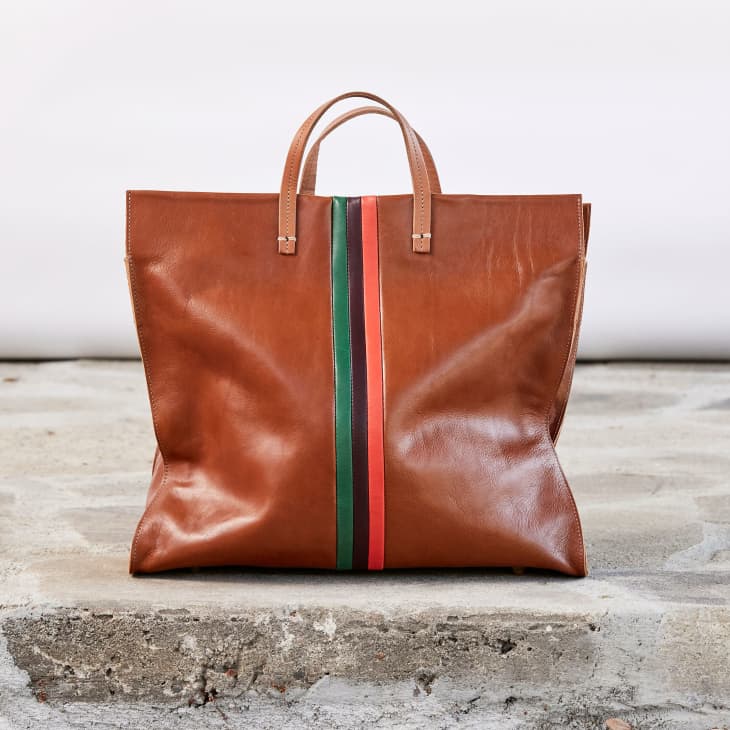
With her bright color palette, punchy prints, French vibes, and penchant for creating classics with a twist, Los Angeles-based fashion designer Clare Vivier is a standout when it comes to her handbags, accessories, and apparel.
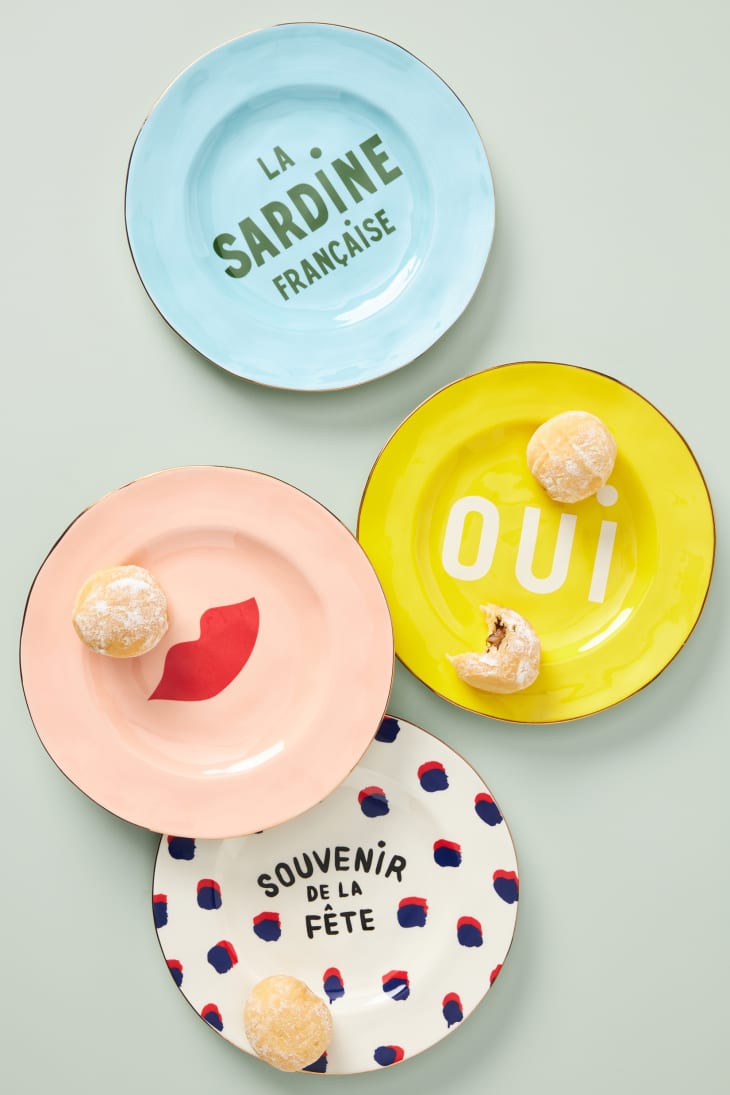
Her signature style was practically begging for a home decor collection — so it’s no surprise that Anthropologie tapped the Clare V. founder to create a capsule collection for them last spring. Nearly two years in the making, it was inspired by Vivier’s summers in Île de Ré, France, and encompassed everything from tongue-in-cheek dessert plates to patterned bento boxes, monogrammed journals, and vibrant beach towels, chairs, and umbrellas. “We had a really good time doing it, and it was very successful,” Vivier says.
Though teaming up with Anthropologie again has yet to be confirmed, Vivier is open to partnering with others to collaborate on home decor. She has also worked with The Inside* to turn some of her motifs and patterns into fabrics. Similarly, LA-based Wallshoppe transformed a few of her patterns into wallpaper. “We will continue to pursue the best avenues for home decor in the future because we think it works well,” she says.
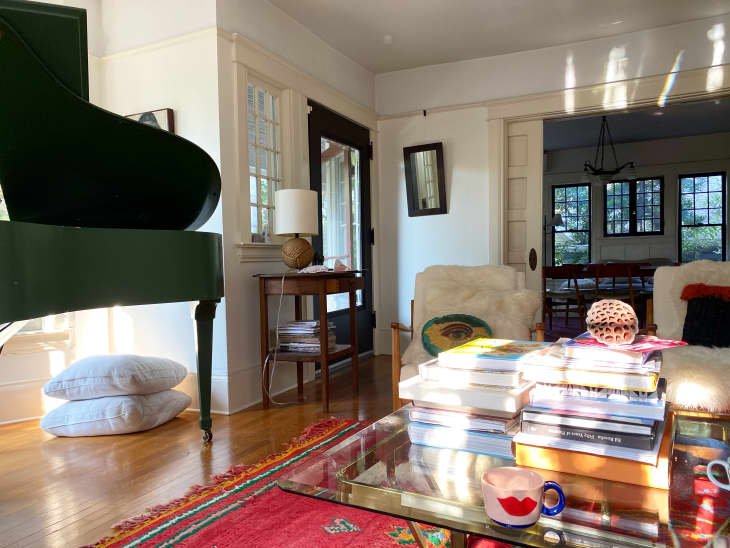
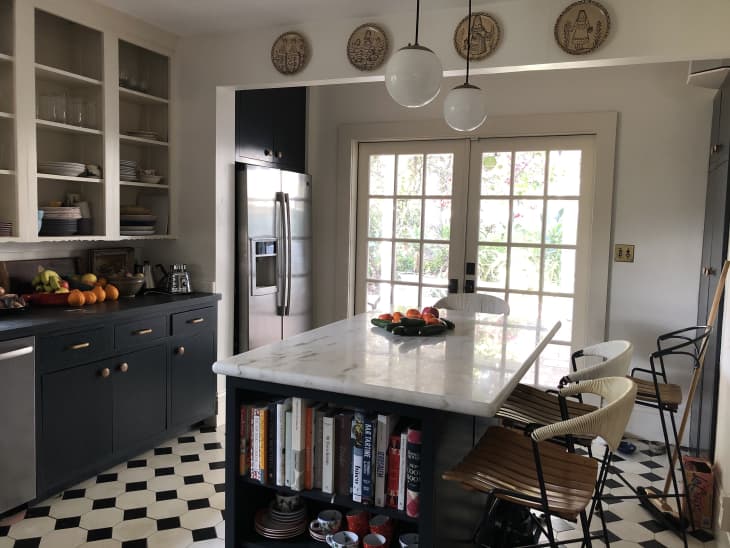
Anyone who has peeked inside Vivier’s home knows she has a knack for translating her fashion prowess to four walls. “I’ve always been interested in decor in so far as making my homes particular to my style and desired coziness,” she says. She spent a year renovating her current home in Los Angeles. “It was a full year of living in dust,” she says. “We wanted to make it as special as we could. Since we’ve moved in, which was many years ago, we have continued to fix up different things over the years.”
A major project for Vivier this year will be working on the home in Saint-Calais, France, she recently bought with her husband, who originally hails from the same town. “It’s a real fixer-upper, but it has beautiful bones and a beautiful exterior that I was really attracted to for many years of taking walks in his small town,” Vivier says. “I was always in love with this house. This is a fun project for us, even though we can’t be there very often to actually work on it.” They plan to fill it almost exclusively with vintage pieces. “It’s really important to me because there’s no reason to buy anything new,” she says. “We don’t need to be consuming like that when there’s already so much, especially great interior stuff out in the world.”
Apartment Therapy: How does being a fashion designer inform your decor pieces and vice versa?
Clare Vivier: Once we built out [stores] for our brand, once we had that vision, it became much easier to build out items for decor, just taking elements of that and thinking about how it would become a plate or a chair or towels or umbrellas. It felt very natural, and we saw that happen when we did a home collaboration with Anthropologie.
The opposite, which is how decor affects my fashion design, that’s an interesting thing. That’s not how I ever think about it because fashion, handbags, and apparel are always at the forefront of my mind. That’s the place that I start from. There are certain materials that you find in home decor, such as beautiful vegetable tanned leathers and things that really age well, and that has become even more part of my brand since using them in decor pieces in my stores.
AT: How did you translate your fashion aesthetic and bring it to life through the decor of your stores?
CV: We have nine of our own stores, which we designed the interiors of. They had to be a projection of what we are as a brand. How do we create this brand and build it out so that when people walk into it, they feel like they get the entire vision, aesthetic, and the feeling? That was a real process and a fun learning experience to build out blank spaces into brand spaces. For example, the San Francisco store, which I think is one of our prettiest stores, there’s this sense of a beautiful, classic space. There’s very high ceilings, skylights, and a painted pink floor. Then we mixed in wood because we couldn’t just have it all very clean and classic. We needed it to have an earthy sensibility to it, which is part of our brand as well. It’s very much an LA brand. It’s not all sleek and chic — there’s a natural component to it as well.
AT: Do you plan to expand your decor offerings at Clare V.?
CV: Yeah. We’re constantly looking to carry mostly local artisans and craftspeople to sell at our own stores. We have this great vehicle for retail, and I love to be able to build out the whole vision a little bit more and put things that I would actually put in my house in our stores or that I feel go really well with the brand. Oftentimes, it’s friends of ours whose work we’re selling. It’s nice to offer people a real brick and mortar space where they can show their goods. We would love to [design more of our own decor pieces]. It’s definitely in the cards. We just don’t know when we can get there because we’re a pretty small company still, so we want to do it when we’re able to do it right.
AT: What were your design inspirations growing up? What is your inspiration now?
CV: Initially, my design influences were my parents. I always loved going into my mom’s closet and finding her fancier pieces and trying them on. They were usually things that she didn’t wear very often, like party pieces. I was always very attracted to the shiny bits in her closet. My dad had really great style. He was a very dapper dresser and always wore bow ties and three button suits and had a really innate style. I took a lot of style inspiration from him and I still love mixing masculine and feminine elements in the way I dress.
Then, interiors-wise, I think about where I grew up and the things that I started to notice. I grew up in St. Paul, Minnesota, in a great neighborhood called Crocus Hill. I remember going to people’s houses and realizing, “Oh, this is fancy. This is something that we don’t have.” A friend’s house in the suburbs had brass hardware in their bathroom. It was gold. It felt so fancy to me. I remember pieces of furniture at my house and at my dad’s office as well. We had a striped velvet bench with wrought iron sides. That always felt very luxe to me.
AT: What three words would you use to describe your work or style?
CV: Classic, chic, humor.
AT: Is there a specific piece or design of yours that you think is particularly indicative of who you are or what you’re trying to do?
CV: I don’t think so. There’s a lot of our pieces that I hope represent that. We have a pretty extensive collection. We have a really small design team. It’s me and my design director, Greta [Heichemer]. The two of us design everything in that entire collection. Then we have a really talented art director who does all of our lettering and patterns. Since we are a small team, I hope that almost everything we do is imbibed with those three words and my aesthetic and what I want the brand to portray.
AT: How do you think the past year will impact the design world moving forward?
CV: I’m hoping that people are a little bit more considerate about the things that they’re buying because we’ve all lived with a lot less this year. We’ve been home so much that we haven’t had the desire to purchase as much, especially fast fashion because fast fashion got its claws into people by duping people into thinking they needed new things to go out all the time. Now that nobody’s doing that, I’m hoping we realize that we don’t need to consume that much and that more attention is paid to things of quality and things that mean something.
AT: How has 2020 changed your perspective on or approach to your work?
CV: More than ever we’ve been thinking about what people really need instead of just passion pieces that might be frivolous, which I think we’ve always considered anyway. That’s always been the impetus or the seedlings of each collection. We all need to be more considerate of the planet and the resources that we’re using. We manufacture everything in the U.S.; 90 percent of what we do is manufactured here locally in Los Angeles. Not only am I proud of that for the lower carbon footprint, but also for the jobs that it provides and the way that it affects our community. The fact that we are keeping people employed has even more meaning to me at this time.
AT: What, in your mind, is the power of good design?
CV: That’s a complicated question. There are things that are well-designed for utilitarian purposes. A full, well-rounded, good design would be things that work well from a utility standpoint, but also that spark some kind of joy. I don’t mean that you have to smile when you look at it, but it’s something that brings you some type of pleasure and deep-down appreciation. I think it has to do with utility and beauty.
Interview has been edited and condensed.
*Editor’s note: Apartment Therapy Media CEO Maxwell Ryan is an investor in The Inside.