
Leanne Ford’s Kitchen Uses a 144-Year-Old Layout — And You Might Want to Copy It
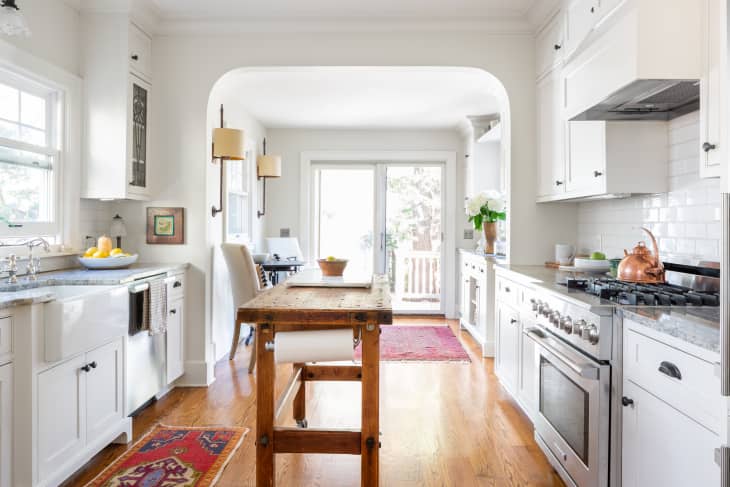
When it comes to kitchen redesign, there are several factors that most homeowners take into consideration: how to create more storage space, how to bring more light in, and how to fit in a bigger kitchen island. But interior designer Leanne Ford decided to break all three of those rules when redesigning her own kitchen. And the result looks so clean, spacious, and open, you might consider doing the same exact thing.
“My kitchen,” Ford captioned a recent Instagram post. “No uppers. No overhead lighting. No island. No problem.”
Ford included a “before” picture of her kitchen, which had a huge L-shaped island that took up most of the floor space. She replaced it with lower cabinets and a large center dining table and kept upper cabinets and recessed lighting out of the equation. And in doing so, she connected the kitchen back to its historic roots.
Although Ford’s kitchen is washed in a clean, modern white, the layout is really similar to layouts from the Victorian era. These kitchens would often feature freestanding furniture that acted like lower cabinets, as well as moveable pieces like hoosier cabinets and hutches. And at the center of Victorian kitchens was a worktable, similar to Ford’s dining table, that could function as an island or an eating area.
If you love the look of Ford’s light, airy, and open kitchen, you might want to consider ditching your upper cabinets and island, too. You can get creative with your lower cabinets, adding enough drawers and doors for all your essentials, and then use the leftover wall space for open shelving or a plate rack, or leave it bare.
Doing this will bring your kitchen back to a simpler time, and your kitchen will feel less cluttered. You may just find that your need for all that extra stuff that filled your upper cabinets will simply disappear.