
You Should Skip This Popular Paint Hack — There’s a Better Way to Keep Cans Clean
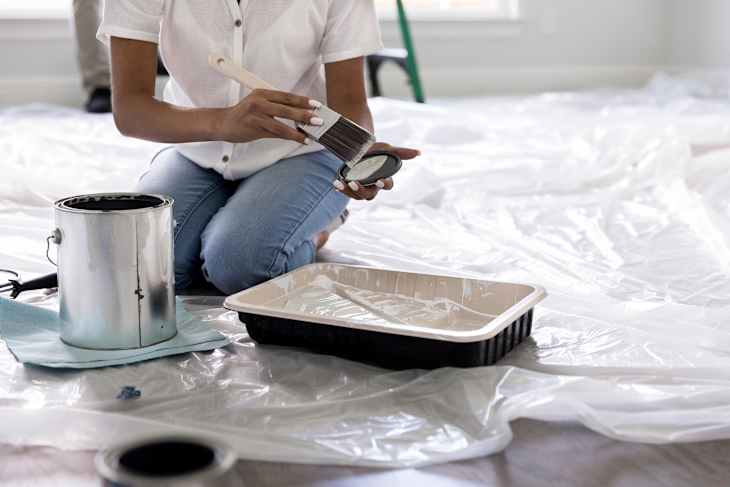
If you’ve ever started a painting project clean only to end up looking like Jackson Pollock’s assistant by the time you’re done, you’ll understand that it can be a very messy process. Whether you’re painting a chair or refreshing an entire room, the prep work involved to keep the process clean before, during, and after your paint session is almost as much pressure as trying to achieve crisp edge lines.
For that reason (and so many more), it’s helpful to stay on the lookout for shortcuts that speed up the process and make painting anything a less labor-intensive (and more successful) endeavor. There are plenty of paint hacks out there that work — including one of DIYer Ashley Poskin’s recent favorites, the elastic band method— but just as many that aren’t worth your time and effort.
The Nail Paint Can Hack
Simply put, there’s nothing more annoying than that crevice around the rim of your paint can. For such a small spot, it certainly causes a lot of issues. Pooling paint? Check. Dried-on gunk? Check. Not to mention, cleaning it out isn’t a walk in the park either; you either have to run your brush around the rim in the hopes of spilling it back into the paint can instead of onto the side or you have to use a paper towel to clean it out and risk getting your hands all dirty. Wouldn’t it be great if there were a way to minimize the mess and guarantee a neat paint job? Some pros suggest tapping a nail into the rim of the can to create several little holes and allow paint to drip through as a solve, but could a toolbox accessory really change the game?
To help DIYer Ashley Poskin, known for her bold home (see: colorful paint projects and whimsical lamp upcycles), put the method to the test. She gave her honest thoughts on how useful an addition a hammer and nails could be to your painting arsenal. Spoiler alert: This one isn’t worth the effort, guys.

Does the Nail Hack Actually Work?
“Unfortunately, it really isn’t worth the time it takes to tap the holes into your paint can,” says Ashley, who tested the hack during a recent painting session. “If you’re working with decent paint, it’s going to be too thick to drip down through the holes.” Ashley tested this hack with Sherwin-Williams Emerald paint, which is in the same category as other favorite brands, like Benjamin Moore. Translation: Any paint worth buying probably won’t jibe well with this method.
In order to give this shortcut her best shot, Ashley first tested creating holes the size of her nailhead, then went as far as to make them larger by adding consecutive holes atop that. “On my next attempt, I tapped a second hole right next to the first, to see if it would allow the paint to drip any faster,” she explains. “I then tapped a third hole in between, joining the two and making a much larger hole, and had the same results — no drips, and hardly worth the effort.”