
My Quirky Living Room Gave Me a “Renovation Headache” — Here’s My Advice
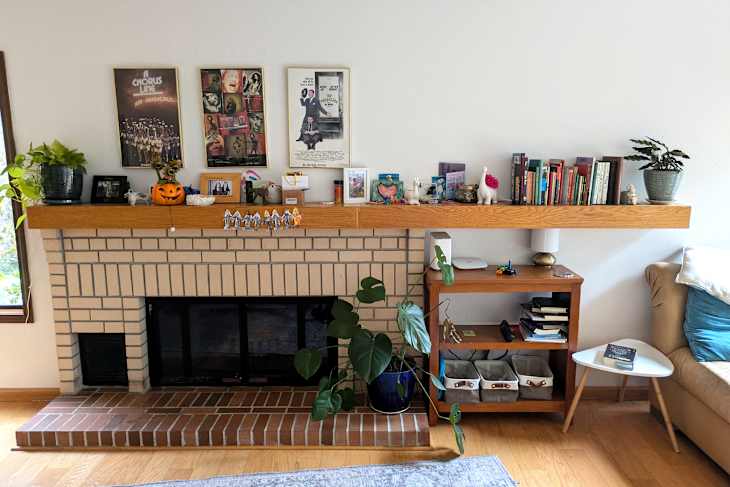
My house was built in 1979, and truly I love the vibe. I have tall vaulted ceilings with wood paneling in the living room, cool linoleum in the upstairs bathroom, and architectural angles galore. However, there are two rooms that are problematic — my oddly designed kitchen, and the living room that I call the “room of decades” because there seem to have been some basic remodels over the years, all done very wackily.
The floors are a gorgeous hardwood with a nice light color, but, weirdly, they don’t match the darker wood in the rest of the house. The mantel awkwardly extends past the fireplace by some feet, and there’s nothing that makes sense to go under it except a couch. Even then, I still hit my head on it sometimes. There’s a hanging light that came with the house, and a couple of sconces on the walls. These lighting fixture “choices” aren’t ones anyone would make now, I’d think.
When I moved in, I was pandemic house shopping after my divorce, so I had a short window of time to find my next place. I totally didn’t notice the mantel’s length (the sellers had kept their TV under it) or the lighting fixtures because I was very stressed and overwhelmed. Basically, my thinking was as follows: House location and size are good. Price is fine. Let’s do it. The house had six offers that day — the peak of pandemic homebuying madness — so I’m glad I didn’t waver.
I don’t regret buying my home — not at all. I love it to this day, but I do wish I had the time to pay attention to the details beforehand. And if I ever buy another home I also would like to know the types of questions to ask if I ever come across another haphazardly renovated room again, because this room gives me a major renovation headache.
In the case of my home, I wouldn’t even know where to start and how to tell what’s original and what’s not. That’s why I asked Jesse Dill, principal real estate broker at Premiere Property Group, LLC, how to make sure I (or you!) never get into this situation again — or how to properly remedy it once you’ve found yourself in it.
He said to first ask your real estate agent for the records to your home (or home-to-be, if possible), which would, of course, be the easiest way to find out what renovations had been done and when. Real estate agents also have a good breadth of knowledge when it comes to style. “One way to start [figuring out the date of renovations] is by looking at the materials used. Sometimes the type of finishes, appliances, or fixtures can give you a clue, as they might have model numbers you can track back to their manufacturing date,” he says.
If you can’t trace info from the house itself, you may need to do some sleuthing. “If the remodel required a permit and a permit was obtained, you have a better chance of getting all the information you need. Those records are usually kept at the county or city level. Many of these places have online tools to check permit history,” Dill says.
If you have no access to any of that information at all, and are still trying to figure out what style your house is or when something was remodeled, that’s when you have to roll your sleeves up and do some research by looking into different styles of interior design and when they were popular.

Over the years as I’ve settled into my home, my own research has led me to guess that my living room had been remodeled in the ’90s. I went looking at galleries of other ’90s homes and researched style trends to try and match what was happening in my house. The lighter wood and emphasis on durability and usefulness over beauty tipped me off, just based on experience being in people’s houses from that time period when I was growing up in the ’90s in suburban California.
However, when I looked up “floating mantel,” I found out it was likely remodeled in the 2000s to 2010s, which shocked me — I had imagined it was installed in the ’90s.

When it came to the light fixtures, I found more variety than I expected. A Google Lens search led me to believe the pendant light might be original to the house, which was surprising. It’s a Danish-style light, which, again, surprised me based on the look of it. I haven’t yet determined if my pendant light is inspired by the fancy Danish one or if it is itself Danish. If it’s the real deal, it’s actually somewhat valuable. If I ever switch it out, I could probably sell it. My sconces, which I hate, are likely “vintage” IKEA, indeed from the ’90s. So those are worth less, and I’ll feel less bad about replacing them when I do.
In the end, the room was even more of a “room of decades” than I originally thought. The window wood and hanging light are original to the 1970s home, but then in the ’90s and onward the rest of the room came together. I don’t care that much about my mismatched living room — the light is nice, and the style isn’t horrendous. I will probably upgrade those IKEA sconces, though. But I’d recommend doing this research before buying a house and will do similar research if I ever house hunt again.