
“Shosai” Is the Japanese Room Concept I’m Dreaming About for My Next Home
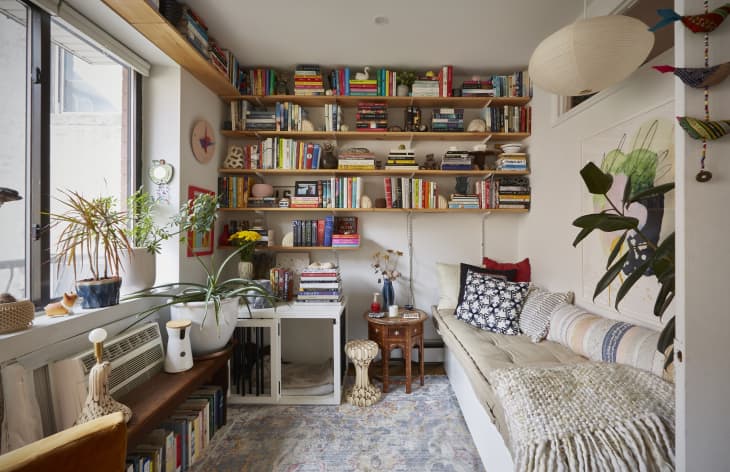
I consider myself a dedicated extrovert. I love going out with friends, meeting strangers, and hitting up every party and activity I’m invited to. But once I’m worn out, I’m worn out. I get quiet, and my face tends to go blank, which leads to endless pestering from well-meaning loved ones who want to know if I’m OK. So, a few years back, I discovered how to avoid this sudden zapping of my energy — I just need to spend a little time every week by myself, with no distractions.
The best place for that is my home office, and it’s been working well enough — I’ll be in my desk chair, thinking or doodling on my notepad to “reset” — but honestly it’s hard to separate the association I have of my office being a “work” space from it being used as a “quiet” space for recharging and relaxing. My office may be a separate space from the rest of my home, but it is the place I most associate with work, emails, computers, and the overall stress that comes with it.
That’s why, when I learned about a Japanese room called a “shosai,” I felt like I needed to go all-in on the concept — and look at investing in a separate space for quiet time that’s not my office. I think it might solve all my problems.
What Is a Shosai?
A shosai is “a quiet room in your house where you can go to study, work, or relax without being disturbed,” says Graham Hill, a real estate advisor with Find Osaka Agents. Think about it as a meditative space where you can be with no distractions, to just enjoy the quiet around you. It can be as big as a bedroom or as small as a walk-in closet or alcove.
Hill learned about them from dealing with multifamily and commercial buildings in the Japanese real estate market. “This is a modern amenity that some owners … use to add value to their buildings, and to help them to offer something that helps them to be distinct from similar buildings,” he says.
If a shosai sounds familiar to you, that shouldn’t be much of a surprise. In the United States, these types of spaces have typically been sought out for use as a home office. According to Leon Fisher, a project manager at Zook Cabins, it had to do with remote work becoming more of a priority during and after the pandemic, when employees with young children were looking for a space to have a quiet Zoom call.
Now, though, homeowners are looking more towards the shosai as the quiet space it’s intended to be. Fred Loguidice, a real estate expert and founder of Sell My House Fast Delaware, has seen a clear uptick in buyers shopping for homes with quiet rooms, as well as sellers advertising them. Although he says it’s still a niche trend here, he’s recently worked with a buyer who wanted a private room to use as a soundproofed meditation space, and a seller who turned a walk-in closet into a soundproof serenity nook with a built-in white noise machine.
That being said, though, “shosai” rooms still have a long way to go before they’re considered the norm here. “Quiet rooms are more common in urban or suburban markets where there is noise pollution, and for some buyers with certain needs like neurodivergent customers or remote workers,” Loguidice says. “For me, it’s not yet fully a make-or-break selling feature for most of my clients, but it’s a very trendy point of interest that astute sellers are starting to take advantage of.”
How I’m Adding a Shosai of My Own
My husband and I recently purchased a classic Chicago bungalow, and I have big plans for a shosai of our own. Just off our bedroom there’s a small space surrounded by windows, like a sunroom but with a closet and a door.
Once it’s fully decorated, it’s going to have two comfy pleather chairs, a handful of plants, some tranquil light blue paint, and a stack of books. That’s all. No tech will be allowed in this space; I plan to do what they did in the latest season of The White Lotus, and throw all electronics in a bag or basket at the entrance. Loud activities will be strictly forbidden. We can watch the birds in the morning through the windows, read, or meditate, but no loud conversations, television, or anything more than soft music will be allowed here.
I work from home, and even though it would be quite easy to turn this room into a sun-drenched office with lovely views, I’d much rather have it as a space for quiet reflection, where I can go after a long day to unwind and make the transition from work life to home life in a calming way. Plus, when my extroversion wears out, I can recharge there, or even just take a five-minute break if we have people over.
Honestly, I think every home — and resident — would benefit from a shosai. Today’s world is so full of distractions and a constant onslaught of negativity in the news and on social media. It’s the perfect space to separate ourselves from all of that and have some time to become more grounded. I think of it as something akin to a panic room, but for the soul. When life and the world feels hectic and overwhelming, you can shut yourself into your shosai and return to a simpler time.
Plus, if you ever decide to sell your home, Hill thinks it’s a valuable asset. “It is my opinion that quiet rooms as a feature of residential real estate will market best as a luxury feature, and will appeal to that kind of sensibility, even if they are included in more modest homes,” he says. “The sensation of a quiet room is certainly luxurious.”