
A $50 Cast Iron Sink and a Hoosier Cabinet Combined to Create a Kitchen Focal Point
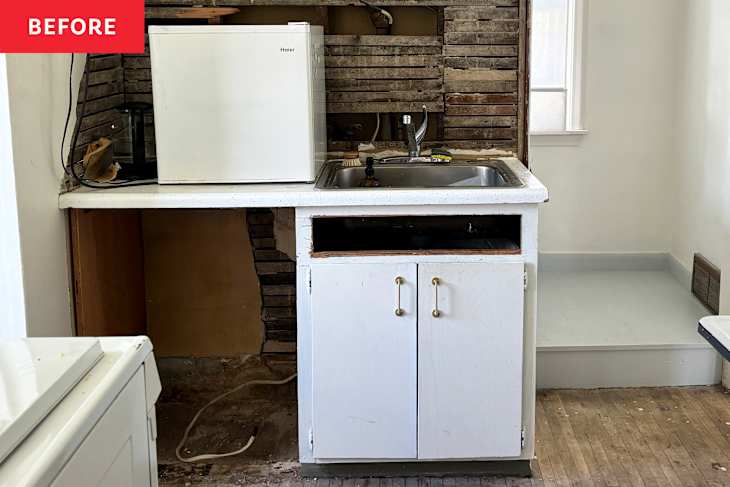
It’s the age-old tale: A historic home is updated somewhere along the line and, while the sentiment is positive, the new fixtures just don’t quite make sense with the home’s aesthetic. That was the case for Alison O’Reilly and the fixtures in her 1921 cottage’s kitchen.
The tiny 75-square-foot kitchen had “standard fixtures [that] were literally cramping its style.” Alison removed the cabinets, Formica countertops, and the too-small stainless steel sink to refinish the wood floors and repair any damage to the plaster.
To Save Space, She Combined a $50 Secondhand Cast Iron Sink and a Hoosier Cabinet
Alison’s sink was located on its own wall of the kitchen — and because her space was already limited, she knew whatever she put in its place would need to take up a much smaller footprint.
“After keeping my eye out for a year, I finally found a reasonably priced cast iron sink on Facebook Marketplace, and with a Hoosier cabinet I’d already acquired, the idea clicked: Combine the two into one space-saving piece, true to the home,” Alison shares. “Enter: the Hoo-sink.”


After Hauling the 200-Pound Sink Home, the Antique Cast Iron and Hoosier Cabinet Needed a Refresh
The first step was hauling the 200-pound cast iron sink out of the seller’s backyard into her car, which doesn’t sound easy. But with Alison’s determination, she was able to do it with some help.
Once the sink was in her space, Alison got to work. “Amazingly, the cast iron sink was in great shape and just needed a solid cleaning with repeated applications of Bar Keeper’s Friend and Dawn Dish Soap to remove the surface rust,” Alison says.
Hoosier cabinets, beautiful 1930s do-it-all kitchen hutches, weren’t made to hold sinks — instead, they had ample workspace. So Alison and her boyfriend replaced the cabinet’s enamel tabletop and used a piece of plywood to create a space for the sink’s plumbing.
But the couple also had to consider the weight of the cast iron sink and how the cabinet would support it — meaning they had to reinforce the base cabinet’s frame and make sure they mounted the hutch top securely to the wall during installation.
“I’m not new to refinishing furniture, but the cabinet took many more hours of sanding, priming, and painting than I had estimated,” Alison shares. She refurbished the Hoosier cabinet using Behr’s Premium Cabinet, Door & Trim Enamel Paint in the shade “Simply White” to accurately restore the antique. “I wanted to do it right.”


Making Sure the Hoosier Cabinet Could Support the Weight of the Sink Was Crucial to Her DIY
Alison knew that the “structural support and durable construction would be key,” and with the reinforced base cabinet, Alison and her boyfriend already had a promising start.
“Luckily, the sink still had the original wall mounting bracket, so I knew I could mount it to the wall studs,” Alison describes. She also added extra blocking to the Hoosier base cabinets to guarantee that it could support the sink’s weight.
But plumbing was the most challenging part of the transformation because Alison had to do extensive research to fit modern fixtures with the antique pipes. It took “plenty of trial and error to get it right,” Alison notes.
In the end, Alison got it to work, but only at the expense of shortening two base drawers by five inches to accommodate the plumbing.
“Overall, we didn’t lose [any more] space or functionality,” Alison comments.


Sharing the Finished Project with the Original Seller Was Her Favorite Part of the Whole Thing
“Aesthetically, I wanted the ‘Hoo-sink’ to look like it belonged to the space — like it had always been there,” Alison explains. “Practically, I wanted to be able to wash dishes and store stuff.”
Not only was Alison able to achieve those DIY goals, but she was also able to share the finished project with the woman who sold her the cast iron sink. “She was so happy to see a piece of her family’s history being used again and to know it had found a loving home,” Alison says.
Finding antique pieces and giving them a second life has always been a passion of Alison’s because they’re typically made from materials that were built to last.
“I always try my best to look past decades of dust, surface rust, and peeling paint to see what’s still solid underneath,” Alison says. “I always say, ‘It’s not broken — it’s just dirty.’”
Inspired? Submit your own project here.


