
Designers Want You to Stop Playing It Safe in Your Spare Room (Mine Is Orange!)
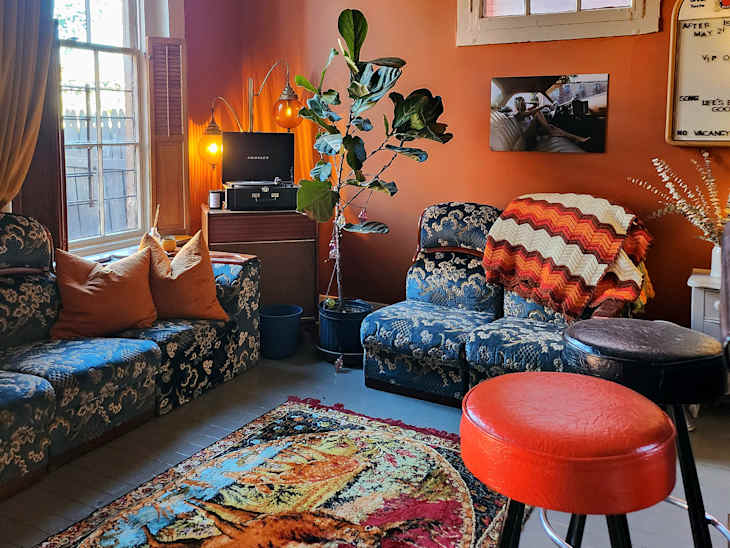
Whether your home has always had an extra room or you have a newly empty space, it can seem odd to have a room you don’t regularly use. As of 2023, there were more than 30 million extra bedrooms in homes across the United States, according to Realtor.com. Spare rooms feel like an artifact of earlier eras — a time when it was customary to host visiting friends and family — that somehow we haven’t stopped to question.
Why You Don’t Need a Guest Bedroom
The thing is, “the person you’d want to stay with you wouldn’t care if you had a spare room,” says Leidy Klotz, author of In a Good Place, and a behavioral scientist who studies how and why humans design. Whereas somebody who needs their own space, he tells me, “probably wouldn’t impose.” (I actually came to that conclusion myself a while back; keeping a “good guest room setup” on standby was one of the things I let go of after turning 50.)
Your Extra Space Is More Than a “Spare” Room
Even calling it a spare room is implying that it’s excess or “that it doesn’t need to do something,” Klotz explains. And “those mental labels become self-fulfilling prophecies that limit both our spaces and ourselves,’” he writes in In a Good Place.
Well, if you were waiting for a sign to reclaim your spare room, consider this it.
And that empty room is the place where you can — and should — break all the rules. It’s the one that visitors probably won’t see, where you can create a space of your own dedicated to, well, whatever you want. And where you can have fun! “I love to pack a punch in a small space,” says interior designer Sasha Bikoff, author of forthcoming High Vibe Design. When communal areas are a little bit more neutral, she says, the “smaller, more intimate places [can be] more extravagant.”

Why Selling in the Future Shouldn’t Hold Back Your Style
If you own your home, I can hear your concern already: But we can’t go all-in because of resale. Keeping your design choices bland if you think you’ll be selling your home in the foreseeable future may be the old conventional wisdom, but it just doesn’t hold up. Mentions of color drenching were up 149% in Zillow listings in late 2025, part of a bigger trend toward mood-driven escapes, according to the listing platform’s data.
And guess what? When I painted a spare room in my old house a vivid saturated orange, filled it with all things vintage — ranging from a floral velvet sectional to a leather bar to a rug emblazoned with straight-out-of-the-70s deer and landscape — it didn’t faze buyers when it came time to sell. Rebecca Fairman, an interior architect who specializes in well-being design and neuroaesthetics, says that’s because people respond to stories and spaces that actually feel lived in. “Humans recognize humans,” she says.
If you rent, you might wonder how far you can push your design. Thankfully, a lot of landlords let you paint walls as long as you return them back to the original color when you move out (just make sure you ask!), but you can also play with peel-and-stick wallpaper and bold decor and accents.
How to Embrace Making an Empty Room Your Own
Whatever you do in your spare room, your priority should be making the space work for you. “The first need that we have from our spaces is to feel like we’re in control of them,” Klotz says.
My husband and I certainly weren’t thinking about future buyers when we transformed our spare bedroom after our niece, who’d lived here for her senior year in high school, moved out. This marked a new chapter. The house was ours, and ours alone, and we needed a space to make that tangible in all its record player/macramé plant hanger/owl etched mirror glory.
And the “party room” that we created with its bold orange walls served a need far greater than holding a bed for a guest who may or may not ever stay the night. This one-time spare room was, at the unique moment in time that was summer of 2021, a recognition that we wanted to gather with people, play music, throw back a drink, and generally live our lives loudly.
No, it didn’t look like the rest of the house, and that’s okay. While a home should feel cohesive, “that doesn’t mean things need to match,” Bikoff says. “Each room is its own chapter.”

Give Yourself Permission to Have Fun with Your Spare Room
You could still feel like you’re going against the grain to dedicate what could be a guest room to a something entirely for you — but if the latter is what you’ll use more, then doesn’t that kind of make sense?
Fairman wants you to have “permission to be a little selfish.” Sure, the word has a negative connotation, but I’d argue your home is for you, so it should make you happy. “[W]e feel guilty in taking over that space for ourselves,” Fairman says. The reframe here, she notes, is homing in on “what really brings you happiness,” and your true identity. “I do think there are ripple effects … that then improve your relationships so that it’s not actually a selfish act, but it’s the whole ‘putting your oxygen mask on first’ idea so that then you can even … demonstrate to others the benefits of that.”
Swapping what could have been a spare room for one that was a (potentially inadvisable) aesthetic commitment — and entirely ours — was a statement. But if it inspired even a single guest, who came for a drink and not for the night, to look at an empty room in their own home differently, I’ll consider that my ripple effect.
Find all the inspiration you need to design your next act with Re-Nesters from Apartment Therapy and The Kitchn. This content was presented by a sponsor; it was created independently by our editorial team.