
One of the Biggest Cons at This Famous FLW Home Will Cost $7 Million to Fix
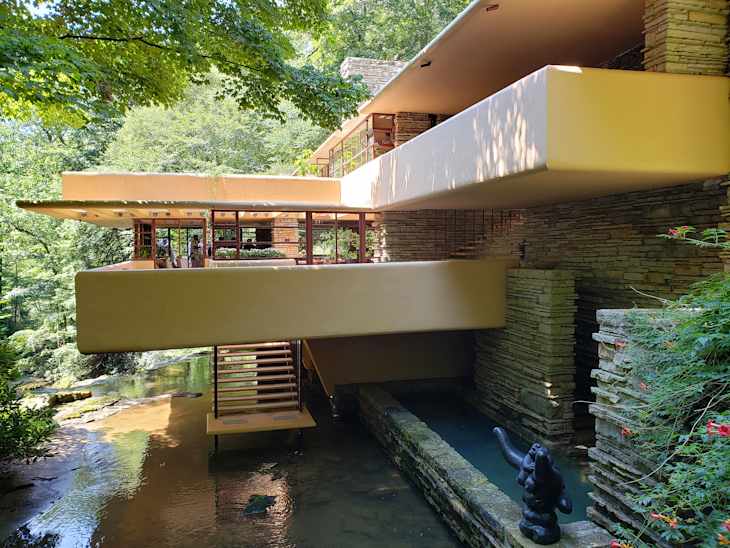
It’s a pipe dream of mine to one day own a Frank Lloyd Wright home — or at least a home with a similar vibe. But besides the fact that a FLW home going on the market is a very rare thing, and that every single FLW home on the market is out of my very imagination-based-only budget, some funny news stories have come out over the few months that reveal that it might be a little bit more work (and way more out of reach) than I could have ever imagined.
First there was the hilarious TikTok that revealed that in some Frank Lloyd Wright homes, dusting the more intricate glass window work is an endeavor that can take days, requiring tools as delicate as a Q-tip to ensure that the 100-plus-year-old glass (and 175 windows) don’t get damaged in the cleaning process.
And now there’s news that at Fallingwater, one of Frank Lloyd Wright’s most famous architectural marvels in Mill Run, Pennsylvania, built over a waterfall, it will cost $7 million dollars to repair leaks all over the home. Yes, $7 million.

The good news is that Fallingwater, which was built in 1936, is not owned by a private individual. It’s a museum, so the repairs don’t need to be funded by any one person. But still, they need to be done.
It turns out that, according to reporting done by The Wall Street Journal, the cost of the repairs are 40 times as expensive as it cost to build the home in the first place. The WSJ reporter joked that the process could be called “stallingwater.” (Ha ha ha!)
According to the reporting, because of the way the home was built, not just over a waterfall but in construction, the home is particularly vulnerable to leaks. The walls are “hollow masonry tubes” that were “filled with sandstone left over from construction” that have been settling over the past 9 decades, so now, water is collecting in those empty spaces.

On top of that, Frank Lloyd Wright apparently hated the look of copper flashing — a “lifetime” material that home builders put under roof surfaces and in construction to protect homes against, you guessed it, water leaks, so water is getting in that way, too. (Wright’s hatred of copper flashing is also reportedly posing a problem at the Guggenheim Museum in New York City.)
Don’t worry, though, there are fixes on the way. The restorers are using a “proprietary mix” of liquid grout to fill the leaks, re-caulking the windows and doors, and “replacing waterproof membranes on roofs.” And — when they have to — they’re using lead, not copper, flashing.
So there you have it — yet another reason the FLW homes are an unrealistic pipe dream for me. Add it to the list!