
Julia Chasman, a Former Hollywood Producer Turned Designer, Thinks Every Room Needs an “Anchovy”
We’ve scoured markets and feeds to spot the standout looks shaping home style next year. From "Soft Architecture" and the latest “it” shade of green, to shine-maxxing, and the vintage furniture everyone’s going to be shopping for soon, see every trend we're calling in our full New/Next List.
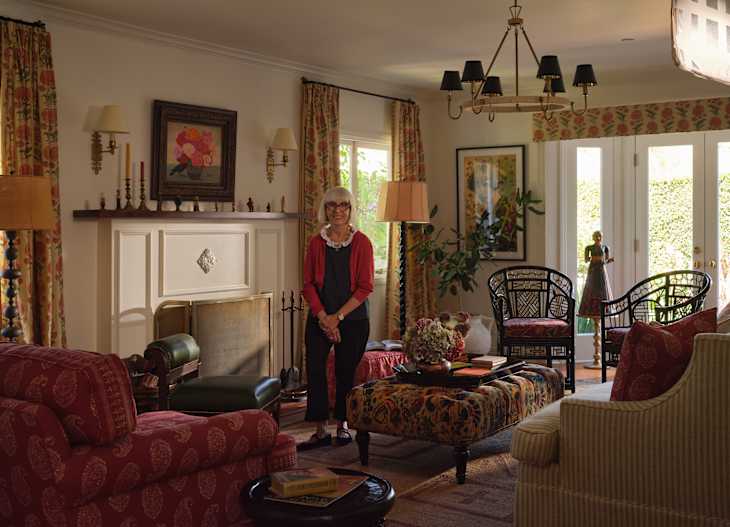
For decades, Los Angeles-based designer Julia Chasman told stories on film sets. Now she tells them through interiors, using antique furniture, bold textiles, and an “anchovy” or two (but more on that later). A longtime member of the Academy of Motion Picture Arts & Sciences, Chasman has borrowed her silver screen design approach and adapted it to her residential projects, creating her signature layered look that has a cinematic quality.
“In film we start with a script, a cast, location, and sets, and fine tune with lighting, music, costumes,” she says. “In the home space, we have a main design scheme, construction, architectural changes, selection of furniture and decor, and lighting and art to round it out.” Even scheduling and budgeting skills carry over — cutting a scene and nixing a new guest bathroom aren’t all that dissimilar. “Both processes can be painful but are full of joyful moments,” she says. “And in both jobs, I am working as a storyteller.”

Hollywood Taught Her How to Design a Home
That storytelling instinct is on display in two of her current Los Angeles projects. One is a lovingly preserved 1930 Mediterranean Revival in Hancock Park, finished in fine materials like limestone and hardwood, with a light-drenched living room that looks out onto a courtyard garden. The final touch? Restoring the octagonal fountain out front, which is being clad in handmade Ann Sacks tile chosen to echo the home’s interior colors. The other project is a full-gut renovation and expansion of a historic mid-century home in Glendale’s Verdugo Woodlands neighborhood, just two doors down from a landmarked R.M. Schindler house.
The homes couldn’t look more different on the outside and inside. But Chasman approaches all of her design work with the same philosophy: respect the architecture, layer in historical charm, and always leave room for a few surprises.

Designing with a Lifetime of Experience
Chasman first came to interior design in 2018, but that doesn’t mean she’s a late bloomer. “I think every designer comes with a tool box that’s a mix of life experience, education, travel, and natural taste,” she says. That perspective, combined with her ability to create mini-worlds for all different kinds of plots and settings within the movies, has helped her understand clients at every stage of life. She brings the same expertise and zeal to all of her clients, from young families making practical decisions to empty nesters rethinking how their homes can reflect a new chapter.
Around-the-globe travel has also been instrumental in shaping her design eye. After moving from New York to London as a child, she spent weekends combing the Portobello Road secondhand shops before discovering flea markets in Paris, antiques fairs in Italy, vintage stores in Lisbon, and, more recently, the Marrakesh souks. Today she still sources internationally whenever possible. In Los Angeles, she regularly turns to Obsolete Gallery for investment-worthy, storied pieces, and The Mart Collective for the thrill of the hunt.

Every Great Room Needs an “Anchovy”
If there’s a single hallmark to Chasman’s rooms, it’s a deliberate wrongness — one piece that doesn’t quite belong. She embraces the “every room needs an anchovy” theory popularized by interior stylist Mieke ten Have, who borrowed the concept from designer Thomas Jayne. “I love that analogy because humor or whimsy is a quality I cherish in design — something unexpected, seemingly at odds with the rest of the room, something that adds tension,” says Chasman. In a quintessentially “her” space, that may look like a child’s chair arranged among adult furniture.
That same willingness to take risks defines how she mixes furniture. “The only way to mix is boldly,” Chasman says. English Country antiques might share a room with Italian mid-century pieces, for example, which could also be mixed with carved Spanish furniture or African stools and textiles. For Chasman, there’s no formula beyond getting the proportions right. The result is rooms that feel collected over time and layered with history — frozen in a single period.

Luxury Comes from Layering
Materiality is key for her, too. Natural stone always wins over engineered alternatives, especially in kitchens, while handmade details — whether a custom dining table or a painted flea-market dresser — bring personality that money alone can’t buy. “If you can’t afford a top scenic painter, then use your talented daughter-in-law to do it,” says Chasman. That’s the perfect example of her resourcefulness.
While Chasman loves sourcing art and antiques for clients, she’s quick to point out the most meaningful pieces in a room are often the ones she didn’t buy. Paintings or other finds her clients have collected on their own travels, she says, can be the most personal additions to their decor, and she always prioritizes their placement.

Blurring Architectural Lines and Design Styles
Although she’s a native New Yorker, Chasman describes herself as a “die-hard” Angeleno after spending three decades in Los Angeles. “No other city has the variety of architectural styles and the unique interplay of nature with its man-made structures,” she says of her adopted city. She’s worked across Craftsman, Spanish Colonial, mid-century, and contemporary new builds. Each is an opportunity to blur the lines between the architectural styles and break the design rules a bit.
“I’ve found joy in erasing the lines that define each one, and melding elements of all of them, once a sympathetic restoration has taken place,” Chasman says. “A Spanish-style home is never just Spanish once I’ve updated it but is the best version of the original house it was when I’m done.”

The Next Chapter for Chasman
Chasman is currently wrapping up the aforementioned Hancock Park restoration and Glendale renovation. Welcoming new clients (in southern California and beyond) to her roster, she’s open to whole-home projects or smaller briefs, especially if it includes her design soft spot: kitchens.
Her dream project isn’t a house at all, though, but instead a boutique hotel or restaurant — places, she says, that people return to because they feel as welcoming and personal as home.
To meet the latest trailblazing design talent, check out the rest of our New/Next Designer List for 2026.