
5 Brilliant Ideas to Steal from Julia Child’s World Famous Kitchen
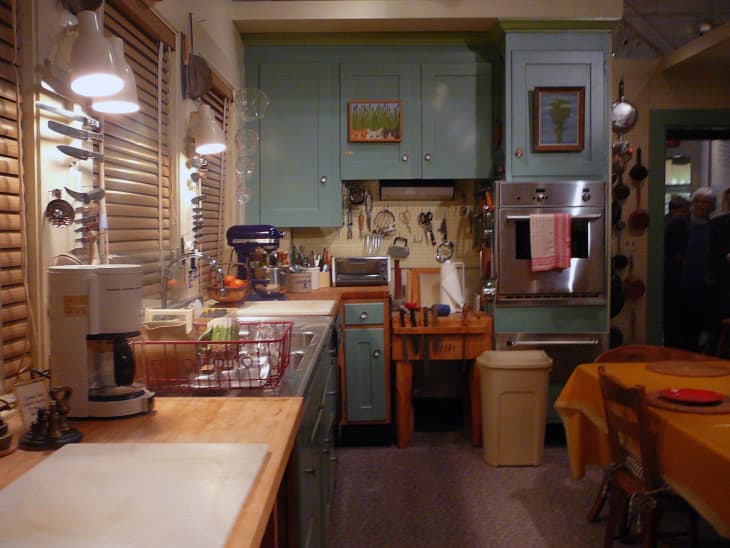
In 1976 Julia Child wrote an essay for Architectural Digest about her home in Cambridge, Massachusetts. In it she called her kitchen “the beating heart and social center of the household … both practical and beautiful, a working laboratory as well as a living and dining room.” Sounds so lovely, right?
We—as her humble servants, now and forever—can’t get enough of her kitchen either. Over the years, Julia’s famous pegboard has gotten a lot of attention, but there’s so much to learn from the rest of the kitchen, too. From how she set it up, to the amazing way she labeled her utensil crocks, to the copycat paint color we found for those iconic blue-green cabinets, here are five other things to take away from Julia Child’s kitchen.
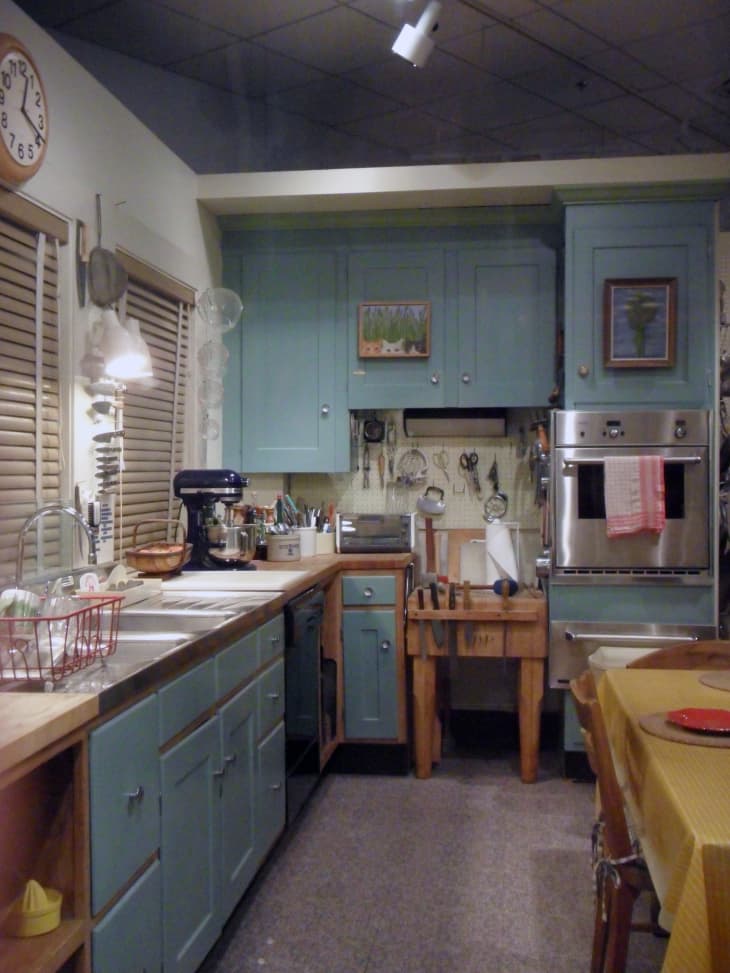
1. It’s okay not to be a minimalist
In general, we’re big believers in decluttering. We believe that counters should be clear-ish and that there are plenty of good reasons to pare down your kitchen belongings.
But if you’re Julia Child, to that you say…um, no.
Julia was a total kitchen maximalist. Throughout her cooking career, she was an unabashed collector of any smart kitchen tool, gadget, and small appliance that made cooking easier and more accessible (some of which she championed right as they hit the market, like the food processor). Rayna Green, the curator of the Julia Child exhibit at The Smithsonian, told The Litchfield County Times in 2010 that Julia “was a gadget freak and a knife freak, as she put it. She never met a knife she didn’t like.”
So if you’ve always inclined to stock up rather than pare down in the kitchen, you’re in good company. The key to this, though, is what happens next.
2. Store things out in the open
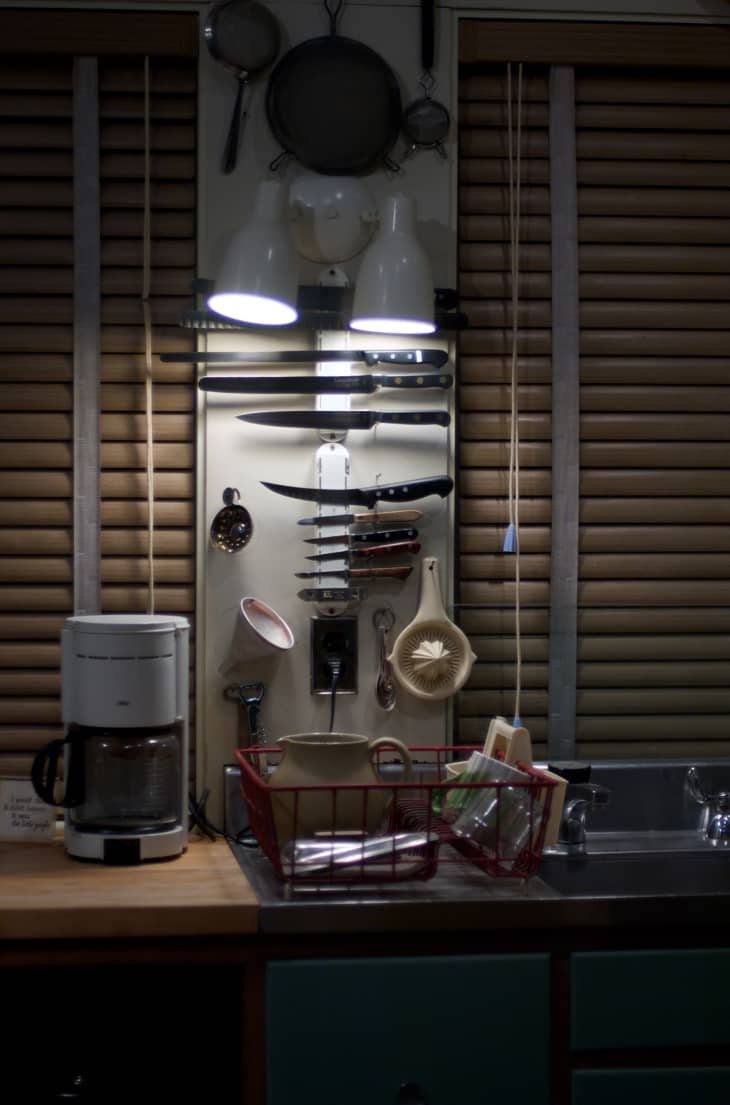
Although Julia was “always very quick to embrace anything that made sense,” Tina Ujlaki, executive editor at Food and Wine, says here, “she didn’t like clutter.” To keep things organized, Julia stored almost everything out in the open, either hung on a pegboard or stacked in a crock, and made sure every piece had a place near its work zone.
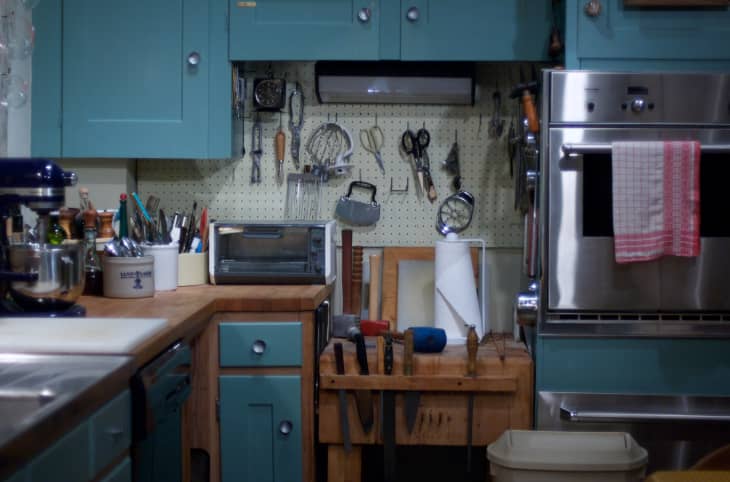
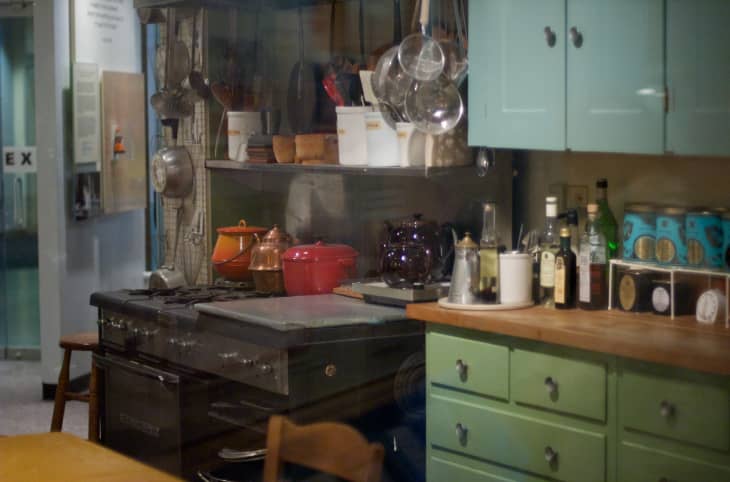
She placed large knives and butcher tools on the side of the butcher block (her prep surface), and hung her chef and paring knives on a magnetic knife strip over the sink. She stored her sixteen baking sheets in vertical slots in a cabinet right next to the dishwasher, kept all the silverware in containers out on the countertop (not in a drawer), stored her six rolling pins in a big copper pot, and all stirring spoons and wooden utensils in a ceramic crock directly behind the stove. With this method, stuff was out and available when she needed it.
3. Customize your kitchen workspace
Forget standard-height countertops: Julia had her maple countertops built two inches higher than normal—to 38″ instead of the standard 36″—to suit her 6’2″ height. If you have the means to customize your countertop, your height is a smart place to start. (The same logic applies to short people, too.)
4. Give your utensil crocks amazing names
A stainless steel shelf jutted out over Julia’s large Garland range, and on it she had four ceramic crocks for storing utensils and tools. Each of these crocks was labeled with a marker and masking tape. The labels were: the “Spoonery” for spoons; the “Forkery” for forks; “Spats” for spatulas; and “Wooden Things” for presumably all wooden things (spoons and the like).
On a related note: “Spoonery” is my new favorite word.
5. Paint really can make a big impact
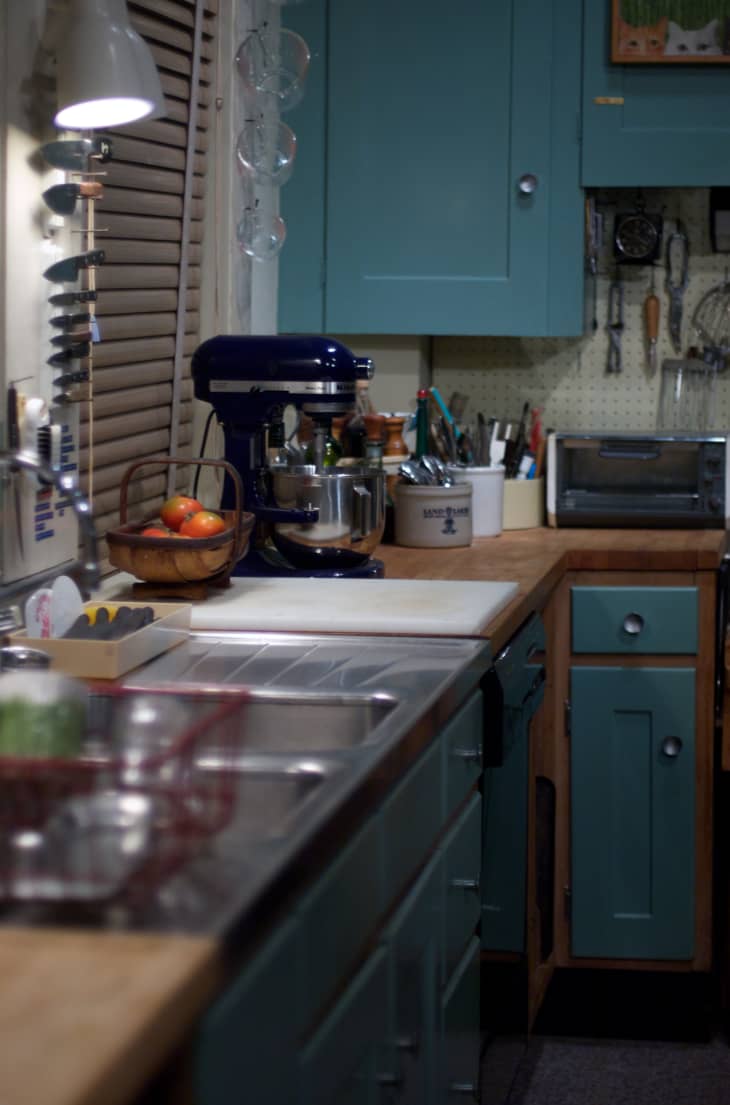
Rayna Green, the head curator for the Smithsonian exhibit, once said everyone wants their kitchen to look like Julia’s: “We wish we had a nickel for every inquiry we’ve had about Julia’s kitchen design!” she says. “We receive many requests for copies of her kitchen plans—sorry, we don’t have them—the names and numbers of her paint colors.” The color of the cabinets (that lovely blue-green hue) was chosen by Paul Child in 1961, and the specifics are lost to history.
But when Julia’s childhood kitchen got a makeover a few years ago, the designer found a paint color for the ceiling of the kitchen that is almost identical to the cabinet color in Julia’s famous Cambridge kitchen. The name of that color? Bali 702 by Benjamin Moore. So, now you can have a kitchen just like Julia’s.