
How ‘The Baby-Sitters Club’ Marries ’90s Nostalgia with Modern Technology
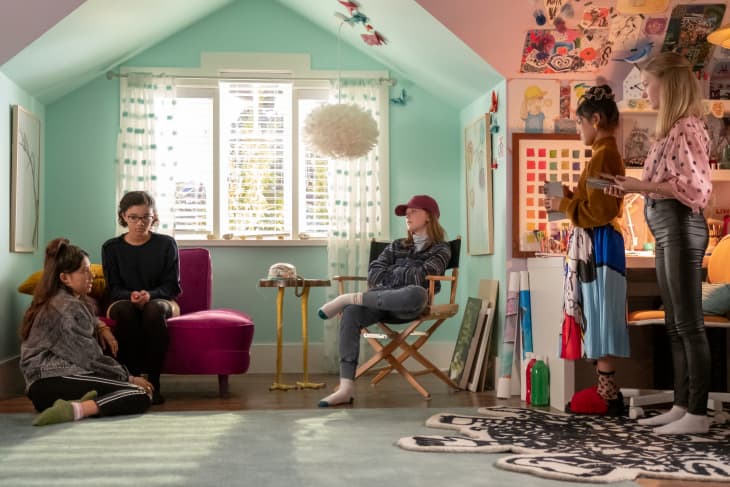
Have you heard? Word on the fictional streets of Stoneybrook, Connecticut, is that “The Baby-Sitters Club” series just hit Netflix. And as someone who grew up in the ‘90s and read my sister’s hand-me-down paperbacks, this news can only be described as totally rad.
The show reimagines Ann M. Martin’s beloved book series in the 21st century, where five of the original club members—Kristy Thomas, Claudia Kishi, Mary Anne Spier, Stacey McGill, and Dawn Schafer—live during a time when cell phones and scrunchies coexist. And undoubtably, one of the things that make me most obsessed with this new take on an old tale (and there are a lot of things I’m obsessed with) is how the crew married nostalgia and modern tech into the set design.

It can be argued that the process was more organic than you would think, with ’90s style coming back in recent years: Polaroid photos, pastel colors, paper flowers, see-through phones (okay, maybe that’s just Claudia… for now). And don’t get me started on the fashion.
Curious about the design process, I reached out to Lucia Aniello, Executive Producer and Director of Netflix’s “The Baby-Sitters Club.” How did they so seamlessly blend technology in the design? What thought went into Claudia’s room? Is there a character Aniello relates to the most? So many questions—and luckily, she answered them all.

Apartment Therapy: Since it takes place in 2020, how did you merge nostalgic design with today’s modern technology?
Lucia Aniello: Because the ’90s are back in so many ways right now, it was actually creepy how much stuff from then worked now. The only obvious difference is laptops and tablets. Plus, so much of New England interior design style is evergreen—craftsman houses with Stickley furniture, Cape Cod houses with walnut tilt tables with Tiffany-style lamps—why change a classic?!
AT: Did you have a relationship with the BSC series prior to being brought on to produce/direct?
LA: I was absolutely obsessed, and if there ever was a chance of me having a group of girlfriends like the Baby-Sitters Club, I absolutely blew it by spending so much time reading the books instead.
AT: As a BSC fan, how did you go about designing each girl’s bedroom? Where did you turn for inspiration?
LA: The books, naturally, but also Instagram and Pinterest to make sure it also felt current. We also wanted to make sure that each sitter’s personality came through in their rooms—part of what’s always been so fun about the books is that each girl is so different and has their own unique style (yes, even Kristy has a personal style).

AT: Claudia’s room was the popular hangout for the gang.
LA: It was definitely the one we spent the most time on—we wanted to give her a space for her art, clothes, and a mix of the art to feel like some she made and some was just stuff she liked and collected. A personal favorite was the table with the ostrich legs that the phone was on—I wish they let me keep that.
AT: What are some design elements that align with the books?
LA: They were mostly in Claudia’s house: a chair with a hiding space for candy, hollow books to hide Twizzlers, and pictures of Mimi. Also, the girls would never wear shoes in Claudia’s house, so we made sure to have an area near the front door for shoes.
AT: Any items you knew you HAD to keep?
LA: The phone!!! I believe our production designer Tink tracked it down on eBay and made a couple tweaks to make it camera ready.
AT: How about modern trends?
LA: Stacey’s felt the most trendy of all, squarely 2020—white, grays and pale pinks. I feel like Stacey makes trends and follows trends in equal measure.

AT: What are some of the challenges you faced when recreating the BSC bedrooms?
LA: We wanted [Claudia’s room] to not feel too staged—shooting five (or seven!) girls in a room means you want it to have dimension and color no matter which way you’re shooting, but you also don’t want it to be so zany that it’s hard to focus on the girls. Tink had the idea for that dormer window space that gave us an additional visual feature. We also needed a space Kristy could put her directors chair!
As for Kristy’s room, we wanted it to feel cramped because it was small and cluttered with hand-me-downs from her brothers in the books. But of course we had to make it a little bigger to accommodate a bunch of camera operators. Mary Anne’s needed to feel frozen in time until she gets up the courage to ask her dad if she can change it…within reason.
AT: Did Ann M. Martin have any influence on what the design set looked like at all?
LA: Ann mostly just gave feedback on scripts, and was very supportive when it came to updating some of the characters. And it was absolutely a highlight of my life to give her a tour of the set and the girls’ bedrooms. She is really the parent of the Baby-Sitters Club, and I consider myself just a babysitter, making sure it lives another day.
AT: Last but certainly not least, which character do you relate to the most?
LA: I don’t think there’s any female director who doesn’t at least relate to Kristy—she’s not afraid of calling the shots. But I also really relate to Claudia’s love of putting together fun outfits, and as a 13-year-old I was as boy-crazy as Stacey. I am also so inspired by all the teenage Dawns I’m seeing all over the country right now, standing up for peoples’ rights. Dawn’s my inspiration.