
I Turned My Plain Sidewalk into a “Joy” Stop — And My Neighbors Love It
I live in Portland, Oregon, where it seems like almost every street I turn down has a little extra whimsy in the form of Little Free Libraries. These mini libraries have evolved too, with little outposts of miniature art galleries, sticker exchanges, or some other free DIY art installations. Over the past few years, another trend has hit Portland called the Worldwide Sidewalk Joy Project, and it’s all about bringing community together beyond a book exchange.
What Is the Worldwide Sidewalk Joy Project?
The Worldwide Sidewalk Joy Project is a free community-driven effort to add whimsy, art, and playful interactions into sidewalks and communities for people of all ages to enjoy. It was started in Portland by artist Rachael Harms Mahlandt, who was looking for safe outdoor activities to do with her young kids in 2022. She decided to explore her city like tourists and discovered many obscure, delightful installations around town, like the Morrison Street Mini Gallery and the Tiny Creature Swap.
Inspired by these installations, she made a dinosaur diorama (aptly named Dinorama) at her house that quickly gained popularity and created the PDX map of sidewalk joy “as an excuse to get to know the people who made the other swaps.” Harms Mahlandt says that the connections between neighbors is her favorite part of these installations. “The news is really heavy, people feel really divided, and have a whinging belief in humanity. This counteracts that.”
From trinket swaps and puzzle libraries to Croc charm trades, mug exchanges, and mini art galleries, sidewalk joy stops are installed in front yards, on the sides of buildings, and in curbside gardens where people walking past are able to stop and access them for free. Thanks in part to many of these Portland installations going viral online, the Sidewalk Joy movement has gone global. You can search to see if there are any installations near you here, and even add your own, like I recently did.

How to Build Your Own Piece of “Sidewalk Joy”
In general, if you are setting up a sidewalk joy spot on your own property, and nothing you are distributing is dangerous, there aren’t a lot of rules governing them, but check your local district or city regulations to be sure. In particular, if you have any kind of HOA, you could run into issues if you don’t have permission to set yours up.
There is no right or wrong way to build your own sidewalk joy installation. You can also purchase wooden build kits online or at hardware stores. Or if you or someone you know is especially handy and crafty, you could do a full DIY build. Once you have your container figured out, it’s time to decide on your theme and what kind of joy you want to spread. If you want ideas or inspiration, you can check out the Worldwide Sidewalk Joy Project map.
One of my favorite sidewalk joy finds was a “ghost adoption” library where people could go and adopt friendly plastic ghosts. The installation also had handmade ink stamps to commemorate adopting a ghost. (It’s currently closed until October, but the ghost I adopted lives in my kitchen and I hope to go back and adopt another ghost friend next October!)

How I Built My Own Piece of “Sidewalk Joy”
I got divorced a couple of years ago and have spent a lot of time turning my home into a place that is all about fun and whimsy, where my passions and interests are centered, so creating some sidewalk joy on my street just made sense. I decided to create something fun for the dogs in my neighborhood that would bring joy to them while they are out walking with their owners.
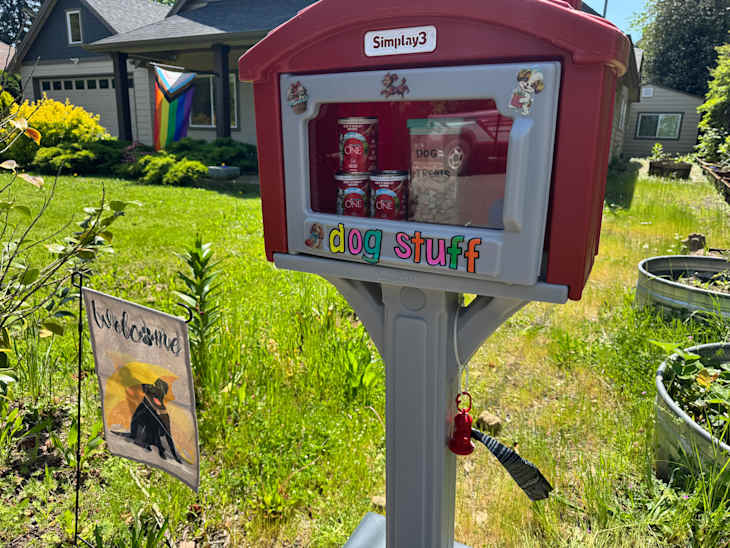
I’m crafty, but more in the paper craft and junk journaling realm. The idea of building a container for my sidewalk joy project was something I knew was outside my skill set. So I ended up purchasing the Simplay3 Indoor/Outdoor Plastic Mini Library.
It was affordable, the assembly was pretty easy, and all I needed was a screwdriver and a bag of playground sand to pour into the base to weigh it down so it wouldn’t tip over. In addition to the setup feeling within my limited building skills, I also appreciated that the plastic exterior would be pretty weather-resistant, which I knew would be helpful living in the Pacific Northwest, where the rainy season feels constant.
Once I assembled the mini library, I added colorful vinyl sticker letters so it would read “Dog Stuff.” Then I filled it with a container of dog treats to share, as well as some unopened cans of dog food and new tennis balls for any neighbors in need of supplies. My dog exchange box has been up for just under a month, and at first it wasn’t getting a lot of traffic on my quiet Portland street, but that has started to change. Now, it’s not uncommon for me to glance out the window and see people’s dogs pulling them over. It has clearly become a regular stop on my neighbors’ morning walks.
Across the street from me, my neighbors have a Little Free Library, and I love watching people cross back and forth, getting books for themselves and treats for their dogs. Just yesterday, I was unloading my car when I overheard someone commenting to the person they were walking with about how cute the dog stop was.
Harms Mahlandt notes that there are 1,800 people and counting who are “taking a risk and putting their heart out there,” by creating these beautiful spaces in neighborhoods not just across Portland but around the globe. The world is hard and full of so much uncertainty. Being able to add even a small amount of whimsy to my neighborhood makes me feel more connected to my local community.