
I Got Rid Of Unnecessary Kitchen Clutter in 15 Minutes, Thanks to This Decluttering Rule
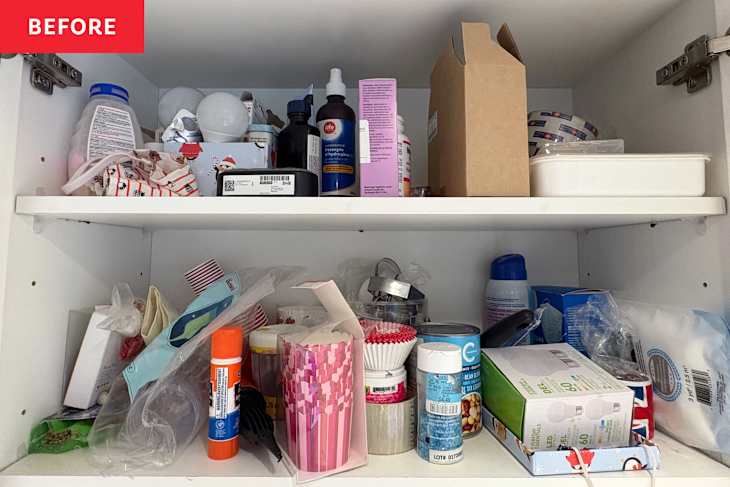
Every time I open my kitchen “junk” cabinet, I wonder how so much clutter — like cupcake liners I haven’t touched in years, glue sticks, and expired condiments — gets stuffed in there so quickly. I can never quite remember how it got to this state. And then, of course, there’s the issue of remedying the clutter.
It wasn’t until I discovered a brilliant decluttering trick right here on Apartment Therapy, which I’ve dubbed the “replacement rule,” that I learned how to tackle the mess awaiting me there every day — and I only wish I’d known it sooner. Here’s how it works.
What Is the Replacement Rule for Decluttering?
One of the best decluttering guidelines to follow is to ask yourself “would you replace this item if it broke or went missing tomorrow?” If the answer is no, then the solution is to toss it. If the answer is yes, then it might not be the clutter culprit you thought it was, and it’s safe to hold onto it.
Essentially, this “replacement rule” asks you to release the need to keep everything you’ve ever bought: Even if something is technically useful or in good condition, that doesn’t mean you have to hold onto it. It allows you to stop and contemplate just how important some of your clutter really is, which can be hard for anyone (ahem, me) who has a hard time letting go of items. As simple as it is, I knew it’d transform my kitchen clutter, so I had to put it to the test.

What Happened When I Tried the Replacement Rule to Declutter My Kitchen Cabinet
I was pleasantly surprised with the process and the effect it had on my cluttered kitchen cabinet. While my cabinet didn’t look too cluttered, there were several unnecessary items that I would never have replaced if they broke or went missing. First, there were fabric and disposable face masks galore from the COVID-19 days; I like to keep a couple on hand just in case, so I set aside a few and decided to toss the rest because I don’t need that many (and wouldn’t need to replace them).
Next, I rediscovered a lint brush that never worked all that well that I got rid of, next to a good lint roller that does work. I also rid the cabinet of plastic wine cups I know I won’t use anytime soon because I don’t drink often and don’t see myself repurchasing. The entire process took only about 15 minutes from start to finish, but could definitely take longer if you confront a bigger space with more clutter. At this point, I was energized to move onto another disorganized space.
Final Thoughts
Admittedly, I was wary of trying this method out — mainly because I knew it would probably work, and I worried about parting with some of my items. Turns out, I didn’t need half of them when I gave it some critical thought, and ended up clearing out nearly half of my cabinet. With what was left, it gave me an opportunity to reorganize in a way that made more sense.
My one piece of advice for this rule, and for decluttering in general, would be to not be too hard on yourself. The very worst thing that can happen is that you keep all of the items cluttering the space, which doesn’t make you any worse off than where you started. You might also find the replacement rule more useful in other areas of your home instead, so don’t feel like you need to force it. I’m so glad I tried it out, and I can’t wait to use it in another room.