
“Covecore” Is Your Newest Design Obsession — Get Ready to Cocoon!
We've scoured markets and feeds to spot the standout looks shaping home style next year. From "Covecore" to bold colors, stripes, and DIY projects, see every trend we're calling in our full New/Next List.
Amidst the ongoing chatter about “recession indicators,” there’s something inherently calming about curling up in a nook — whether it’s a nook for reading, bathing, or eating meals — and temporarily forgetting all your troubles. From beds and bathtubs to stove coves and staircases, alcoves are seemingly popping up everywhere in design.
What we’re dubbing the “covecore” trend, though, isn’t totally new. Alcoves, defined as recesses within walls enclosed on three sides, have been a design staple for centuries dating back to Roman times. According to Britannica, alcoves were commonly used as sleeping spaces in the drafty hallways of castles and monasteries during the medieval era. (Middle-Ages Modern, anyone?)

From there, this architectural detail evolved as a small space solution for apartments with curtains and timber partitions. No matter where you find one, alcoves run the gamut in terms of size. One can span an entire wall or portion of a wall; other scaled-down versions are compact and often feature shelving for displaying sentimental objects, knickknacks, and tchotchkes.
So why is your feed full of nooks of all kinds again? I spoke with six designers to find out why the alcove, despite never truly disappearing from homes, is running it back big-time in design right now.

Making a Case for Covecore
Designers and content creators Barry Bordelon and Jordan Slocum of the Brownstone Boys are big alcove advocates. Whether you’re looking to create an interesting moment or add an architectural detail in a run-of-the-mill space, an alcove is always the correct answer in their home renovation playbook. And it doesn’t matter whether the alcove has a classic arched opening or features an enclosure with right angles.
“They’re a beautiful way of highlighting a piece of art or a memento — I think it not only adds value to that specific special piece but can also expand the design of the space wherever you’re doing it,” says Slocum of alcoves. “Anywhere and anytime you can put one in, go ahead and put it in.”

One of the couple’s favorite alcove types is the “coffin corner,” which Bordelon refers to as the “OG nook” in the stairwell of many historic brownstones from the Victorian era. (He insists that it’s the perfect spot for a floral arrangement, but a sculpture works here, too, as shown just above.) Slocum recommends bathroom nooks as a storage-savvy hack for concealing all the daily essentials from your top shelf. “Sometimes you can even hide [the nook] with a recessed mirror,” he adds.

Designer Sarah Sherman Samuel agrees that nooks are “great in areas that might otherwise be considered unusable.” Think: beneath a staircase or under a sloped ceiling. Even though it’s a small detail, a nook, she says, can bring a lot of functional character into a space.
As far as alcoves are concerned, Samuel is “very pro alcove bed,” especially for kids’ rooms (see an iteration of her son’s room above) and guest bedrooms. “It’s not a situation you want when sharing a bed, but if I’m sleeping alone or want to take a nap, I’m picking the alcove bed,” she says.

Samuel’s Mediterranean-inspired home in East Grand Rapids, Michigan, is full of prime alcove examples. “I recently installed one in our guest room, and it’s where I retreat to if I get the chance to take a nap or read a book,” she explains, as shown here above. “We enhanced the cocoon-like coziness by wrapping the entire room in a deep, earthy desert red from our Color Atelier collection and hanging drapery in front of the bed in the same hue.”

How Different Types of Alcoves Make a Space (and Its Inhabitants) Feel
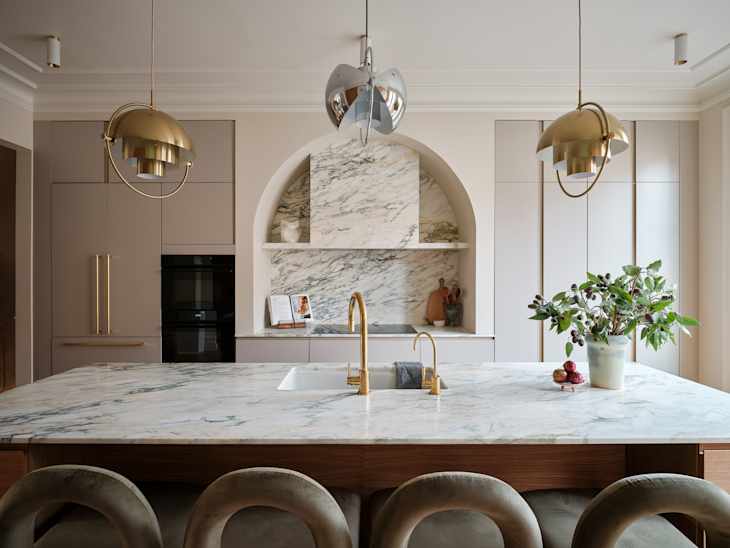
While most alcoves are created for functional purposes, Bordelon says they “can be aesthetic,” too. For example, when renovating a Carroll Gardens brownstone, the design duo added a stove cove to the kitchen for a touch of elegance that complemented the Parisian theme of the home (though with a few recessed shelves for spices and the like, a stove cove can become a stealthy spot for storage).
For some, it’s more about the feeling an alcove creates. According to designer Melissa Lee, founder of Bespoke Only, more clients are requesting reading nooks so they have a private place to perch in pleasurable solitude.

“Reading is often a solitary thing, you don’t share that with people, and it’s meant to be in this place that you can really be enjoying your own little world,” she says. “With an alcove reading area, you can really block out the distractions, be in your own zone, and go into your book.”

However, a nook of one’s own is so much more than a symptom of “main character syndrome.” Lee emphasizes that the “covecore” trend has become a clever way to foster an unstimulated environment for kids to focus in their rooms.
Parents are using reading nooks to break through the digital noise and cut back on screen time. “It’s like a gentle, loving, friendly timeout,” the New York City-based interior designer says with a wink.

Curating a Taste for Small Spaces
Not only does a nook provide a moment of respite from sensory overload, it also evokes the feelings of warmth, ease, and protection that smaller spaces inherently tend to embody. “It’s very cozy and really helps provide a sense of safety — it’s almost like a weighted blanket,” Lee insists. “People tend to feel calmer when they are in a smaller space.”
Samuel points out that nooks are a wonderful way to cultivate a sense of intimacy in a room, especially within larger spaces like her own 5,000-square-foot house. “We are always looking for a sense of safety and retreat in our homes,” she says. “By re-thinking overlooked spaces, we design with both practicality and imagination, creating moments that offer function and a sense of escape.”

Designers Levi Faber and Audrey Hughes of Faber/Hughes recently finished working on a dessert shop located on the Upper East Side (shown just below) that is nooked to the brim like a museum vitrine. “We designed the millwork to perfectly fit each candy bin so every sweet is illuminated, making the display feel more upscale,” Faber says. “We like nooks because when done well, they can feel especially considered and a bit unexpected. If you’re limited on space, like many of our New York City clients, nooks can also help maximize interest in the smallest spaces.”

Hughes also suggests that alcoves are reminiscent of traditional shingle-style homes. In this way, they recall and project the comfort of an English cottage with a coastal grandmother (or fisherman) aesthetic.
“They can be a cozy, intimate way to optimize a small home or program small or irregular leftover spaces in an older house,” she adds. “Built-in furniture can turn a leftover, unused space into a thoughtfully-programmed nook.”

More Privacy (and Peace), Please!
So what is the driving force that’s pushing the “covecore” agenda? Lee suspects that more people are currently craving a room-within-a-room moment at home as a way to detach from the overwhelming sociopolitical climate. Faber thinks alcoves are on the rise as more people yearn for privacy within open floor plans that combine kitchens with dining rooms, living rooms, and everything in between.
Bordelon agrees with both these notions. He also suggests that the appetite for creating a real sense of space might be another manifestation of the post-pandemic era.
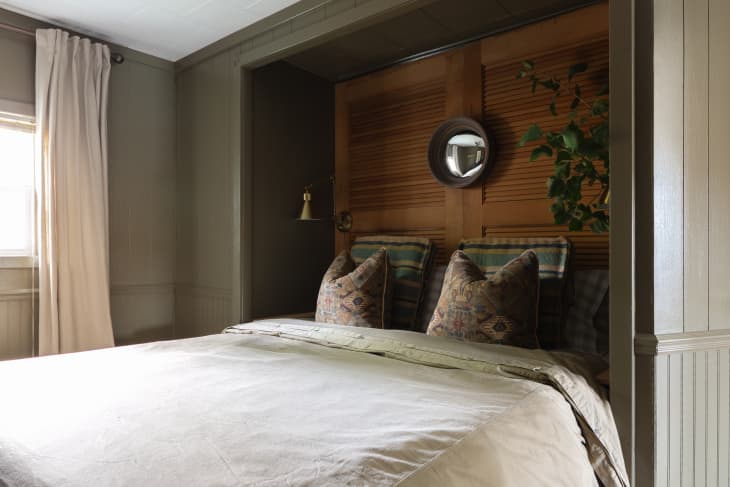
“If you have a studio apartment and want to create a sleeping alcove, it’s so you can have some separation between your sleeping space and your living space,” he says. “I think now we are coming back to being very intentional with that design down to the stove cove … I hate when there’s a huge bathroom and a toilet is just sitting there — like, he needs some privacy.”
So whether you’re yearning for a moment of peace, privacy, or just a bit of extra coziness, covecore can help you find a comforting retreat within your home.