
Why My Husband Swears Ironing Is Better than Using a Steamer
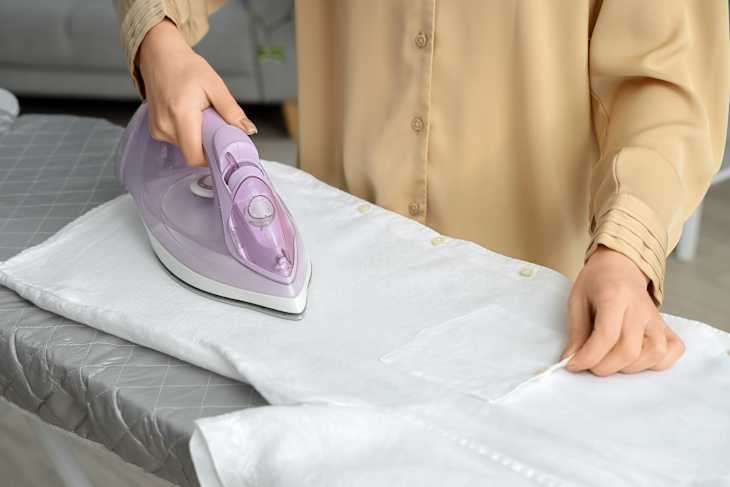
I’m not sure when, but at some point the millennial generation (and younger) quietly disavowed ironing clothes in favor of steaming them. In fact, roughly 30% of 18- to 34-year-olds don’t own an iron and have never even touched one before, according to some reports. On the other hand, garment steamers are known to be quick, efficient, and in-demand — so much so, that its market value continues to rise with many favoring steaming over traditional ironing.
But my husband feels differently. He seems to be the only person our age I know of who, each morning before work, still breaks out the trusty (inevitably stained and decrepit-looking) ironing board to crisply flatten anything that needs it — even jeans.
Why? As a former uniform-wearing member of Junior Reserve Officers’ Training Corps (JROTC), he has his embedded ways and reasons. And to be honest, they would convert me to being an iron-user if I didn’t already have him to do it for me. Here’s why he prefers ironing over steaming his clothes.
Ironing actually takes less time than steaming.
Steaming is often touted as a “quicker” way to de-wrinkle clothes, but if you’re working with a handheld steamer, which most households will have instead of a commercial-sized one, you’ll spend more time unscrewing it, refilling it with water before most uses, and then waiting for it to heat up. Then, as a safety function, the steam intermittently stops every few minutes, which results in more waiting and, in my husband’s opinion, not nearly as good of results. By the time the steamer spits out its second or third round of good heat, he could have a button-up crisply pressed.
The fact that we have a mini ironing board hung over the iron in our laundry room is helpful, too, because it doesn’t require wrestling a large piece of equipment. But, in his opinion, a board is crucial because “the shape makes it easy to lay out sections of a shirt really flat, so you can iron it well.”

Ironing simply works better.
Steaming is known for its efficiency, but ironing delivers on quality. “Steaming just lets the wrinkles fall, but ironing gets a crisper finish,” says my husband. Of course, that attention to detail was expected in the form of “military creases” in his JROTC shirts. Those three creases in the back and two creases in the front going down the middle of his button-ups simply could not be achieved with a steamer.
And although he doesn’t technically need to go “military far” in his day-to-day ironing now, the precision still carries over. And let us not forget that an iron does use steam, so using one offers the benefits of both tools.
Our iron, the Black and Decker Easy Steam (which we’ve had for years), has both a steam and a sprayer mist function that disperses water evenly — no risk of splattering your clothes with excessive moisture. He uses one or the other, depending on how wrinkly a garment is. On a deeply crumpled piece, he’ll spray it down lightly with the misting function to get a transformational first pass. Then, he’ll do the finishing touches on dry material.
The steam function comes in handy when he really wants to impart a dry-cleaned-esque finish. The final pass with a few steam puffs really locks the work in place, he tells me. He even has a technique for ironing a shirt collar: First he unfolds it, sprays it down, and irons it flat. Then he folds it down properly, steams it, and irons directly on the crease to secure it in place.
Ironing is versatile, customizable, and material-safe.
My husband irons most things on the cotton setting, which is usually an iron’s highest temperature. But it is worth lowering for other materials like silk or polyester — something you can’t do with most steamers. “It’s just a feel-for-it kind of thing. If you’re ironing something on a lower setting and it’s not working, just turn it up a little bit,” he says. “I’ll iron just about anything.”