
What Ruined Our Marriage Made Us Perfect Roommates — For 16 More Years
In After the Split: Apartment Therapy’s Divorce Issue, we’re spotlighting stories that explore what life at home after divorce can look like, whether it’s reclaiming your space or beginning again somewhere new. Read along here.
My ex-husband Yash and I have shared a two-bedroom apartment for 23 years — 16 of which we have been divorced. We failed at marriage, but damn if we don’t make good roommates.
I am a professor at NYU. Yash works in a high-end restaurant as a career waiter. I work late afternoons, while he works nights. We are not quite ships passing — more like a night owl passing a vampire. When we were married, this was an enormous problem. We never went out with other couples or had dinner parties together because he was never available after 5 or 6 p.m. I went everywhere by myself: theatre, films, museums, opera. Even our vacations did not align, so I traveled alone. It is ironic that one of the things that ruined our marriage — opposite schedules, which meant we rarely saw each other — was the exact reason we could happily cohabitate for two-plus decades, almost twice as long as we were wed.
“Do you think we will always be in each other’s lives?” I have asked Yash this more than once. “Yes,” he always says. “Yes.” I want to believe him, but as our living arrangement is about to end, I wonder.
Why I Chose to Be Roommates with My Ex-Husband
This is not the first time I have written about my living situation, which is unusual even by modern standards. In 2011 I had a piece published in Modern Love, a weekly New York Times relationship column. Mainly it dealt with the anger I had toward my then-husband during our failing marriage, and how that anger dissolved after divorce. What I did not consider was friendship.
After our divorce, which was surprisingly benign, I looked for another place to live. At some point during this process Yash asked me, “Why not stay?” I no longer remember why I said yes, except that the rent-stabilized apartment was in both of our names. Rent stabilized leases are like gold in this town; there are approximately 1 million left, out of about 2.3 million total rental units city-wide. Every year our rent goes up between 1% and 5%, voted on by the city council. It is a protection of sorts; for example, the landlord is not legally allowed to raise the rent a thousand dollars simply because the area gentrifies. This is how working people can afford to live in the city. In order to take either of our names off said lease, both Yash and I would have to write letters to our landlord stating as much.
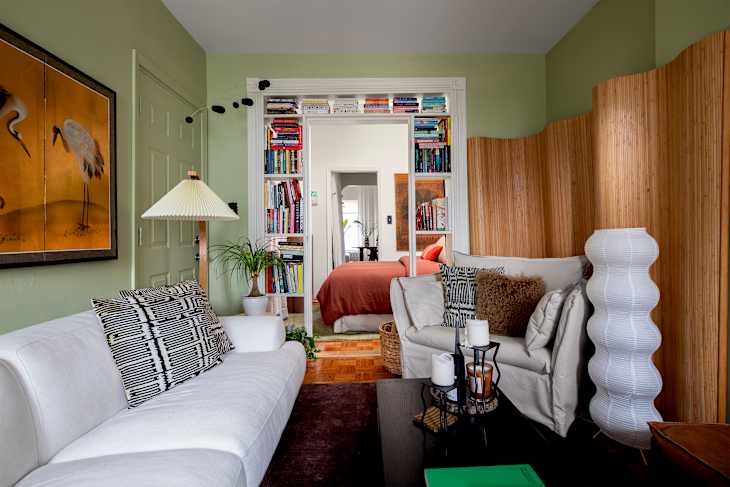
The apartment is also on the Upper West Side (a convenient location for me), we had three cats, and there was no animosity between us. And I really loved the apartment. It’s a railroad flat with a kitchen painted turquoise, a library/wreck room (that spelling is deliberate) in a tomato soup red color, and the sitting room and bedroom are in a color my grandfather called sandalwood that reminds me of sunsets in Italy. I have done exactly what I wanted with this apartment, and living in this space makes me happy. Writing and holding writing workshops in the sitting room, cooking in the kitchen, decorating the whole home to my heart’s desire (Yash gave me his blessing to do as I wished, as his decorating ethos was cardboard boxes dotting the periphery of white rooms) — all made me happy.
Our Marriage Ended, but My Feelings Didn’t
So many people have asked me, “Why do you live with your ex-husband?” If I had to distill it, I would say this: My feelings about the marriage changed after the divorce, in that it was really over, but not my feelings toward Yash. I loved and still love him. We were like-minded politically, intellectually, food- and sports-wise, culturally — we had a lot of intersectional commonality. We had always been friends.
Joan Didion said that marriage isn’t just about love — it’s about time and memory, the accumulation of a shared life. Yash and I have known each other since 1999. I sat shiva for his father’s funeral. I sat shiva and spoke at his mother’s funeral. During that particular shiva, I made myself useful by handing out plates of food, pouring coffee, serving dessert — to the point where Abby, Yash’s sister, said I should rent myself out as a “shiva shiksa.”
Yash has met my errant father, about whom much ink has been spilled. He sat with me in the Quincy, Massachusetts, kitchen of my grandfather’s house when he was in deep mourning for my grandmother. Like a champ, Yash ate the two plates of burned pasta that my grandfather had proudly made himself; I only ate one. When my grandfather took my hand, walked me to the stovetop where a white candle was burning, and said, “I light this every day for Nonna,” with tears in his eyes, Yash was beside me.
The Ground Rules of Living Together While Divorced
Yash and I had gone through three rounds of marriage counseling. We separated, and then got back together. We had tried everything we could to make the marriage work. The divorce changed me profoundly in the following way: I no longer had romantic notions about Yash. That part of my life with him was over. We might have failed as husband and wife, but we made great roommates. And here we are, 16 years later. How does this work, exactly? Mutual buoyancy and ground rules.
No overnight “guests” was the main one. But Yash did not date anyone, and I mean anyone, for the better part of 15 years. He said it was a combination of self-sequestering as a hermit, and carrying something between a latent and a dormant torch for me. This never really manifested, though. I think Yash knew that despite this torch, nothing about our lives or the dynamic between us that wrecked the marriage had changed.
On Sundays, the one day off we have that coincides, we catch up. We talk about our respective week, leading to many a “can I tell you something?” or “oh, I forgot to tell you,” while half-watching a baseball or football game. We tell each other our stories and even have dinner together twice a month. I cook often and leave half for him. It would not occur to me to do otherwise.
We share chores: dishes, trash take-out, litter box, cat feeding. However, he works longer, more laborious days than I do. I can clean a room faster than he can. Yash does the bulk of the grocery shopping, which I dislike doing. We play to our strengths. Yash’s temperament is different from mine in the respect that he has an inordinate amount of patience. He is also very smart. I have asked him to read my work on a regular basis.
I know and Yash knows that we are incredibly lucky. This is a city of over 8 million people. It makes you feel bad if you are not doing something every night of the week. In this respect, it can make you feel very lonely. We have kept each other from being lonely for 23 years.
It’s Time for Us to Move On
We have also known that inevitably one of us would fall in love with another person. One of us would eventually leave the lovely Upper West Side apartment. And 23 years later, it’s happening.
I am getting married in August to a man I have known for a decade. We met on a plane, fell in love — another story for another time. As this kind of love goes, we are planning to move in together, into a townhouse, a place that we are transforming into our home. Yash has fallen back in love with an ex of his — a woman he knew before me, 25 years ago. She resides in another country, but the plan is for her to eventually come here and replace my name on the lease.
The day we first walked into that Upper West Side apartment, it was empty and white and full of light. It became a place filled with life — a full life. When I think of leaving this apartment, a place where I was happy for 23 years, and leaving my living situation with Yash, pangs of pain make my chest ache. Despite this, I would not have chosen differently. Yash and I have a shared history of time, memory, love. Of friendship. I will take all of that with me when I go.