
I Asked AI to Make Over My Bookshelf — Its Suggestion Was Too Good to Ignore
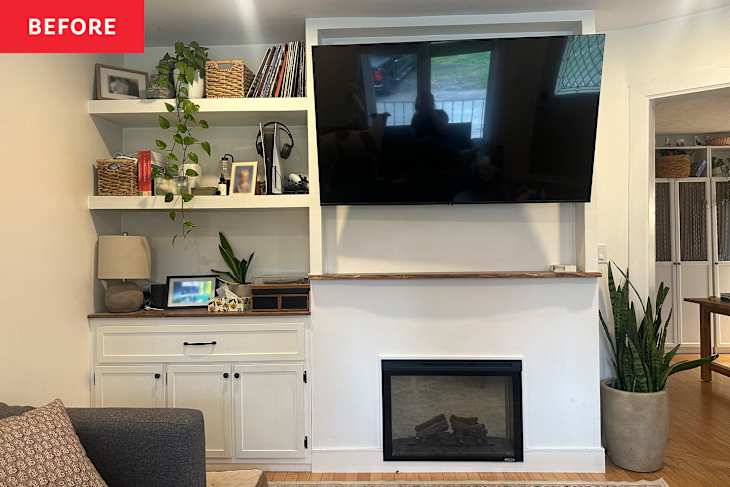
I love a good shelf styling moment. Stacked books, thoughtfully chosen decor, and a collection of prints and family photos arranged on display is such an art form — and it’s a careful equation that I firmly believe design pros have to master. When it comes to styling my own shelves, though, I don’t feel as if I’ve cracked that code just yet. I’ve pinned what feels like a million Pinterest ideas, hung onto cutesy decor that’s also personal, and tried my hand at arranging the perfect vignette — all to no avail. Something always seems to be missing — especially with the built-in shelves in my living room, where I have an opportunity to wow guests.
In this room, blending form and function on the shelving is key. This is also where a host of unaesthetic items — including an internet modem, TV remotes, and my husband’s PlayStation — all live. Working around those makes my situation feel extra-challenging and overwhelming, so I’ve largely left it untouched over the past few years. But with the holidays approaching, I felt it was the perfect time to give this corner of my living room a fresh new look. Stumped for ideas, I begrudgingly turned to AI for inspiration. And I was surprised in what happened next.

I Turned to ChatGPT, Gemini, and Claude for Advice — And Wildly Different Tips
I don’t use AI much — but when I have, I’ve usually turned to ChatGPT, so it was my first choice. But out of genuine curiosity, I decided to test a few different platforms to see whether and how the advice would differ. And boy, did it differ! I used the same prompt for all three platforms: “I want to restyle this shelf to look more aesthetic. I’d like to incorporate a winter/holiday seasonal touch, but keep it minimalist and timeless. Can you generate some inspiration photos?”
In hindsight, I think my prompt may have been a bit misleading. I was looking to keep the holiday decor minimal, but I fear that didn’t translate well based on the query I created (Gemini can attest to that). In any case, I made it work. Alongside each prompt, I uploaded a “before” picture of the shelf.
My Shelves Were Becoming a Bit Cluttered and Messy
While there are some items I can’t move on the shelves (the PlayStation and modem, for example), I didn’t include those instructions in the prompt. Instead, I wanted to see what the platforms came up with and then use the inspiration photos to create the best look for my space. I also knew I wanted to stick to using decor I already had at home — no shopping trips allowed! So I was interested to see what I could achieve. Here’s what each platform created for me.

ChatGPT
This is exactly the type of inspiration I was hoping for when I started. I particularly appreciated that the platform offered a few different options with slight variations. That said, ChatGPT always has a way of throwing size and proportion off a bit — and the images always look heavily filtered and altered, which can feel unattainable when it comes time to actually execute.
Nevertheless, I preferred the options it gave me, and I made sure to remind myself that whatever I did wouldn’t look the exact same as the renderings. A strong start, and one I that I saw myself coming back to. I was feeling particularly drawn to option three or four, even though I’d obviously never do something as silly as lighting an open candle beneath the top shelf. The lighting suggestions were valid, though!

Google Gemini
There are few words to adequately express how much I hated this. Gemini totally missed the mark. I even tried adjusting my prompt a bit, as it clearly focused too much on the “minimalist” part — but the subsequent mockups weren’t much better, although I do appreciate that the actual base image still looks like my living room.
I quickly gave up and moved on to Claude.

Claude
It turns out Claude can’t generate custom images, at least not on the free version of the app I was on. Instead, it pulled a few inspiration images from the web and offered guidelines and tips to help me create the look I wanted for each shelf.
Sure, this guidance was somewhat helpful, but not exactly what I wanted this time. As a visual learner, I really felt I needed the inspiration image to guide me!
How I Implemented ChatGPT’s Design Tips
For me, ChatGPT was the clear winner of the bunch. After studying the inspiration images, I quickly got to work resetting my shelves and preparing for new decor for the upcoming holiday season. This involved taking everything off the shelves and giving them a much-needed wipe-down. Then, I slowly started redecorating.
First, I put back the items ChatGPT seemed to appreciate, as they were included in the mockups. This included the lamp on the bottom shelf, the framed picture, a potted plant, and the wicker basket on the top shelf.

Adding Holiday Decor into the Mix
Next, I dove into my home decor stash. Fortunately, I have a solid selection of holiday decor, plus a growing collection of vintage and antique goods I’ve been steadily thrifting. I managed to find most of the pieces ChatGPT suggested in my own collection — including brass candlesticks, a wintry piece of artwork, tonal books for stacking, vases and pots, white ceramic Christmas houses, and even seasonal greenery and stems (foraged from my backyard!), and I made adjustments as needed.
Notably, I had to incorporate the PlayStation and internet modem, which I left on the middle shelf. It’s not necessarily pretty, but it’s part of our everyday life, and you need to account for that in any home design or restyling moment. In the end, this is what I came up with.


The Bottom Line on Using AI to Fix a Design Problem
In the end, I’m happy with the final restyling result — and I think leaning on AI helped me get there. Being inspired by someone else’s home is one thing, but being handed a blueprint to follow for your own space is totally different. Fortunately, by pure happenstance, I already had many of the items ChatGPT suggested; otherwise, it would have been harder translating the inspiration into the final look.
All in all, I feel like using AI for this restyling project helped me overcome a mental block I was experiencing when decorating this corner of my living room. Hopefully, I can use this blueprint moving forward to create new vignettes for the space to suit any season.