
How a Designer Used Bold Stripes (and ChatGPT!) to Transform Her Entryway
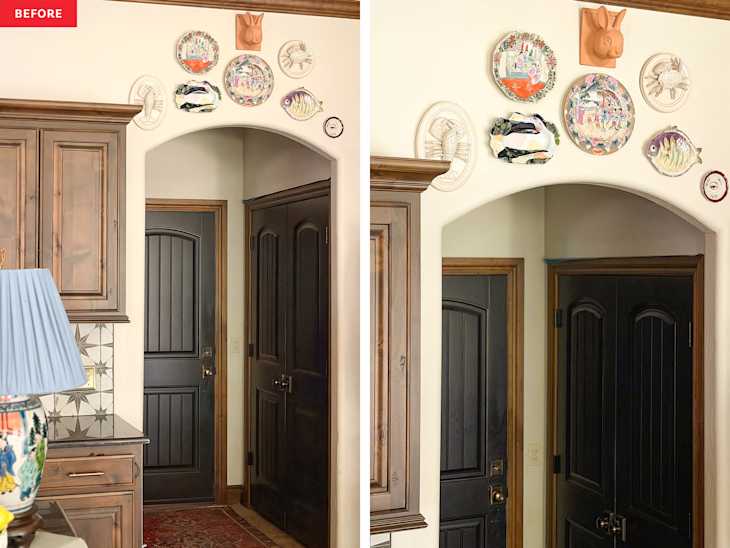
It’s true that creativity can be the basis of great interior design, but sometimes technology comes in handy to help bring everything from passing thoughts to our wildest daydreams to life. That’s especially true for Natalie Turner, principal designer and founder of Oklahoma City-based design firm Dovetail Studio, who used ChatGPT to help visualize an idea she had to add what she calls “extra detail” to the doorways of her own home. Starting with a side entryway that opens up into her kitchen, Turner initially wished to call attention to the romantic archway that helped define her home’s layout by creating a showstopping focal point with bold, circus-chic stripes.
But it wasn’t until she asked AI for a rendering that she realized her painting technique could be shifted to help save time and make this DIY so much easier. “For this project, I already had the idea of incorporating bold stripes into this archway — AI helped me visualize how that might look before committing to paint,” Turner says, adding that she often uses ChatGPT to create visuals for clients so they can see her ideas mocked-up versus just as written proposals. “When planning the stripes, I wanted to be mindful of existing architecture, including rounded bullnose drywall corners … I wanted the pattern to be visible and make an impact.” Her solution? To extend the stripes onto the nearby wall.

Why Circus Stripes Turn Heads in Any Space
Stripes have been dominating spaces for a few years, thanks to the playful effect they create. The pattern can help homeowners showcase more personality in any room by creating an expressive layer that works well with many styles, which is why interior designers have leaned heavily into the trend itself. “Stripes are a wonderful way to embrace personality; they can feel traditional, whimsical, or incredibly sophisticated depending on how you use them. They bring structure to a space while still allowing you to have fun,” Turner explains. Their versatility is a big part of why they’re popular: Stripes are nostalgic, but their repetition also makes them easy to incorporate into rooms that already have multiple textures, patterns, and colors in play.
“I think it’s all about finding a balance … I’m not afraid of mixing patterns, colors, and textures, but I do think there needs to be something that ties everything together,” Turner adds. For her own makeover, that meant sticking to a simple palette of black and a warm neutral — one that was already cohesive with the rest of the home as it was. Turner’s ChatGPT renderings included a slew of paint options, but she ended up choosing the same color already on nearby walls to ensure these stripes made a statement (and not a clashing color story!).
How She Created a Chic Entryway with Half the Effort
To define her distinctly dark stripes, Turner maintained the same paint color she had in her nearby kitchen (Sherwin-Williams’ Natural Choice (SW 7011) rather than adding another hue into the mix. Her stripes — painted in Sherwin-Williams’ Tricorn Black (SW 6258) — created high contrast all on their own, and the decision essentially cut her painting job in half. She then chose a stripe width that accentuated her trim and baseboards: “I wanted something bold enough to make a statement without feeling too busy, so I settled on a width that felt balanced with those architectural details,” Turner explains. “That’s important when working with any bold pattern. The scale should feel intentional and complement the architecture rather than compete with it.”
When it came time to paint, Turner says the secret to achieving professional-looking stripes was all in the preparation. “Good-quality painter’s tape is incredibly important, but my biggest tip for getting crisp, clean lines is to seal the edges of your tape with your existing wall color before applying the contrasting paint,” she says. Turner first painted along the tape edges using additional Sherwin-Williams’ Natural Choice, sealing any tiny gaps where the darker paint might otherwise seep underneath. Once that layer dried, she applied Tricorn Black, creating clean, defined edges between the two colors. It’s a crucial technique when working with dramatic contrasts, where even the smallest paint bleed can become noticeable. As Turner puts it: “Sometimes the smallest details in your preparation make the biggest difference in the finished product!”


How to Nail the Look in Your Own Home
Don’t have an archway at home? That’s OK — you don’t need any special or dramatic features to pull off chic stripes. Experiment with the pattern on a smaller scale: Paint an accent wall, add the motif to the back of a bookshelf, or lean into dressing up an existing piece of furniture in striped upholstery. Turner says peel-and-stick wallpaper could also work. “You could cut the wallpaper into individual stripes and apply them to an existing wall or architectural feature,” she explains. “It’ll give you a similar effect without committing to painting the pattern directly onto the surface.” Even a few stripes along the inside of a doorway can provide a pop of unexpected personality without a full renovation. As Turner puts it, “Introducing a little unexpected pattern in just one spot is what makes a space memorable.”
Take a page out of Turner’s book and try using ChatGPT (or other AI services!) to bring your thoughts to life in a rendering. “Be specific, ask questions, make adjustments, and don’t be afraid to go back and forth until you get something that helps you visualize what you’re trying to accomplish,” she advises. Whether you’re experimenting with stripe widths, testing different color combinations, or deciding which detail deserves a little extra attention, AI can indeed help explore all the possibilities long before you reach for any painter’s tape.