
Mahjong-Curious? We Rounded Up the 6 Prettiest Sets to Get You Started
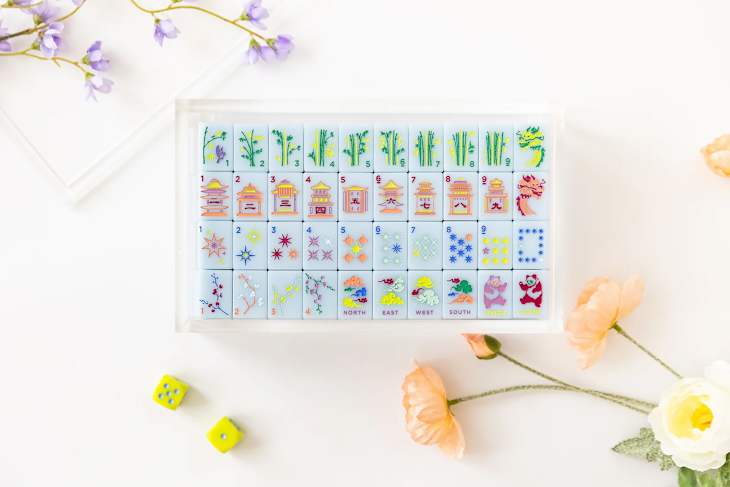
If you’ve rescheduled a hangout with your social circle more than three times in the past two months, raise your hand. (No shame. I’ve been there!) In what feels like an ever-increasing crush on your social calendar, it can be harder than ever to find time to have real, face-to-face connection — even, or especially, with the people whose friendships you value most.
Maybe that’s why mahjong has been calling to people lately. The appeal of a weekly (or even monthly) standing appointment where friends are gathered, phones are put away, and real connection happens has never felt more appealing. Necessary, even. No “sorry to cancel” texts, no rescheduling, just a regularly recurring game for your closest circle. It sounds idyllic.
Picking the Right Mahjong Set for You
Whether it’s your first time playing mahjong or you’re a seasoned player, there’s a set to suit your style. Some are designed to cater to a particular regional style of gameplay (like American mahjong or Vietnamese mahjong), but many of the nuances in modern sets are purely aesthetic, distinguished by different artistic interpretations of the classic Chinese tiles.
And I’m not the only one who think so. While the game’s long-running popularity speaks for itself (it’s been played continuously since its creation in the mid-1800s), you might have noticed mahjong becoming more visible across different spheres lately. Pop-ups and community events like East Never Loses, a queer-friendly event producer in Los Angeles aiming to introduce mahjong to a new generation, have helped spike mahjong’s popularity among wider audiences and brought increased access and visibility to the game.
“For generations, Mahjong has been used as a tool to bring people together,” says Angie Lin, founder of East Never Loses. “It’s for people who want to connect, compete, and build community — it’s ultimately for everyone.” And she really means everyone; Lin is also a mahjong teacher based in Los Angeles and has taught everyone from celebrities to first-time players in private lessons, events, and partnerships, and she says it’s becoming more and more popular every day.
What Exactly Is Mahjong?
Mahjong is a tile game originating in 19th-century China. It’s traditionally played with four players, and combines elements of luck with decisive skill and strategy.
A traditional set consists of 144 tiles marked with Chinese characters, though there are variations in the tile numbers as well as in the gameplay itself, as the game has evolved over time and been adapted by different communities.
What Are the Different Kinds of Mahjong?
There are countless variations of mahjong due to regional differences, localized gameplay quirks, and more. But some standardized versions exist. “Chinese mahjong is incredibly diverse, with no single official rule set. Because it originated as a street game, it developed organically. Different cities and households play with their own rules, scoring systems, and rhythms. In many ways, Chinese mahjong functions like oral history, passed down through generations and constantly evolving,” Lin says.
By contrast, “American mahjong” rose to popularity beginning in the 1920s, taking on its own rules and regulations that distinguish it from the version played across the Asian diaspora (and often, its own spelling). “It’s a standardized variation that took root in the Jewish-American community,” Lin explains. “In 1937, the National Mah Jongg League was formed to formalize the rules and publish the official card. Each year, the league releases a new card that defines all valid winning hands, making American mahjong structured, evolving, and shared across players.” Ultimately, though, whether you play American mahjong, one of the many Chinese variants, or another version, the history is kind of the point. “Mahjong isn’t just an aesthetic; it’s a game with deep cultural history,” Lin says. “Context is key when engaging with mahjong respectfully. Understand that although there is American style, it is not the only or original way of playing mahjong. There’s also Japanese Riichi mahjong, Filipino mahjong, Korean mahjong, and more, each with its own unique rules, strategies, and cultural context.”
Who Can Play Mahjong?
“If someone is curious about mahjong, chances are they’ll fall in love with the game,” Lin says. While the game may seem intimidating at first, Lin notes that most newcomers she teaches can pick up the game within three to four rounds, or about 45 minutes, without prior experience. Of course, it takes longer to truly master the strategy and nuance of the game, but learning that is where the fun comes in.
Whichever version you play, mahjong can be a great way to connect with community and tradition. Luckily, the community-building that’s at the center of the game is also the best way to ensure you’re engaging respectfully. “Find a mahjong community near you,” Lin suggests. “Chinese and American mahjong clubs are popping up all over the U.S. and abroad. Chances are you have one near you.” And don’t feel the need to decide on one style right away. Sampling from a few different variations and communities can be a great way to get familiar with the game’s history. “If you play American style, reach out to a Chinese mahjong teacher to learn more about Chinese mahjong. Mahjong has so many different styles — in the end, there is no ‘one way’ to play mahjong. All styles are fun!” Lin says.


