
I Turned My Living Room into the Mahjong Parlor of My Childhood — And Reconnected with My Heritage
I grew up in a mostly white suburb in New Jersey, and I wasn’t interested in learning how to play mahjong when I was a kid. The small white tiles stamped with intricate flowers, swirling circles, and sharp Chinese characters felt foreign to me. Instead, I observed from the outside; I watched family friends play the game around the kitchen table, chatting into the late hours of the night. The sound of shuffling tiles was a familiar lullaby, my mind drifting off to the hypnotic clicking and clacking.
Throughout my childhood, I was only comfortable being Chinese American in the few spaces it was accepted: family gatherings, weekend Chinese school, the Asian grocery store. Apart from that, I tried my best to conceal my culture; I was too embarrassed to bring Asian snacks to school, and too reluctant to speak Cantonese.

Finding Myself Through Mahjong in NYC
Once I graduated from college, I didn’t hesitate to move out of the suburbs to New York City. For the first time, I had access to Chinese neighborhoods in just a short train ride — from Flushing, Queens, to Chinatown, Manhattan — and I didn’t feel like an outside observer. I could meet other Chinese Americans who were also finding their footing in Asian spaces.
So when my friend asked me to join her at a mahjong night at Land to Sea, an Asian-owned cafe in Brooklyn, I surprised myself by saying yes. As someone who had spent years feeling disconnected from my cultural identity, I was now ready to learn the game I grew up watching. The day before, my friend and I studied countless cheat sheets, trying to memorize each character and symbol so that we could play our best.
Walking into the cafe was like stepping foot into an ’80s Hong Kong mahjong parlor. Five tables with red stools were set up throughout the room, along with a very fitting neon sign of a mahjong tile hung on the wall. I was surprised to see the cafe buzzing with young people from all cultural backgrounds. I had always associated mahjong with the stereotypical Chinese grannies and grandpas, not 20- and 30-year-olds.
After observing a few rounds, my friend and I decided to try our hand at the game, playing as a pair. As we sat down, each person warmly introduced themselves and patiently taught us the rules, unbothered by the (unsurprising) amount of mistakes we made. While chatting at the table, some players shared that they also grew up feeling disconnected from their heritage and learned mahjong to reconnect.
That night, my friend and I won our very first game and declared we would continue going back. Since then, we’ve attended dozens of mahjong events in a variety of unique spaces, from stylish hotel gardens to DJ-hosted warehouses flowing with drinks.

Bringing Mahjong into My Home
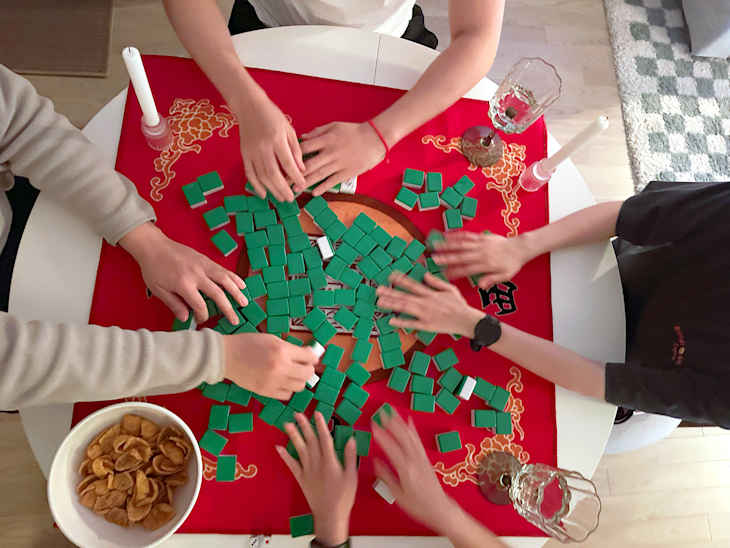
After a year of playing at different venues, I decided to host a mahjong night at my apartment. My partner and I don’t own a mahjong table, but we had the necessities: a mahjong set, a kitchen table, and four friends willing to trek to Queens. In the span of an hour, we turned our apartment into a modern-day mahjong den, fitted with soft mood lighting, yuzu-scented candles, and a makeshift mahjong table. We used my partner’s old set that was sitting in storage for years, scattering the dusty tiles across the red mat on our table.
Our setup reminded me of the kitchens where I watched adults play as a child. But instead of serving cut-up fruit assembled on a porcelain plate, we dug into plastic bowls filled with Trader Joe’s snacks. And instead of getting drunk on Tsingtao beer, we sipped on bubble tea and seltzers.
The sounds of shuffling tiles filled our apartment for hours while we played into the night. Throughout each round, we caught up on our lives — career updates, personal goals, quarter-life crises. We also learned new skills, like unique ways to earn points and how to memorize patterns in our hands. I couldn’t help but smile as my friends tossed tiles at the center of our table, our laughter echoing off the walls. Years ago I never envisioned myself as an adult playing mahjong with my friends, let alone in my home.
Hosting an apartment mahjong night was one of the first times I didn’t feel like an outsider to my Chinese heritage. I realized mahjong is more than just a game. It’s also a cultural ritual passed down through multiple generations. Younger generations are rebuilding this tradition through the spaces they create, whether it’s trendy venues or their own home. Setting up the table, washing the tiles, rolling the dice … it’s all the same, no matter where you are or who you’re with.
As we shuffled the tiles one last time for our final round, it brought me back to the lulling sounds that put me to sleep as a kid. But this time, I was on the inside, playing the game I learned to love.