
Waterfall Kitchen Islands Are Officially Out: Here’s What Designers Say Will Replace Them
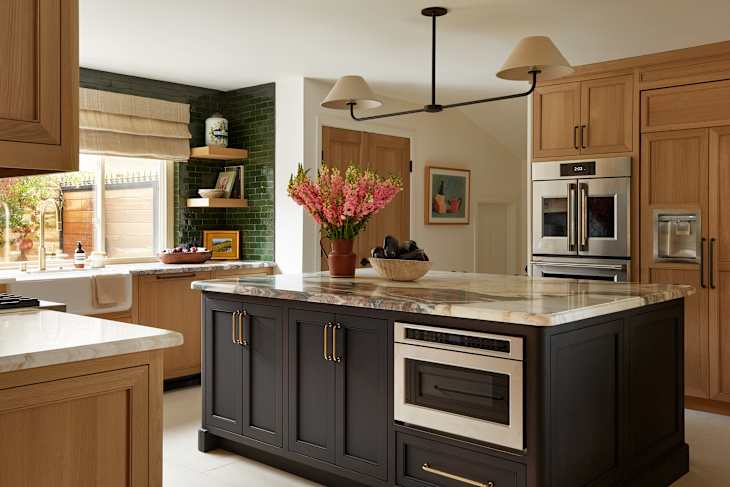
In recent years, the waterfall kitchen island has been the pièce de résistance in many a kitchen renovation. Waterfall kitchen islands have been synonymous with modern, upscale designs — you’ve likely seen them in several celebrity home tours, at least. The designs look undeniably luxurious: Expert stonework makes the “waterfall” edge appear to be one large, continuous cut of stone draping over both sides of the island and down to the floor.
But now the tides are turning — and the waterfall might just be falling from grace. While visiting a friend recently, I fell completely in love with her unique kitchen island. There was no quartz, and no mitered edges of polished stone or matching cabinet bases. Instead, her “kitchen island” was a charming, antique wooden table.
While you might think that using furniture for a kitchen island would look less than luxe, I’d beg to differ. In this case, it instantly made the kitchen look more interesting — and more intentional and inviting, too. I began to wonder: Why the shift? I reached out to a few industry experts to find out, and to hear their thoughts on whether or not furniture-style islands might truly become the new “it” kitchen feature.

What Is a Furniture-Style Kitchen Island?
Furniture-style islands are simply kitchen islands that look like a piece of furniture. Often made from wood, they can add a lot of personality and warmth to a kitchen. They can be antique or modern, and most include storage in some capacity. Carved wooden legs can lend a much lighter and more interesting look to a space than a large block of cabinets or a mass of honed quartz.
But why are they suddenly so popular now? Umair Kabani, real estate professional and producer, thinks that the shift in styles could be due to the larger movement towards individuality and personalized design. “The waterfall island became popular because it photographed well, but it never told a story. Furniture-style islands bring character back into the kitchen. When an island looks like it could have existed for decades, the space instantly feels warmer, more human, and more emotionally grounded.”

Homeowners are choosing furniture-style islands because, more often than not, they’re also opting out of minimalism and stark industrial interiors and leaning into something more cozy. Ethan Greenfeld, interior designer at Ethan Charles Design, adds, “There’s a big push to make otherwise utilitarian elements feel softer and more decorative. I am seeing a shift to clients wanting softer homes that feel more lived-in, whether it’s through wood detailing on an island, or something as simple as eliminating the toe kick in exchange for a base molding.”

These types of islands are also the perfect spots to gather around and socialize with friends and family while cooking. Some feel almost like a dining table in the middle of the kitchen — a natural gathering point. “It’s part of a return to the home as a place of comfort and a move away from stark minimalism,” concludes Jessica Shaw, design director at The Turett Collaborative. “People are spending more time at home, and the economy is pushing that too, so the home feels less like a showpiece and more like a reflection of how you actually live.”
Design Defined
Never miss the style inspo and recommendations you crave with Design Defined. Follow along each week as our Home Director Danielle shares the best style advice, latest trends, and popular decor finds you just can't miss.