
The “60 Inches” Rule Is Instagram’s Buzzy Way to Improve Your Home Overnight
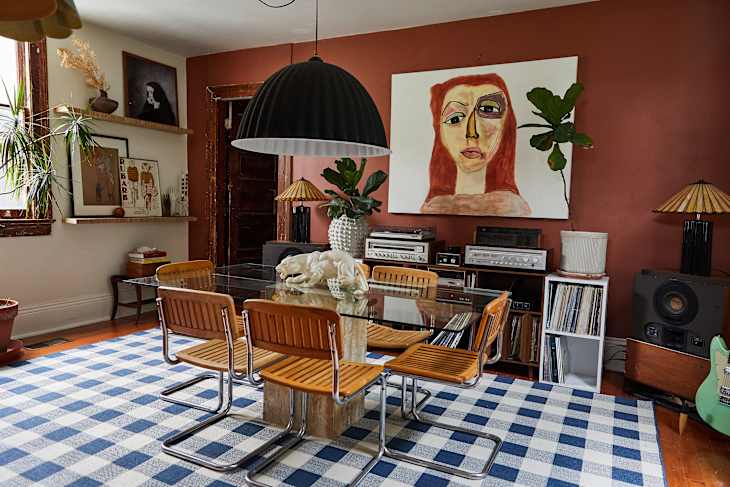
There may be nothing as nerve-racking as finishing painting your walls, putting your furniture back in place, and getting to the point of a room makeover where it’s time to hang art on your walls. You’ll be stressed not to damage the pristine job you just finished, sure, but you may also be struck by indecision on where your art should actually go. After all, banging nails and frame supports into a new paint job willy-nilly is a no-go unless you have a guidepost. So here it is: 60 inches.
According to Leor from @lz_nteriors on Instagram, 60 inches is the measurement you always want to keep in the front of your mind when hanging art on the walls. She and fellow design pros use the “60 inches” rule (including our very own founder, Maxwell Ryan!) when hanging artwork, no matter the artwork’s size or what wall it’s going on, as it’s a general guideline that seems to work 99% of the time. And once you learn how to embrace this rule, hanging art is going to be a breeze.
What Is the “60 Inches” Rule?
“Sorry, guys. I’m firing your designer again if your art is hung at the wrong height,” Leor said in a recent Instagram video. “The center of your art should sit exactly 60 inches from the floor. Not the top of the frame, not the bottom, the center. And this rule applies no matter how big or how small the piece is.”
You’ll first want to measure the height of your artwork and divide that number in two to find the center point of your piece. You can mark this point with a small piece of tape or a sticky note if you need a visual aid. Then, use a tape measure to measure 60 inches from the floor, mark that spot on your wall, and match that mark with the center of your piece. Finally, you can make a mark at the top of your frame, measure down from that mark to where a hanging wire is, and nail your hanger into the wall. You’ll end up with a perfectly hung piece of artwork that’s exactly at eye level.

The Rule Applies to Pairs of Artwork, as Well
“When you are hanging two pieces together, it is not the center of each one individually,” Leor says in her video. “It is the center of the two combined. Treat them as one unit, find the midpoint between them, and that midpoint sits at 60 inches from the floor.”
If you’re planning on hanging more than one piece, you can use the “60 inches” rule here, too. Lay your artworks out on the ground first — including the amount of space you’d like in between them, and get the center-point measurement that way. Then you’ll have to do a bit of math to figure out where exactly the nails should go, but once the hard part is over you’ll end up with a picture-perfect gallery wall (pun intended!).
And Yes, Stairs Are Also Included in This Rule, Too
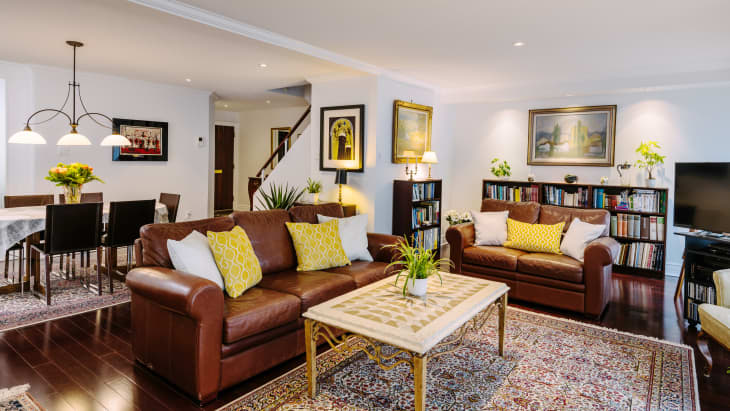
If you’re hanging a gallery wall in your stairwell, the “60 inches” rule still applies. But you’ll be measuring from your stair treads rather than the floor. “Every piece of art going up the stairs should be 60 inches from the step directly below it,” Leor added. “Not from the floor, from the step.”
Of course, rules are meant to be broken — so don’t feel as if you must follow this rule in your own home. But if you’re feeling like you don’t know where to start when hanging art, this rule of thumb might be the perfect solution to overcome your fear and confidently get art on the walls without second-guessing a thing.