
Everything You Need to Do When Downsizing Your Home, According to a Pro Organizer

No matter the reason — whether you’re trying to save money, becoming an empty nester, or wanting a different home layout — you may need to downsize your home at some point in your lifetime. As a professional organizer, I’ve been called numerous times to assist with this undertaking because many people underestimate just how much stuff they own and don’t know exactly how to downsize their home.
Moving under any circumstance is stressful, but downsizing adds another layer because you must first significantly declutter and clean out your home. Here, I’ll share why downsizing your home (and, subsequently, your stuff) is a positive step, how you can do it correctly, and my best tips for making this life event an easier transition.
Benefits of Downsizing
Aside from the apparent advantages of downsizing — namely (and ideally) reduced rent or mortgage payments, utility bills, taxes, and maintenance — there are also upsides from an organizational perspective.
You won’t be starting life in your new home with clutter.
I once had a client downsize from an 8,000-square-foot home to one that was 3,000 square feet. I know that’s still a lot of space, but there was a difference of 5,000 square feet. Imagine if she tried to fit everything from her old home into her new home. Even if she hired both a pro organizer and a magician, the stuff wouldn’t fit. Even if your downsize isn’t as drastic, you still don’t want to begin this new chapter surrounded by clutter. Less space means owning less stuff; it’s simple math.
You’ll realize what matters and what you actually need.
You might be convinced you need all those serving platters, but it’s only because you have room to store them. Downsizing forces you to hold on to what you genuinely love, need, and want — and to let go of what you don’t.

Tips for Downsizing
These are a few things to keep in mind that will make a difference in your cozy new home.
Thoroughly measure your new home.
I understand this isn’t always possible — especially if you’re moving long distances and can’t easily access the new home. But if you can, go through closets, cabinets, and storage spaces and measure them. This will give you a much more accurate picture of what kind of room your things will have to live in, rather than going by overall square footage. It also allows you to shop for proper organizing supplies that will fit (or, better yet, ensure the ones you already own will fit).
Get your kids involved, if you have them.
I’ve seen many people go wrong when downsizing because their kids have flown the coop and, yet, they think their childhood stuff needs to come to their new, smaller home. Sometimes, it’s because of the parent’s sentimentality and refusal to let it go (even though the kids clearly expressed they don’t want boxes of old trophies).
Other times, parents don’t have open conversations with their kids where they ask their children to either take or toss their childhood belongings. Either way, it’s essential to address the issue: Explore your resistance to letting go and find clutter-free ways to preserve memories or give the kids a deadline to take their things and let them decide what to do with them.
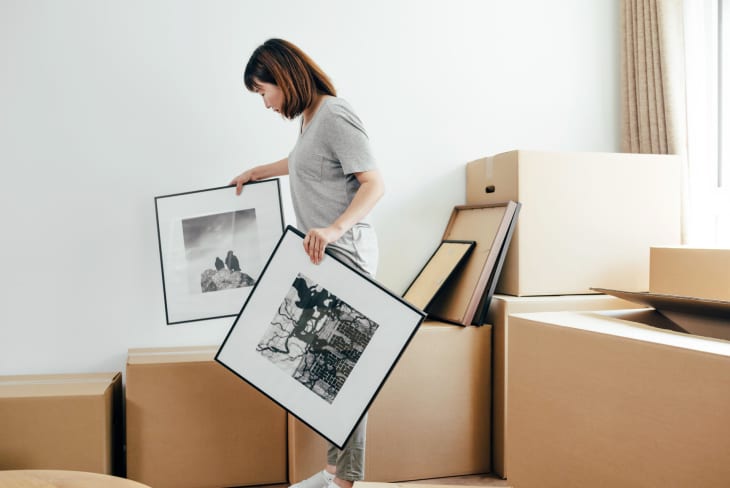
How to Declutter Your Home for Downsizing
To prepare to move into a smaller space, you’ve got to pare down your belongings. This could take as much as a couple of months to complete. So I say, start as early as possible to prevent added stress.
First, tackle the big things like furniture.
This should be (relatively) straightforward because only so much of it will fit in your new home. Once you know what you’re taking with you, you’ll have enough time to donate or sell the rest before the big move.
Next, sort through off-season or rarely used items.
If you’re moving in the summer, declutter Christmas decorations and winter gear, as you’re not using or wearing them. Also, take note if you’re moving to a different climate, as that can make it easier to let go of more things if they won’t be needed there. Have an abundance of servingware because you host every holiday? If you won’t be doing that in your new home, pare down significantly. Decide which mementos and home decor will be coming with you as well; letting go of sentimental items can be tough, so give yourself enough time to keep coming back to it as you lead up to the move.
Finally, deal with clothes, paperwork, tools, and supplies.
Clothes, toiletries, linens, office supplies, paperwork, kitchen tools, and so on must be addressed. Start with things with expiration dates (like medicine and pantry goods), and then go room by room and separate things to keep and pack from things to toss or donate.
Remember that everything must leave the house before you hand over the keys, so pace yourself and avoid zigzagging. If you start to declutter a drawer, go through it and decide about each item before moving on to the next one.
Think about temporary storage while settling in.
If you’ve decluttered and are still unsure if the new home will accommodate the things in your keep pile, consider renting a short-term storage solution. A service such as PODS or a local storage facility will offer month-to-month rentals, which could allow you to move things in at a slower, more intentional pace. If you find that some of it won’t fit comfortably, give it away to someone in need rather than trying to shove it somewhere in the house. Be disciplined with yourself, though, because storage units can be a slippery slope. If you have hoarding tendencies, I’d strongly suggest doing all of your decluttering pre-downsize.
It may feel overwhelming at first to downsize, but in my personal and professional experience, the long-term benefits are worth it. Plan ahead and declutter as soon as you know you’re moving. Or, heck, start downsizing now even if you haven’t made the decision yet, so that when the day does come, you’re ready and you’ve lessened the load (literally and figuratively, of course).