
I Made Pot Roast Recipes by Julia Child and Ina Garten and Found the Clear Winner I’ll Cook for Life
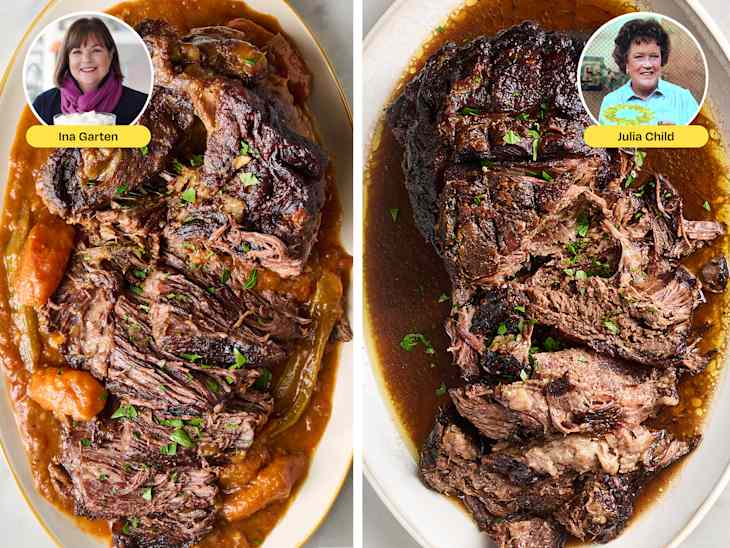
I have a soft spot in my heart for vintage recipes (I have a sizable collection of old cookbooks and consult them often). When I think about finding the best recipe for classic dishes that have been cooked for a long time, I want to consult the OGs as well as our most revered current chefs. What methods and ingredients have stood the test of time? What techniques have endured? What’s been left by the wayside? Is the old way of doing things really the best? Or do the innovations of modern cooking yield a better result?
As I am writing this, it is just beginning to feel like fall. Autumn is the realm of cozy food — roasted chickens, hearty stews, and braised meats, including the timeless classic, pot roast. Beef pot roast is a storied one-pot wonder. A big hunk of beef goes into a large pot with broth, a little veg, and herbs, then cooks low and slow until fork-tender. It’s quintessential comfort food — right up there with chicken pot pie and chili.
To figure out whether history or modernity reigns supreme, I pitted the recipes of two culinary legends — Julia Child and Ina Garten — against one another. The former a culinary pioneer of the modern recipe in the American kitchen, and the latter a contemporary north star for many home cooks. Read on to find out whose version of classic pot roast yielded the most delicious results.
So, Whose Pot Roast Recipe Is Best?
Although both of these recipes yield delicious results, Julia Child’s Boeuf à la Mode is truly something special. With complex flavor built over the course of both a long marinating time and a low-and-slow braise in the oven, it scored top marks for both flavor and texture.
Meet Our Pot Roast Contenders
These are two classic recipes that take a similar, but not identical, approach to this quintessential dish. Both recipes call for a roughly 5-pound beef roast (tied), and the recipes share many common ingredients and flavors. Both were cooked in a large Dutch oven, with the roast being seared to start, removed, additional ingredients added, and then the meat returned in addition to ample liquid before covering the whole thing and braising in a low oven for a few hours.
- Julia Child’s Boeuf à la Mode. Julia’s classic French approach to pot roast involves a long marinade, which is then reduced to concentrate the flavor before adding the seared beef back to the pot with additional liquid and braising until tender. Once done, the braising liquid is strained and then further reduced to make a flavorful sauce for the meat.
- Ina Garten’s Company Pot Roast. Ina’s pot roast recipe is a straightforward affair that involves searing the beef in a Dutch oven, removing it to brown a mix of vegetables and aromatics, before adding in liquid, herbs, and a large tin of tomatoes. The beef is then returned to the pot and everything goes into the oven until tender. Once ready, the beef is removed and half the sauce is blended until smooth before being added back to the pot to create the thick sauce.
Key Differences
Ina
- Coat the beef with flour before searing
- Includes tomatoes
- Includes big chunks of vegetables
Julia
- Includes marinating
- Beef seared without flour
- No tomatoes
- Only small pieces of vegetables
How I Tested the Pot Roast Recipes
- I used consistent ingredients for both recipes. I bought all of the ingredients from the same store on the same day and the same ingredients (like olive oil, brandy, and wine) in both recipes.
- I cooked both recipes on the same day. I also enlisted the help of two additional tasters who tasted both recipes blind to help determine the winner.
- I consulted videos for both recipes. These recipes are both written in an informal style that leaves some details open to interpretation (more on that below). To ensure that I was cooking the recipes in as close to the intended way as possible, I watched videos of both chefs preparing these roasts, which you can see here and here. I should note that Julia’s television preparation does vary slightly from the printed version of the recipe that I referenced from her book, The French Chef Cookbook.
- I tasted both recipes side by side. I (and my additional tasters) tasted both recipes side by side alone, and also with a side of mashed potatoes.
Why You Should Trust Me as a Tester
I’ve been a professional cook and recipe developer for over a decade. I spend my time thinking about what makes recipes foolproof and perfecting them in the kitchen for home cooks. I’ll say right off the bat, I don’t worship at the altar of either of these chefs. I am obviously very aware of both women and their respective impacts on our home kitchens, but I’ve never before cooked a Julia Child recipe and had only cooked a single Ina Garten recipe in my life before this. I have never watched any of Ina Garten’s cooking shows and, while I have watched episodes of The French Chef, it was more to witness a cultural landmark than as an actual learning opportunity. I say this to impart that I didn’t have a favorite going into this process. I also don’t cook a lot of pot roast, so I did not have any preconceived notions about what ingredients should be going in or what method yields the best results. I went into this process with an open mind.
A quick note on recipe style: The steps of both of these recipes are written in a loose, paragraph-style format, forgoing numbered steps. They’re vague in the way of older recipes. There is a reliance in the writing on what the writer assumes to be a certain level of comfort in the kitchen or a base of cooking knowledge that the reader possesses.

Ina Garten’s Company Pot Roast
About this recipe: This is the more “straight-ahead” approach to pot roast of the two. You begin by patting the beef dry and seasoning with salt and pepper before coating the whole roast in flour. A quick note about the salt in this recipe: It seemed to me like an enormous amount (almost 3 tablespoons total, plus a bouillon cube), and I was a little worried that the final dish would be overly salty (spoiler: I needn’t have been.) After adding a little oil to a Dutch oven, the beef is then browned on all sides and removed from the pot to rest. Next chopped carrots, leeks, celery, and garlic are added to the now-empty pot, along with additional olive oil, salt, and pepper, and cooked until tender. Burgundy wine and brandy are added next, followed by a large can of whole peeled tomatoes, chicken stock, a bouillon cube, tied stalks of fresh thyme and rosemary, and more salt and pepper. The roast is then added back into the pot, and everything is brought to a boil before covering and transferring to a low oven until tender, about 2 1/2 hours. For the final step before serving, the meat is removed once again from the pot and half of the cooking liquid is transferred to a blender and blitzed until smooth before being added back to the pot along with a thickener made of a mixture of butter and flour. The roast is served sliced with the thick sauce spooned over the top.
Results: Ina’s recipe yielded a nostalgic version of pot roast that reminded me of childhood meals. It was tender and rich with a velvety sauce full of cozy, familiar flavors. The meat was tender and flavorful (not too salty!), and I would be happy to make and eat this again.
However, if I had to find fault it’s in the overall flavor of the dish as a whole. There are a lot of ingredients and flavors that go into this roast, and they blend together beautifully — almost too beautifully. Everything came together so perfectly that I couldn’t pick out any one of the ingredients on its own. I wanted the flavors to be a bit more layered and complex; instead they blended into one delicious, but homogenous dish.
My second quibble might be a strength to a different cook. The addition of tomatoes pushed this into meatloaf territory for me. I love a good meatloaf, and I was not unhappy to be reminded of it when eating this roast, but when tasted next to Julia’s, it seemed a little bit run-of-the-mill. This recipe also yielded an astonishing amount of sauce (as did Julia’s, to be fair). On the one hand, I think this is largely unavoidable, as you need a certain amount of liquid to braise the beef. On the other hand, I was left with more sauce than I knew what to do with even after the whole roast was long gone.
What I loved: This was a super-comforting and nostalgic-tasting take on pot roast. I love that it included big chunks of carrots that you could bite into alongside the beef.
What I would tweak: I wasn’t a huge fan of the addition of whole tomatoes. If I were to make this again, I would either omit them entirely or use diced (or even purée) to get a bit of the flavor but not be left with whole tomatoes in the sauce.

Julia Child’s Boeuf à la Mode
About this recipe: This one was a project. Before you even get started cooking, Julia calls to marinate the beef for 6 to 24 hours in a mixture of spices (whole allspice and peppercorns), herbs (parsley, thyme, and bay leaves), chopped carrots, celery, onions, and garlic, and not a small amount of Burgundy wine. When ready to cook, the beef is seared until browned on all sides and removed from the pot. The marinade is then added in and reduced by half before adding the meat back in along with stock. The pot is then covered and the meat is braised in a low oven for 2 3/4 to 4 hours until tender. Once ready, the beef is removed and the liquid strained before being returned to the pot where it is reduced by half. Julia mentions that you can add optional thickener to get the sauce to your desired consistency. The beef is then sliced and served with the sauce.
Results: It’s worth noting that Julia’s recipe is missing a lot of key scaffolding that would be present in a well-written modern recipe. What heat level should you brown the beef over, for instance? How long does it take? She relies heavily on a baseline knowledge the reader is assumed to have. That’s where errors creep in. (I browned the beef over medium heat, if you’re interested.) She also doesn’t offer any guidance on how long to reduce or the final volume of the sauce. Tip: If you come across a recipe that wants you to “reduce by half,” but doesn’t give a volume or a time, stick a stainless steel (aka washable and food-safe) ruler in it. Make sure it hits the bottom. When you pull it out you’ll be able to see exactly how deep the liquid is at its current volume (it will be wet and dirty there) and then you can reduce it to half that depth (in this case 1 1/2 inches reduced to 3/4 inch).
This recipe is simultaneously very similar to Ina’s and very different. The bones are the same, but where the recipes diverge is what made all the difference in the end. I was initially skeptical of the long marination time. The beef was about to be submerged in liquid and cooked until extremely tender anyway, a process that would impart flavor all the way through — was a long marinating time really worth it? It really was. Despite the presence of wine in both recipes, the roughly 12 hours this roast spent soaking in the flavorful marinade made a big difference in terms of both the depth of flavor and the texture of the meat. While both roasts were fork-tender, Julia’s was a bit firmer and more easy to slice.
What I loved: This roast had a distinct depth of flavor from its long marinade. The flavor from the ample amount of wine did not overpower the more delicate flavors of thyme, allspice, and garlic. That blended together to create a roast that truly sings. This roast is worth the wait.
What I would tweak: I missed the chunky vegetables present in Ina’s recipe here. Julia instructs you to strain the (more finely chopped) vegetables out of the liquid before reducing the sauce. I kept them and added them back in to give the dish a little hint of veg. If I were to make this again, I would add hearty chunks of carrots and maybe potatoes as well.
Overall Key Takeaways
- Choosing a winner between these two recipes was hard. There were no big missteps here, and I would happily eat both recipes again. Julia’s recipe just edged out Ina’s for its distinctive flavor profile. Spending the extra time to marinate the meat in a mixture of wine, herbs, and spices infused the meat with a distinctive flavor that made it stand out as something truly special.
- Julia’s recipe takes more time than Ina’s, although it’s largely hands-off time when the meat is marinating — but it’s worth it, in my opinion. However, if you want pot roast but don’t have the time for a lengthy marinade, you can’t go wrong with Ina’s either.
- If you’re a newcomer to the kitchen or this is your first big braise, Ina’s recipe is more newbie-friendly than Julia’s. That said, I recommend watching the videos of each chef preparing her own roast (linked above) no matter which recipe you choose. Seeing someone cook through a recipe is a really useful tool!
This post originally appeared on The Kitchn. See it there: I Made Pot Roast Recipes by Julia Child and Ina Garten and Found the Clear Winner I’ll Cook for Life