
Why a 111-Year-Old Kitchen Countertop Material Is Suddenly Popular with Gen Z
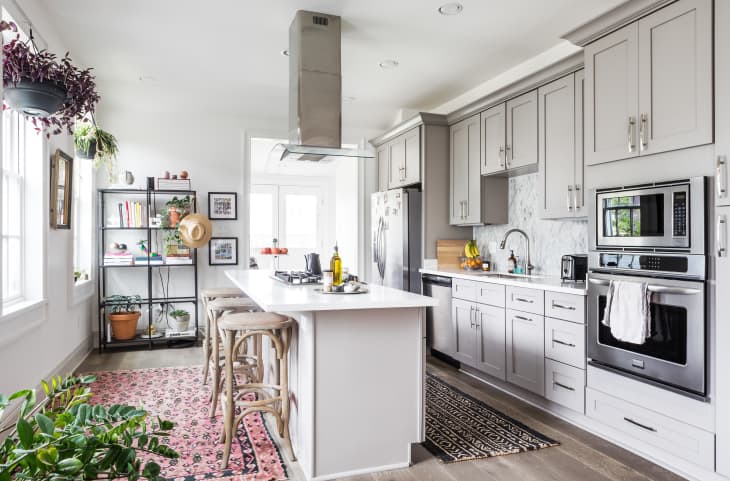
In late 2024 Formica ran a 1,000-person survey that asked Boomer, Gen X, millennial, and Gen Z homeowners how they felt about laminate countertops — specifically, if they’d consider it for their kitchen countertops. The results? Millennials and Gen Zers were more likely to opt for it than Boomers and Gen Xers.
Whether you’re surprised by that or not, this study reveals that younger generations aren’t shying away from laminate. Of course, many still gravitate towards natural stone countertop options, like granite and marble. However, the high price tag of stone is not something everyone can manage when planning for a reno.
Laminate, on the other hand, is a budget-friendly countertop choice — and it’s come a long way stylistically. The material has improved so that it convincingly emulates the unique coloration, veining patterns, and even durability of its higher-end competition.
“Laminate is highly customizable,” says Vanessa DeLeon, CEO & principal designer of Vanessa DeLeon Associates. “It allows for tailored designs on surfaces and cabinetry, and the wide range of fun patterns available gives [our] clients the freedom to get creative without a major investment.”
Are you considering laminate for your kitchen countertops? Or maybe those in your bathroom or laundry room? Here’s what to know about the material and what’s contributing to its resurgence.

What is laminate, and who is behind the invention?
Laminate, including Formica, is typically made from kraft paper and resins; when high heat and pressure are applied, they harden and bond to create a laminate sheet. Laminate’s thickness is determined by how much paper is layered together before it’s heated.
The look of the laminate — whether that’s a solid, marble, or travertine — depends on the last layer of paper, which features the desired pattern or color. This means laminate countertops can come to life in endless styles: The pattern could be literally anything you can print on paper.
The Formica Corporation developed the process to create laminates and first brought it to decorative products in the 1930s. Gerri Chmiel, a senior design manager at Formica Corporation, notes that the company has made significant advancements in printing and technology over the last nine decades, and they’re no longer just impacting the appearance. “[Those advancements] allow us to replicate the look and feel of natural stone, wood, or even concrete with a remarkable realism,” she says.
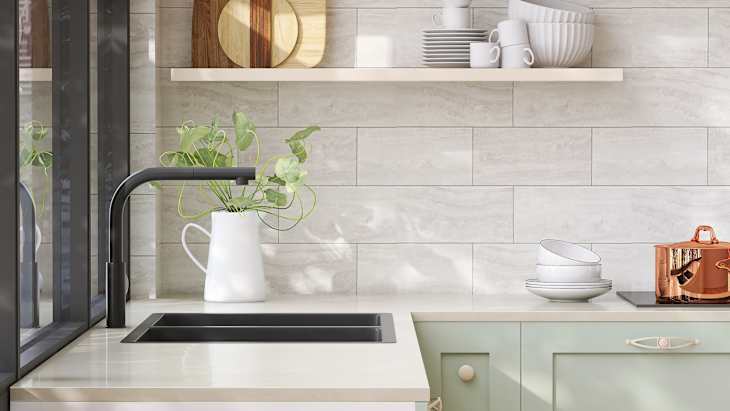
When were laminate countertops first popular?
Laminate surged in popularity starting in the 1950s, as it became known for its durability and affordability, says Chmiel. The post-war era was a time when many homes were being built for functionality, which may explain why laminate countertops in kitchens were so favored: They were design statements ready for heavy, everyday use that didn’t cost a fortune to install.
The rise of laminate also coincided with the peak of mid-century modern (MCM) design. Like the post-war era, the MCM movement had practicality at its core. Mid-century style celebrated bolder color palettes, sleeker forms, and innovative materials — three defining features of laminate countertops.

Why did laminate’s popularity decline?
Like many trends, laminate countertops eventually went out of style. “As homeowners prioritized durability, luxury, and authentic materials, laminate lost appeal,” says DeLeon, explaining that laminate countertops started to feel less premium compared to stone-based options. Regardless of how clean and smooth it appeared, a laminate countertop lacked the natural factor that had become mainstream.
Plus, early laminate designs — for, example the classic boomerang pattern — began to look dated. If they hadn’t been properly kept-up, vintage laminate also proved to be vulnerable to scratches and stains, which made stone countertops seem more resilient.
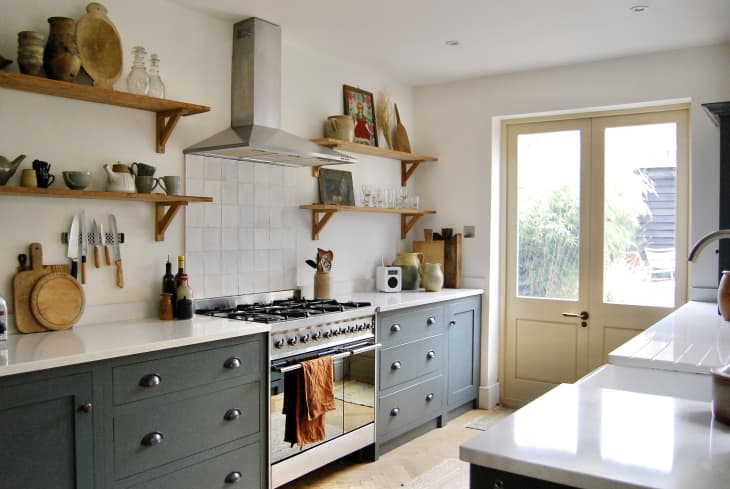
So why are laminate countertops trending (again)?
Since its initial rise and fall, laminate has made impressive strides to address its durability concerns and authentic appearance. Its resurgence is driven by two aspects, according to Chmiel: improvements in realism in design (that include texture and finish) and a growing appreciation for practical, stylish, and budget-friendly solutions on the customer side.
Laminate countertops are reemerging as reliable choices with powerful, visual appeal. “Advances in the industry have achieved near-perfect resolution in laminate imagery,” says Alexander Butler, founder of Alexander Butler Design Services. “It’s making it difficult — especially from a distance — to distinguish between something like Italian Statuary marble and a Formica print.”
Another reason for laminate’s revived popularity is that it can be made for any design aesthetic. You’re just as likely to find the right style for a lighter, brighter Scandinavian-style kitchen as you are for a maximalism-leaning one filled with pattern clashing or color drenching.

Misconceptions about laminate countertops
They’re outdated.
One big misconception that DeLeon wants to clear up about laminate countertops is that they’re an outdated home feature. “While that was true decades ago, today’s laminates have come a long way, with options that mimic natural stone, wood, and even metallic finishes very convincingly,” she shares.
They’re not sustainable.
Laminate is actually a sustainable choice. Laminate was created with longevity in mind: It was (and still is) meant to compete with natural stone. Plus, today’s laminates often use FSC-certified paper stock and water-based resins.
“The industry has made significant strides toward sustainability by incorporating recycled materials, enhancing energy-efficient production methods, and promoting responsible disposal practices,” says Butler. “Although earlier products were associated with the release of volatile organic compounds, these concerns have largely been addressed and are now mostly a thing of the past.”
They require professional installation.
“Unlike stone or engineered stone countertops, which often require professional installation, laminate countertops can be installed by do-it-yourself enthusiasts, which can save both time and money,” says Chmiel. While it’s certainly a project, eager DIYers can be reassured that it’s possible to personally tackle this kitchen upgrade.
Even beyond installation, there are opportunities to spruce up your existing laminate countertops sans the extra hands. A mini-project like covering with contact paper is ideal if you’re a renter, or you can take it a step further with a full-on paint job, as long as you’re using the right countertop coating.
Durable, stylistically versatile, sustainable, affordable, and DIY-able, there is a lot to love about today’s laminate countertops.