
They Stripped This Victorian Living Room to the Studs — And Revealed Its Best Features
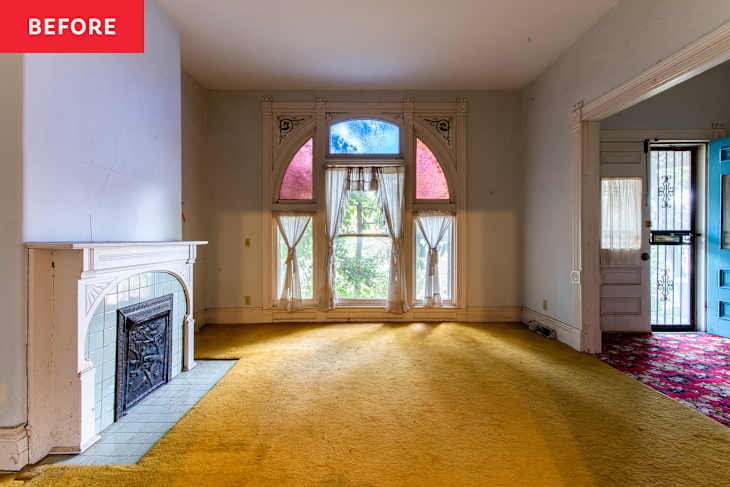
When my best friend Michael and I walked through the living room of a once-grand Victorian home we decided in 2020 to buy and restore, we did it with some seriously rose-tinted glasses. The room was dim despite its huge windows (for some reason tinted hot pink and blue?) because the front of the house was being choked by overgrowth. Decades-old carpet may have been chartreuse once. The plaster was crumbling in places (a lot of them).
We had just enough experience living in and renovating big, old houses that we could imagine the possibility: original hardwood floors with inlaid corners hiding beneath the carpet, tall ceilings, a fireplace (one of four!), pocket doors. We also had just enough hubris (or naivete, if I’m being kind) to let us think this house would be, maybe not easy, but, you know, manageable? Yeah, during a pandemic — and all the supply chain and other issues that entailed. In hindsight, we had no idea what we were in for. But we knew it could be — should be — a beauty once more. We dubbed the house and room “Sleeping Beauty,” and made a pact to revive her.

Everything Had to Go
Here’s how we brought the Sleeping Beauty living room into the 21st century. On paper, it sounds almost simple. But it … was not. To start, we took her down to the bones. I thought we could repair the plaster, but when a contractor pressed on a wall and his hand went through, we had to admit when we were beaten there. So down to the century-plus old studs we went — and to the brick on the fireplace — and of course the carpet went into the dumpster on demo day.

The house needed new electric (and plumbing and everything else) so once that was complete while the walls were open, new sheetrock walls went back up. Because most of the woodwork was sadly unsalvageable, we ordered period- and scale- appropriate trim made from a local millyard. No flimsy PVC baseboard from a big-box store in our Sleeping Beauty!

Finding the Perfect Warm Neutral Paint Took Some Expert Help
The color palette was a topic of much discussion. Because we’d become infatuated with a Farrow & Ball color (the jewel-toned Scotch Blue, now an archive color) for the kitchen, we opted to do the brand’s Colour Consultancy for the living room. That entailed completing a 14-item questionnaire and sharing my Pinterest board and photos of the space before scheduling the hour-long video consult, which we went into prepared with the brand’s “colour book.”
We asked for a warm, earthy neutral (anything but “flipper’s gray”) and welcoming, relaxed glamor. “It should stand out, but not scare off,” I wrote. I’d also become smitten with a wallcovering, a velvety damask with a smoky green background, when I visited the F&B Chicago showroom, and we planned to showcase newly exposed brick on the fireplace with the striking wallpaper.
Their wallpaper is printed with F&B paint, so it ended up being an easy choice: We opted for Pigeon, the same shade as the wallpaper I loved. They call this a “cosy and nostalgic blue grey,” but in the eastern light of that room, it was closer to a warm sage green to my eye. It was exactly what we hoped.

A Lighting Splurge Brought It All Together
Despite all conventional “flipping” wisdom to not spend too much on things like light fixtures, I knew the hero shot for the real estate listing would feature the living room, so we splurged on the Alyssa chandelier from Mitzi, a dramatic eight-bulb fixture that felt like a clean, contemporary riff on the heritage pattern of the wallcovering. It was perfect.
The colorful tint on the old windows required expert help, and the glass had to be replaced. By now the tree that threatened to eat the house alive was gone, and all the wild, straggly shrubbery trimmed or removed. So light could flood in the 10-foot windows. We turned our attention to the fireplace, getting expert masonry help to clean and seal the brick. Then, we rebuilt the tile hearth with a jet black zellige; the handmade Moroccan tiles are my low-key obsession. This feature became one of my favorite touches. (I loved these tiles so much, I used the leftovers as a backsplash in my current kitchen!)

The Room’s Good Bones Became the Star
When the floors were finally refinished, we could finally see with our own eyes what we could only imagine nearly two years earlier. Gleaming hardwood, warm walls, the touch of glamor with the wallpaper, the textured brick, glossy black tile, light pouring in — it was even better than either of us had envisioned. We’d made good on our promise to Sleeping Beauty.
It took nearly two years, more money than we will ever admit, and the proverbial (and literal) blood, sweat, and tears, but the living room — along with the rest of the four-bedroom house — definitely woke up. So much so that even though the plan was to sell it once we were finished, I could hardly bear to let it go, and came this close to buying it myself. I ended up moving just down the road, though, and I drive past Sleeping Beauty every day. When I’m lucky, that glorious chandelier is lit, and I can see the living room glowing from the road. It’s still perfect. After all, I’d made it my dream home.
Design Defined
Never miss the style inspo and recommendations you crave with Design Defined. Follow along each week as our Home Director Danielle shares the best style advice, latest trends, and popular decor finds you just can't miss.