
I Used the “60/40” Rule to Maximize My Layout — And Now I Swear by It for Life
Starting to plan a room makeover can be really overwhelming, whether you’re starting from scratch and moving into a new space — or just a quick spruce up. That’s why I swear by design shortcuts that really work, or rules set by genius interior designers with decades of experience. But I always personally look for a visual cue or reference that helps me actually envision the results.
So when I set out to design a small sunroom in my newish house, which I use as a home office, I needed a bit of help. It’s not a large area, but it’s completely open to the living room, and its three other walls are essentially covered in windows. I’d need a desk in there, but what other furniture could or should fit into a smart layout?
I needed to be able to visually reference where I could put my furniture. So I decided to take it back to basics: I’d use what’s known as the “60/40” rule to lay out and furnish the space. It provided such a helpful benchmark, I’d 10/10 use it again!
Our weekly newsletter, Design Defined, offers the latest style recs from design pros — now, it’s also on Substack. Subscribe for free!
What Is the “60/40” Rule? Understanding This “Golden” Ratio:
Chances are you’ve heard of the “60/40 rule” by one of its other names: the golden ratio, the golden number, or the golden mean. It’s technically a mathematical sequence (~1:1.618) that occurs in nature, from proportions in humans and plants to the spirals of seashells. The ratio is said to be visually pleasing to the eye, so it’s also pursued in architecture, art, and other crafts.
Turns out it’s also something that can be used for interiors, too, especially when it comes to layout. And if you’re wondering how 1:1.618 became “60/40,” well, know that even designers love a shortcut. Plus, 60/40 is much easier to visualize and remember.
How did I put this rule into practice? The “60/40 rule” here comes down to furniture and floor space. Instead of overstuffing a room with pieces or going way too minimal, you should aim for about 60% of the room to be filled with furniture and 40% of it to be clear to give your eye a visual break from stuff.
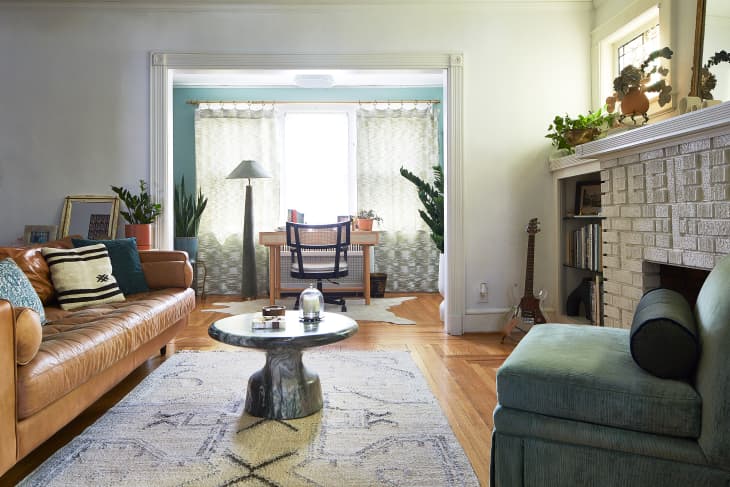
This breakdown actually helped me hone in on the right desk. I had set up the one I used in my last apartment, which was modern and fairly minimal, as it had occupied a small nook in my bedroom (see above). And it just felt, well, a little too small in the tiny sunroom, even when paired with a more substantial desk chair. The rug was a bit too small as well.
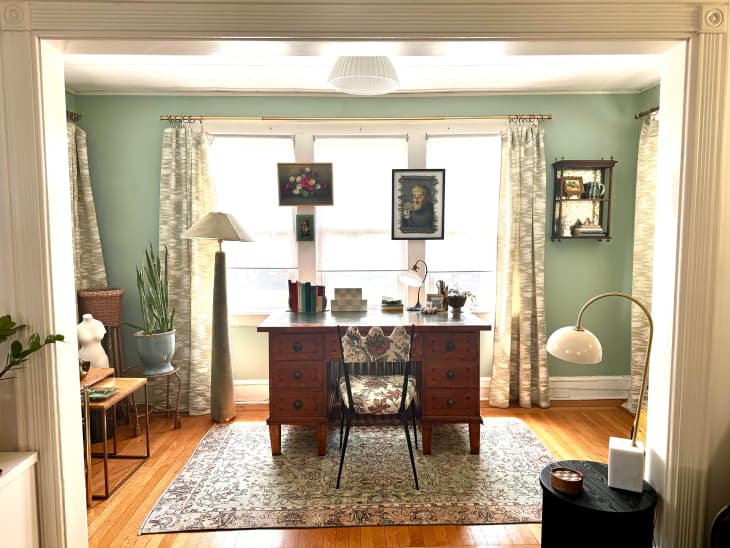
Ultimately, I found an amazing vintage desk that was larger and just has more presence, paired it with a more delicate chair, and I’m much happier with the result. To hit the 60/40 ratio, I added in a few plants in stands and on a pedestal, as well as a side table, and I’ve called it a day in terms of furniture.
How to Use the 60/40 Rule for Accessory Details:
What’s amazing is you can use this breakdown for other surfaces, too. Not sure how big to go with your gallery wall? The “60/40 rule” can help you out. For an arrangement that looks full but not overly so, pick pieces that, when considered altogether, won’t cover more than 60% of a given wall.
You can also think of the 60/40 rule as a way to balance out the individual items in a tableau. In this scenario, you’d want to reserve 60% of a coffee table’s top, say, for an anchor piece like a decorative tray, and then 40% of it for a couple of smaller decorative accessories, like a small stack of books and a candle.
Of course, these pieces don’t have to fill the entire 60% and 40% of the surface, respectively; it’s more about proportions here — the idea that your larger pieces should command up to two-thirds of a surface and then the smaller ones are reserved for that remaining one-third.
So the next time you’re struggling with a decorating project — and laying out a room or surface in particular — remember the 60/40 rule. It’s a great place to start if you want to create a sense of balance in a room.