
I Asked AI How to Declutter My Chaotic Storage Closet, and It Actually Fixed It
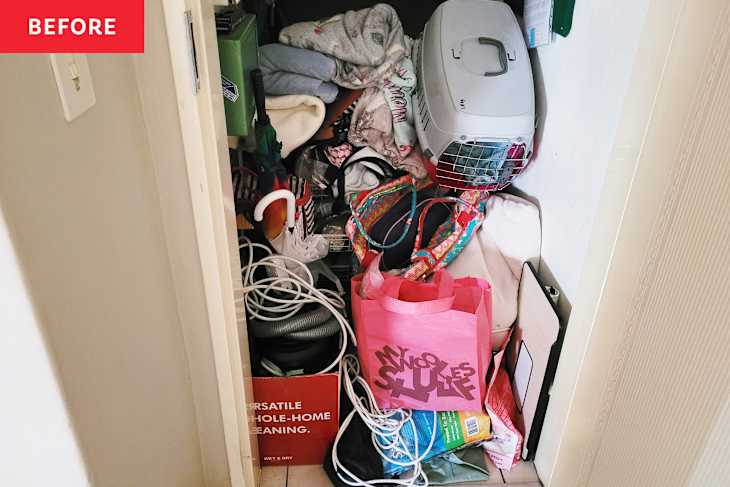
Over time, my storage closet had become the place where everything went when I didn’t know where else to put it. Suitcases were wedged behind a vacuum, cat carriers were stacked precariously on top of boxes, and somewhere in the back was a collection of miscellaneous items I was convinced I would eventually use. Opening the door felt like a game of Tetris — except nothing ever actually fit properly.
I knew it was time to tackle this mess, and instead of spending hours staring at it and wondering where to even begin I decided to ask AI for help. I uploaded a few photos of my closet into ChatGPT and accompanied them with the following: “This is my storage closet. It holds suitcases, cat carriers, a vacuum cleaner, DIY supplies, and various household items. Look at the photos and tell me what you would change first. I don’t want to buy lots of new storage products. I want to make better use of the space.” The chatbot’s response gave me a starting point in just a few seconds. Here’s everything it said and how I followed its advice to reclaim my mess of a closet.

Tip No. 1: Stop Organizing and Start Sorting
Instead of telling me to pull everything out and reorganize the entire closet at once, the agent suggested dividing the contents into broad categories and prioritizing the items I needed to access most often. It also pointed out that I was storing several bulky items in ways that created dead space around them. These are the four categories I landed on: regularly used items I should keep; occasionally used items I should keep; items I should move elsewhere; and items I should donate, recycle, or throw away.
Then, I said: “Help me decide what belongs in this closet. The main purpose of the space is household storage. I want to keep things that are bulky, seasonal, or difficult to store elsewhere, but I don’t want it to become a dumping ground.” AI’s answer helped me create the rule that if an item was useful but didn’t need to be accessed regularly, the closet was probably a good home for it. If it belonged in another room or hadn’t been used in years, it needed to go elsewhere. Items I use regularly should be stored near the front or at eye level.

Tip No. 2: Tackle the Bulky Items
The suitcases were one of the biggest problems because they took up so much floor and shelf space. I asked AI how I should store them so they take up as little space as possible but are still easy to access. Its recommendation was to nest the smaller suitcases inside the larger ones wherever possible, and to store the set vertically or along the side of the closet. It also suggested using the suitcases to store items associated with travel, like packing cubes, travel adapters, and toiletry bags. That cleared up an entire section of the closet without a single additional organizer.
The two cat carriers were also tricky because they’re bulky and oddly shaped, and used very rarely. I asked AI how to store them so they were still semi-accessible, and it suggested putting them together rather than allowing them to occupy separate areas. If they could be safely nested or stacked, that was preferable, while leaving enough clearance to remove the top carrier without dismantling everything around it. This advice was simple, but it was also exactly what I needed to hear.
Tip No. 3: Designate and Declutter
The vacuum cleaner was always leaning against something, so every time I pulled it out something else came with it. AI recommended giving it a dedicated vertical storage zone, ideally along a side wall or near the front of the closet, rather than treating it as another object that needed to be squeezed between boxes.
Next I had to address the miscellaneous DIY craft and home supplies: leftover paint, tools, hardware, adhesives, and various pieces of equipment that seemed too useful to throw away. I typed, “Help me declutter DIY supplies. What should I keep, what should I throw away, and what should I store differently? I have miscellaneous tools, hardware, adhesives, and leftover materials.” AI recommended grouping supplies by function and also reminded me to check for usability, such as dried-out adhesives, damaged materials, and duplicate tools. This advice made the process much less emotional; instead of asking myself whether I might use something one day, I asked whether it was still usable, whether I already owned another one, and whether it was worth the space it occupied.

Tip No. 4: Organize by Zones
Once I’d removed the items that didn’t belong, I took another photo and asked: “Based on this updated photo, create a simple storage plan for this closet. The main items are suitcases, cat carriers, a vacuum cleaner, DIY supplies, and miscellaneous household items. Prioritize easy access, vertical space, and keeping frequently used items toward the front.” This is where AI became particularly useful — it suggested creating zones rather than trying to make the closet look perfectly uniform. The bulky, rarely used items could go higher up or farther back, while things I reach for more often should stay closer to the door.
The final arrangement, roughly:
- Floor or lower section: Vacuum cleaner and other tall or heavy items
- One side toward the back: Nested suitcases, just behind the blankets
- Upper back shelves: Seasonal and rarely used household items
- Dedicated DIY zone: Tools and supplies grouped together
- Cat carriers: Stacked together in an accessible but out-of-the-way section to the right
- Front easy access area: Anything I use regularly (cat litter, food, etc.)

Final Thoughts on Using AI to Reorganize My Closet
I’m not going to pretend my storage closet now looks like something from a home organizing catalog. It still contains all the essentials, but now I can open the door without worrying that something is going to fall on me. The biggest surprise was that I didn’t need a perfect system — I just needed a clear starting point. It isn’t Pinterest-worthy, but it doesn’t need to be. It’s simply a closet where I can see what I have and, more importantly, actually get to it.
Letting ChatGPT help break the daunting project into small, specific decisions made the closet clutter feel way less overwhelming, and now the space works better for my actual life. I’ll definitely ask AI for help with my next organizing project.