
I Finally Ditched My Blackout Curtains After 5 Years — I’ve Never Slept Better
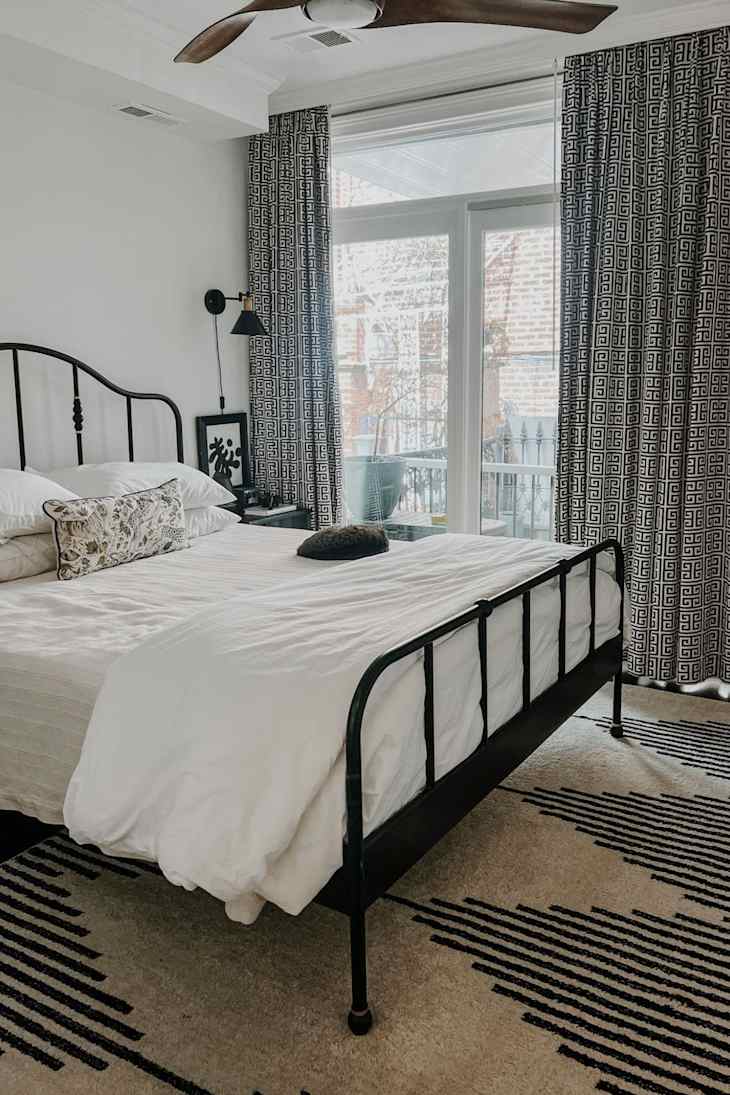
I’ve never felt strongly about blackout curtains. Light doesn’t seem to interfere with my sleep the way it does for other people, and I’ve always been fine with some simple blinds for privacy. But when I moved into a condo six years ago that had beautiful Greek key custom blackout drapery already in the bedroom, I figured, sure, why not leave them up?
My husband was in heaven. He believes there shouldn’t be a sliver of light in the bedroom at night, and these blackout drapes definitely accomplished that. I, however, would wake up in the middle of the night completely disoriented as to what time it might be. I would stumble to the bathroom, trying my best to navigate the complete darkness. In the morning, when I did finally wake up, I’d swear I felt groggier than I ever used to. And, worst of all, I struggled with headaches that seemed worse than anything I’d ever dealt with.
Five years later we moved into a new (old) house, and for the first few weeks we had zero window coverings on our bedroom windows. Luckily my husband had a sleep mask to get through the nights, but within a night or two I had a major realization: I was sleeping better and waking up feeling more well-rested than I had in years. We were sleeping on an air mattress in those early days, so I knew it wasn’t the bed. In my opinion, there was only one explanation: The blackout curtains had been the issue.
Is there any science to back that hunch? I talked to an expert to find out. Dr. Rebecca Robbins, Ph.D., is a sleep scientist at Brigham and Women’s Hospital, but she’s also a sleep expert for Hilton Hotels. And if anyone can speak to the effectiveness of blackout curtains, it’s someone who helps make sure hotel guests get the best sleep possible. Here’s what she said.
Do Blackout Curtains Help You Sleep?
Many people say that blackout curtains help them get the deepest sleep possible. And Robbins’ explanation supports the theory that blackout curtains help create that environment: “The best bedroom for sleep is dark, quiet, and cool,” she says. “A dark environment can facilitate the secretion of the sleep hormone, melatonin.”
The thing is, blackout curtains made me feel disconnected from my environment and as if I might just continue to sleep into eternity rather than get up at a reasonable hour in the morning. I try to go to bed sometime around 10 p.m., and I feel best if I wake up around 6 a.m. Without blackout curtains, that’s exactly what I do. When there was no light, however, I sometimes woke up in a frenzy at 8 a.m., wondering where my morning had gone.
For someone like me, who is going to sleep early enough to rise with the sun, Robbins explains that blackout curtains might not be necessary — which is exactly why they’d been such an issue for me. “If you are falling asleep at a time that would allow you to get enough sleep before the natural sunrise, then falling asleep after sunset and keeping your blinds open so that you could wake up with natural sunlight is advisable,” says Robbins.
That’s not always possible, of course — especially for people who work nights. In those cases, Robbins says blackout curtains really do help them to get higher-quality sleep. “It would be advisable to close your blinds, set your alarm for a time that would allow for enough sleep, then wake up with your alarm, open the blinds, and enjoy the natural sunlight,” she says.

What Happened When I Took My Blackout Curtains Down
As soon as I went without the blackout curtains, I found myself waking up naturally in the morning with the sun — no alarm needed. I wouldn’t try to go back to sleep or wonder whether it was too early to get up. I’d wake knowing it was time to start the day. I had more energy, less grogginess, and, particularly on sunny days, I would practically bound out of bed, ready to make breakfast and get to work.
There is no doubt in my mind this shift was a result of seeing the sunshine as soon as my eyes opened. It connected me to the rhythms of the day and put me in sync with a routine that is bigger than any alarm clock.
If you rely on blackout curtains to get enough sleep, though, Robbins explains that you can recreate this natural phenomenon. “Try to get out into the natural sunlight as soon as possible to help sync your circadian rhythm to the pattern of light and darkness outside. This can give you a jolt of energy, much like that of a shot of caffeine without the jitters,” she says. Using a sunrise alarm clock that mimics the natural light, even if it’s not actually streaming through your windows, can be another useful way to wake up.

What We Have Instead of Blackout Curtains for the Bedroom
Although I did part with blackout curtains in the bedroom for good, I did end up getting some Roman shades for the bedroom. I opted for lined Roman shades, which offer privacy and a bit of light filtering without completely blocking the sunlight from coming in. I wake up energetic with the sun, and my husband? He still has the sleep mask, which creates his own blackout cocoon despite the sun streaming in around him.