
I Incorporated This Heirloom from My Great-Grandmother into My Living Room (Everyone Who Visits Wants One!)
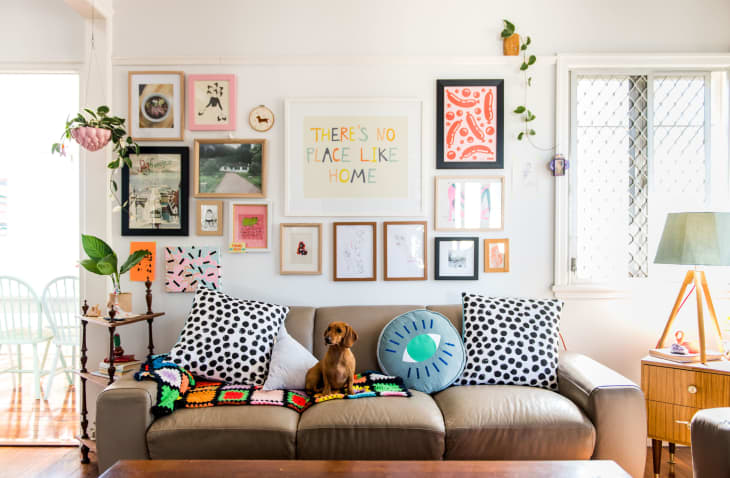
If you take one look at my parents’ collection of throw blankets, you’ll notice they’re all crocheted — except for an oversized New York Giants-themed one that’s reserved for football Sundays, of course. My great-grandmother is to thank for the full storage chest of these, as crocheted blankets were her love language.
While they’ve been a source of stylish warmth over the years, thanks to their lively look, the blankets are also a way to revisit some of our most celebratory family moments. From weddings and new homes to milestone birthdays and bridal showers, every special occasion of ours was marked with one of her crocheted creations.
Although it’s highly unlikely that my great-grandmother had my future living space’s color palette in mind when she was crocheting, she’d be happy to know one of her works is now the statement piece in my apartment. Beyond its intricate patterns and tasseled ends that make for an ideal living room accent, this blanket is so much more than decor: It’s one my great-grandmother made for herself before gifting it to my grandmother, who then gave it to my mother, who just recently passed it along to me. As a secondhand decor enthusiast, I proudly accept the title of fourth-generation owner.

Despite not having hands nearly as crafty as my great-grandmother’s, I’m glad I can celebrate this heirloom in my own ways — even if those ways are limited to styling it on my couch and cozying up with it on cold days. I will say that the blanket has made me realize how unfamiliar I am with what crocheting actually is, and its origins. Spoiler alert: That story doesn’t begin in my family’s storage chest.
What Is Crocheting?
According to the Crochet Guild of America (CGOA), crochet comes from croc, or croche, which is French for hook. While this might lead you to think that crocheting came from France, neither the CGOA nor Birdie Jones, author of the abbreviated volume of Threads of History: A Brief History of Knitting, Crochet, and Fiber Arts, can confidently place its roots there — or anywhere, really. Jones specifically notes this is because fibers used to first crochet were from natural sources, such as cotton and animal wool, which weren’t able to withstand the test of time and properly inform researchers on the who and when.
Both sources do note, though, that timelines have placed crocheting’s origins between 1700 and 1800 in Europe, when it was referred to as “‘tambouring.” This technique is an ancient embroidery form from China and involves a needle with a hook and a background fabric to help form the chain stitch. Tambouring eventually evolved to no longer require the background fabric as the 18th century was ending, and the new practice of ”‘crochet in the air” was born.

Crocheting is often bucketed with other forms of handicraft like knitting and embroidery. However, what makes it unique is the use of one hook instead of any needles, and that it’s always done by hand. Yarn is also continuously noted as the material used in crocheting by the CGOE and Jones, which makes sense, given lots of yarn forms are incredibly durable. All of a sudden, it’s no surprise why this blanket and others made by my great-grandmother have held up incredibly well over the decades.
Crochet’s (and Now My Living Space’s) Coolness Factor
The blanket is currently styled at one end of my sofa (see above), and its ivory and burnt sienna tones have brought a new energy to my accent pillows and the rest of my living room. I can eventually see myself wanting to style it as a throw on my bed, but it feels just right where it is now. I receive tons of compliments on the crocheted blanket, and I feel so fortunate that I now own such a sentimental conversation starter.
Lots of decor in my space has had a past life, and it’s only made me want to continue prioritizing the pieces that come with a story. And, hey, maybe I’ll eventually try my own hand at learning to crochet!
That’s the beautiful thing about this medium, too. If you don’t have a family member who crochets — and learning isn’t in the cards for you right now — you can find plenty of these pieces secondhand for great prices.
Design Defined
Never miss the style inspo and recommendations you crave with Design Defined. Follow along each week as our Home Director Danielle shares the best style advice, latest trends, and popular decor finds you just can't miss.