
11 Living Room Details That Designers Say Give Guests the “Ick”
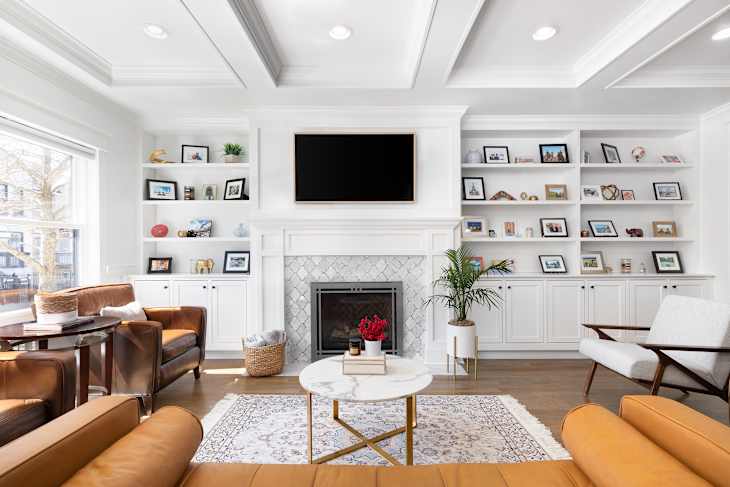
You’ve arranged — then rearranged — the artful stack of design books on your coffee table. You’ve fluffed the pillows your dog insists on squishing flat. You’ve lit the expensive candle. Still, something about your living room layout or vibe can read as “off” to guests walking in. The design quirks you’ve learned to overlook — the awkwardly sized rug you bought three apartments ago, the cords tangled behind the console, the artificial plant caked in dust — eventually fade into the background for you. To a fresh set of eyes, though, they stand out immediately. And despite all your efforts, these elements may create a bad impression you never intended to leave.
If you’re anxiously thinking about your own small living room, it’s time to put on a professional’s hat to rethink some of the details. I asked a duo of detail-oriented professionals — an interior designer as well as a real estate stager — about things that they zero in on when they’re entering a new space. And in living rooms, it’s a mix of small touches and big-picture elements that may have you rethinking decor choices in the long run (especially if you’re trying to sell a home!). More likely than not, you’re hoping to avoid someone clocking anything the second they walk in. Below, I’m walking through 10+ details that may be silent faux pas you never intended to commit in the first place.

1. Cheap Artificial Plants
“Artificial plants, such as an obviously fake fiddle-leaf fig collecting dust in the corner, can immediately cheapen the entire space,” says Austin-based interior designer Alicia Roche. Either invest in well-made faux greenery, or research easy-going live plants that’ll thrive in your space, taking into account the natural light and how green your thumb is.
Low-maintenance options, like a ZZ or snake plant, can survive infrequent waterings and inconsistent sunlight. “Paired with the right riser, they’ll look far better than a poorly made artificial alternative,” adds Roche.
2. Pet Odors and Hair
Sorry, Buster. You may no longer see or smell traces of your beloved four-legged friends in your living room, but guests most definitely can — and for potential buyers, pet evidence can be an especially big turnoff.
“No one likes it when they stand up from sitting on your couch with pet hair all over them,” says Rebekah Cook, managing director and Realtor with Minneapolis, Minnesota-based Anderson Realty. “Managing pet smells and hair is a never-ending battle, but it’s worth it.” Consider an air purifier, and invest in a vacuum cleaner that’s strong enough to handle pet dander and shedding.

3. A Bad TV Placement
If anyone understands, I do: Having a comfortable place to watch your favorite binge-worthy television shows (for me, it’s Bravo all day!) is a top priority. Still, an oversized television perched on a console can dominate a room instead of blending into it.
Roche suggests a clean wall-mount TV installation, an art television like Samsung’s The Frame, or in-wall equipment for a more streamlined look. A projector is another option, as those screens are usually retractable and less noticeable. To conceal a TV entirely, go further with custom cabinetry with doors, sliding artwork, or a roll-up tapestry.
4. Intact Furniture Sets
A fully coordinated furniture set — same wood, same fabric, same scale — can make a room feel like it was plucked off a warehouse floor and never considered again. That matchy-matchy approach can also give a living room an unmistakably dated feel, especially when every piece shares the same finish and silhouette. “A fully coordinated living room set often recalls the interiors of the 1990s and early 2000s,” Roche explains.
Cook agrees. “Throw in a vintage coffee table with that new couch,” she adds. “We don’t want it to look like a showroom. It feels too sterile.”

5. A Rug That’s Just Too Small
A too-small area rug doesn’t just look off; it can make a whole room feel unnecessarily cramped. “She’s cute, but she doesn’t make sense,” Cook says of undersized area carpets.
If you happen to have gone a little too, well, little with your rug, don’t worry. Easy fixes exist, even beyond replacing the rug. “We often end up bringing in a larger rug or layering the small rug over a larger rug to help ground the space and make sure people know the living room is big enough,” says Cook.
6. Generic Artwork
That framed print from a big-box retailer’s “art” section? Chances are your guests have seen it before — maybe even in someone else’s living room. “When artwork feels overly familiar, it can make a room appear less personal, less thoughtful, and ultimately more dated,” Roche explains.
Art can be the ultimate conversation starter, and you don’t have to spend a fortune for something special. Consider framing meaningful family heirlooms or antique store finds instead of a mass-produced buy with no story behind it.

7. Wall-to-Wall Carpet
Wall-to-wall carpet in a living room can be a sticking point — not just for potential buyers, but for anyone who prefers the look and flexibility of hard flooring. “Unless it’s a lower-level family room or a mid-century with the perfect wool carpet, most [people] want hardwood floors in their living room,” says Cook.
For some, wall-to-wall carpeting can make a space feel instantly dated regardless of other decor, while hardwood offers a more timeless foundation that can be layered with rugs for added warmth and softness. Best to go a little more modern underfoot with hardwood or laminate flooring if you can, as it can often be better for those who suffer from allergies as well.
8. Forgotten Window Treatments
Curtains and blinds are easy to install and forget about. That’s precisely the problem, as they tend to hang around even as your style evolves (especially if you’re a renter!).
“Poorly installed window treatments can look flimsy, while outdated styles may suggest they have remained in place far longer than the rest of the decor,” Roche says. “When they do not complement the room’s current aesthetic, they feel noticeably dated and out of place.” The upshot here? Your curtains might be worth replacing if you haven’t thought about them in years.

9. Oversized Family Portraits
That gallery wall of school photos and family portraits might be the thing you love most about your living room. But it’s the first thing a stager pulls down when prepping a home for the market. “Your kids are cute, but no one can imagine themselves living in your space with your family staring at them on the wall,” Cook says.
Even when you’re not trying to sell, guests can sometimes find an entire wall of large-scale portraits a little overwhelming or self-focused — particularly when there’s nothing to counter personal photography. Overloading your room with photos of yourself or your family can start to feel more like a shrine to the people who live there over a thoughtfully designed room. By all means, if your family photos make you happy, go for that gallery wall. But know that designers say it can often be best to display these types of pieces in more private spaces, like an upstairs hallway or bedroom.
10. Excessive Open Storage
Baskets and bins and cabinets, oh my! “Open storage can quickly become a prominent column of visual clutter,” explains Roche. The catch-all basket that swallows books, toys, and everything else without a proper home can read as clutter, especially without a lid on it. Roche equates it to the living room equivalent of a bedroom accent chair buried beneath a mountain of laundry.
The issue of excessive open storage, though, is an easy solve. Bring in some lids so those containers look a little more intentional. Or consider investing in built-ins with cabinets that allow you to close the door on some of your stuff.

11. Too Many Sofa Pillows and Blankets
A few strategically placed throw blankets and pillows can make a sofa inviting; a pile that’s so deep there’s barely any couch visible is another story. “What do we do with all of them, and where do we sit?” Cook says. “Would you ever have 10 people trying to cozy up with a different blanket at the same time?”
Ultimately, the most inviting living rooms aren’t necessarily the ones with the most stuff; they strike a balance between personality, comfort, and actually having room to live.