
6 Outdoor Trends That Kill Curb Appeal, According to Designers
Here’s the harsh truth about a home: Even the most impeccably designed interior can’t overcome a sloppy exterior. Whether you’re strolling up the walkway each day after work or you have friends coming over for dinner, being greeted by an array of mismatched planters, out-of-season decor, and cluttered flower beds definitely throws the vibes off. And this could happen long before you’ve even reached the front door!
These factors all contribute to the curb appeal of your home. While some updates may be well-intentioned, not every design choice is a good thing — often, less is more in the front yard!
To keep your home from becoming that house on the block, I asked the pros to identify six outdoor trends that might be ruining your home’s curb appeal. They also provided their designer-approved strategies for fixing them, so you can be sure your place shines all year long.

Doing Too Much
Have you ever walked past a house and thought, “Wow, they tried to do everything here”? They have the water feature, the tulip garden, the yard art, the bird feeder, the arbor, the over-the-top seasonal decor. Anything that’s ever been thought of as yard decor or landscaping is there, without any regard for what actually fits into the parameters of the space.
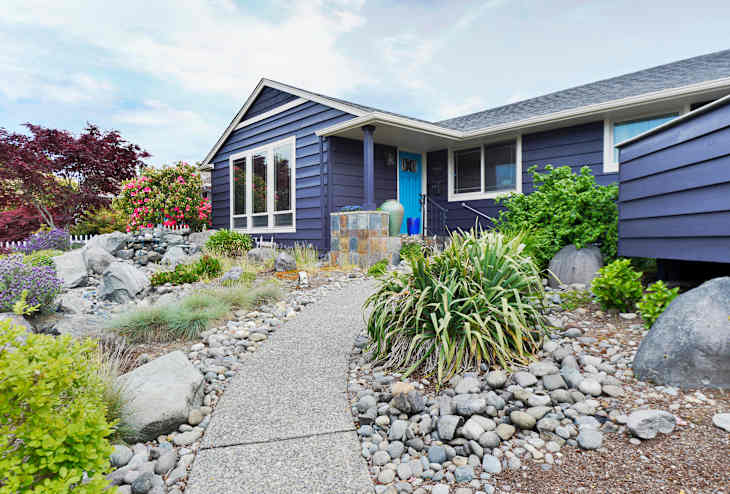
Luckily, curb appeal is best when done with less. “One of the biggest mistakes homeowners make when it comes to curb appeal is overcomplicating the landscape,” says Joseph Richardson, founding principal of Richardson & Associates Landscape Architecture. “In many cases, simpler is better. The most successful outdoor spaces feel cohesive, intentional, and appropriate for the architecture of the home.”
Think about what type of home you have and what your geographic location is, and let that guide you as you select a few elements to play up. All you really need is some shrubbery, a few flower bushes or beds, and maybe a fun front door color.

High-Maintenance Landscaping
Even if you absolutely love gardening, are you really going to carefully tend to the climbing roses you planted? Are you going to have the patience to deadhead and prune?
So don’t get caught up in the charm of the beautiful yet formal gardens you see on Instagram. Anything that requires maintenance or seems highly specific is likely a bad trend to follow, whether that’s due to a persnickety plant or patio materials that need regular refurbishing.
The problem is that the more high-maintenance your yard is, the worse for wear it’ll look when you miss even just a few days or a week of upkeep. “A common issue is installing landscapes that require more upkeep than the homeowner can realistically manage, which can quickly make a property feel neglected,” says Richardson. Better to choose plants, materials, and elements that match your lifestyle and allow a little more room for error.

Kitschy Signs
If the “She Shed” or “There’s No Poop Fairy Here” sign speaks to you, don’t let me tell you otherwise. But designers find signs a little too kitschy. “Go easy on ‘hand-painted’ signs on your front porch,” says designer Laura Medicus.
For more classic curb appeal, maybe skip the signs altogether — or limit them to major seasonal moments where the neighborhood vibe is a little more whimsical on the whole. You can always convey your sign’s message the next time you’re chatting with a neighbor.

Over-the-Top Seasonal Decor
Who doesn’t love a home that’s all decked out for Christmas? Or a house with a few tasteful strings of Halloween bats? Seasonal decor can be done intentionally and in a way that actually adds to the curb appeal of your home. But you have to know when to cut it off — and you might arrive at that place faster than you think. “Avoid too much stuff from the seasonal aisle at the discount retail stores,” says Medicus. “That type of decor is over-used and can look cluttered.”
To rein things in a bit, try decorating only with the seasonal decor you can easily put out in a day and can store out of sight in the off-season. As soon as items start to become fixtures long after their holiday has ended, that’s when your seasonal decor has crossed the line from enhancing curb appeal to cutting into it.
You don’t have to avoid decor altogether; just shop for things that are maybe a little less season-specific, and consider giving them a little bit of seasonal flair instead. “Look for a few classic items that can be used either all year round, or most of the year, like tall lanterns with solar candles and large pots you can fill with annuals in the spring and pinecones in the fall,” Medicus adds.

Trendy Items
Buying smaller planters is cheaper, and you might feel like it’s better to stock up on more of the stylish pot you’ve seen all over social media rather than splurge on the one bigger planter. But tons of bitsy planters can contribute to a cluttered, chaotic feeling that can bring down your curb appeal.
“Think fewer, larger pots of plants over multiple small pots for a bigger impact,” says Medicus. If you want more variety, you can try a few smaller pots on a larger plant stand. Rotate things in and out of the display instead of continuing to add more and more around it.
And don’t feel like you have to have hanging chairs or any other of-the-moment accessories out front. These features are far better in your backyard, where you have a little bit more privacy and potentially more room for furniture and objects.

Single Note Landscaping
It’s all too easy to go to the nursery to pick out a dozen of the same shrub — and a dozen of the same flower — and then put them all in the ground without any regard for how they’ll create movement or a cohesive color palette. But that single-note approach is how you end up with a yard that’s visually monotonous.
“Stay away from landscaping that’s all one height;” says designer Barrett Oswald. “When everything is level, the house just looks flat.”
Instead, Oswald suggests building in layers with tall trees, shorter shrubs, and different textures. “It frames the house better and makes the yard look like it was actually planned out rather than just filled in,” she says.
Design Defined
Never miss the style inspo and recommendations you crave with Design Defined. Follow along each week as our Home Director Danielle shares the best style advice, latest trends, and popular decor finds you just can't miss.