
Designers Always Notice These 5 Home Styling Mistakes
While interior designers are expert big-picture thinkers, they’re also extremely in tune with smaller styling details. They’ll notice if, say, a piece of art is too small (or large) for a given nook of the home — or whether the textiles in a room are reading as sad and dated. And that’s just the tip of the iceberg.
I asked three pros to weigh in on five common styling mistakes that, unfortunately, can make your space look off instantly to anyone who passes through your doors. Don’t worry, though: Those same experts also offered easy, stylish swaps that you can make instead. That way, your rooms will be welcoming and warm all year long.

Hanging Too Many Small Pieces of Art
Remember to vary the size of art you’re displaying on the walls of your home. Too much uniformity and too many bitsy pieces are pet peeves of designer Mariella Cruzado, the founder of Splendor Style. She’d rather see a few pieces that can serve as “large focal points” versus fewer “small pieces of art scattered around.”
Not only does the too-many-pieces phenomenon look off from a scale perspective, but it also isn’t going to distract from a so-so wall color. “I see this happening especially when the homeowner is hesitant to paint walls and instead tries to fix the space with art so it doesn’t feel boring,” Cruzado says. Grabbing a paint brush may very well be the more impactful solution! Then you can accent your new paint job with fewer but more substantial pieces of art to truly anchor your space.

Relying on So-So Pillows
Are your throw pillows looking worse for the wear? If so, they might be bringing your entire room down, according to designer Tiffany Skilling. “Thin, lifeless fabrics and inserts that don’t properly fill the covers leave them looking limp,” she says.
It’s all about quality over quantity for Skilling. “I would rather see a few beautifully made pillows with texture, substance, and generous inserts than a sofa crowded with pillows that don’t add much and leave you nowhere to sit,” she adds. You might even consider going a little larger with your inserts — say, a 20-inch square insert in an 18-inch pillowcase — to make your throw cushions look more substantial. Just make sure when you’re styling a seating area that there’s always a place for people to comfortably rest.
Choosing Mass-Market Art Only
Your art doesn’t have to be expensive, but it shouldn’t all be mass-produced if you can help it, Skilling advises. “Art is an opportunity to bring personality and emotion into a home,” she shares. “A small original work, a vintage sketch, or a beautifully framed drawing from your child can have so much more presence than a large generic print.”
Like her position on pillows, Skilling says it’s better to have fewer, quality pieces of art when you start your decorating journey rather than racing to fill your walls. “Choose something that means something to you, and let your collection grow over time,” she says. You can visit flea markets, craft fairs, local art galleries — or even look on Facebook Marketplace for artists you can commission pieces from. You might be surprised how affordable and special a piece from an up-and-coming artist can be.

Turning Books Backwards
If you’re going to display books throughout your home, there’s no need to turn them around so that their titles are hiding, notes designer Pallavi Kale, who finds this kind of setup to be too fake-looking and impersonal. It’s something stylists occasionally do to avoid issues with publishers on cover rights in professional interior photo shoots. But it’s not necessary or practical in your own home.
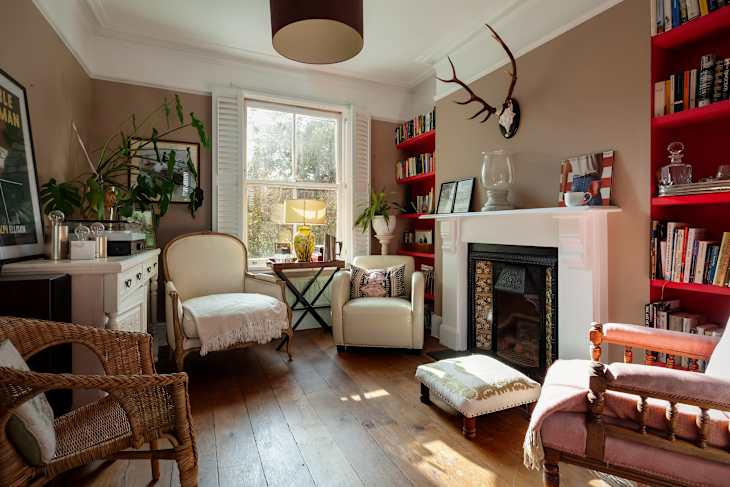
Putting your book jackets and spines on display can actually provide a window into your interests and be a great conversation-starter for guests; plus, it’s just plain functional for when you want to flip through one of your favorites on a quiet day. “I love being able to glance at someone’s bookshelf and see what they’re into,” says Kale. “When you hide the titles, the books start to look like props, and it’s harder to find the one you actually want to pull out.”

Treating Every Shelf the Same with Trendy Items
When it comes to styling your bookshelves with objects, be sure to switch things up, Kale says. “I always notice when every shelf has the same formula: a stack of books, a tiny vase, a strand of beads, a decorative knot,” she says. “When it’s all generic, big-box decor, the shelves start to look like a store display.” Don’t be afraid to think outside the box a bit. “I’d much rather see a piece of pottery you picked up on a trip or something your kid built out of LEGO blocks,” Kale reflects.
Skilling feels similarly. “When everyone has the same bowl, vase, or decorative object on their coffee table, our homes start to lose their individuality,” she says. “You don’t need everything to be rare or expensive, but the combination should feel like it belongs to you.”