
Her 5 Tips Transformed My Cluttered Medicine Cabinet — Now I Have Ample Bathroom Storage
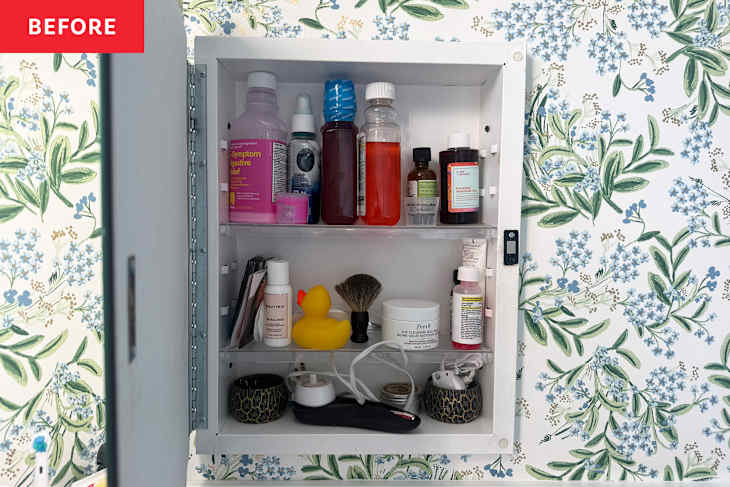
Without my medicine cabinet, I’d have almost no bathroom storage. The tiny primary bath in my rowhome has an 18-inch vanity, which means I have just enough room for a few rolls of toilet paper and an extra bottle of shampoo underneath the sink. The medicine cabinet, however, gives me enough room for floss, makeup remover, and, of course, medicine.
But, transparently, my medicine cabinet is a mess. It’s partly due to my denial that the space, while useful, is small. I also had a hunch it’s not being utilized in the most efficient way, so I decided to ask an expert what I should do. Blanka Molnar, professional organizer and founder of Your Sorted Space, shared with me her advice on how I can make sure my medicine cabinet is living up to its full organizational potential.

Tip No. 1: Declutter Before Organizing
In small spaces like my medicine cabinet, it’s easy to think that it’s already as minimal as possible. But Molnar recommends always decluttering before you organize, even if you think you don’t need to: “Empty your cabinet and check if there are any items that are expired, like medication or health and beauty items,” says Molnar. If they’re expired, toss them, along with worn-out tweezers and makeup sponges.
I immediately noticed there was a rubber duck that I definitely didn’t need and, sure enough, a pair of old tweezers and a bottle of expired Pepto-Bismol that needed to be thrown away. Molnar notes that medicine cabinets are often home to items that need to be disposed of correctly. “Dispose of medication at your local drug take-back site, like a pharmacy or hospital,” explains Molnar. “If you have prescription medication, remove the label and empty the bottle before you recycle the plastic bottle.”
Tip No. 2: Consolidate and Categorize
Once I decluttered items I no longer needed, Molnar suggested sorting the remaining items into categories. “Consolidate the items by category, like with like. For example, your cold medications, first-aid items, or pain relievers [would go together],” she says. Do the same with your health and beauty products.
This is something I’ve loosely accomplished, but it was more about where things fit. For example, medicine bottles only fit on the top shelf, so that’s where they’re grouped. Molnar encouraged me to put more consistency into my organization, so I grouped dental supplies together, grooming items together, and skincare (although I try not to keep most skincare in the bathroom because humidity can degrade it).

Tip No. 3: Use Containers
Generally, I don’t like to buy things to make myself feel more organized, but Molnar encouraged me to “containerize” items within visually cohesive containers to cut down on the sense of chaos. “Items floating in a cabinet cause a visual clutter feeling,” she says. “I would replace the small black and gold containers with clear square or rectangular-shaped containers to create a unified look and maximize space.”
I’ve been using old candle containers to organize items, but Molnar points out that the round containers aren’t maximizing the space, and the visual inconsistency is not doing me any favors. She specifically recommends small square-shaped containers, or longer 9-inch or 6-inch containers to group medication bottles together (which, yes, fit my small and shallow medicine cabinet!). “These are great options because they’re clear so you know what you have in them,” adds Molnar.

Tip No. 4: Corral Cords
One item that’s always bugged me is my toothbrush’s charging cord. On one hand, I don’t want it sitting out all the time, particularly given the vanity is so small and doesn’t have room for items to live there permanently. On the other, the charging cord is a mess when it’s stuffed in the medicine cabinet.
Fortunately, Molnar had an obvious solution that hadn’t occurred to me: to roll up the cable for the toothbrush and secure it. She suggested using either a reusable cable tie or silicone cable tie.

Tip No. 5: Decant Cohesively
Lastly, Molnar gave me an additional optional suggestion. While decanted bottles are beautiful in the kitchen, she recommends doing it in the bathroom too for apothecary-level organization.
“If you go one step further, you can use reusable glass or plastic bottles for each liquid medication and replace their original bottles for a more unified look,” says Molnar. She notes that you need to label them correctly and preserve any necessary information.
The End Results
I’m not quite there yet on her last tip, but I’m headed that way — we’ll see if I can stick to the initial four tips to keep my petite yet impactful medicine cabinet organized first.