
37 Small Entryway Ideas for Tiny Homes and Micro Apartments
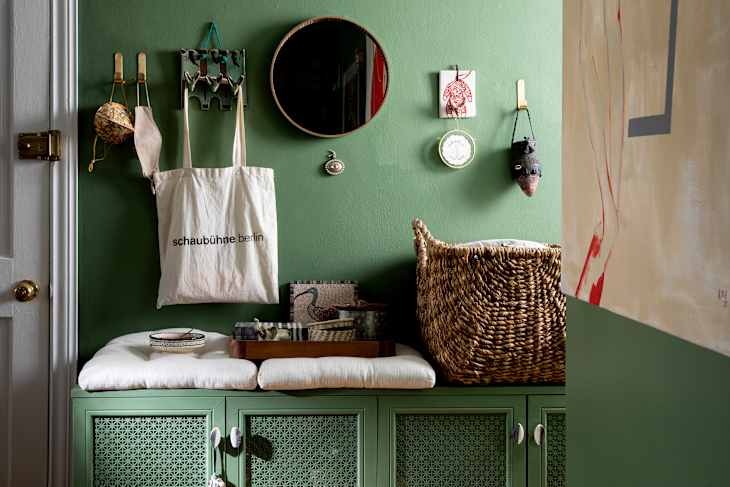
Whether you live in a studio apartment or a suburban cottage, even the smallest of floorplans have clear entryways that act as hotspots all day long as you come and go. Shoes, coats, keys, mail, and essential storage for homes with nonexistent closet space; entryways are crucial spaces.
Solving problems in small spaces is what Apartment Therapy editors obsess over — particularly, in our real-world house tours that feature how people get creative in limited floor space, including the precious square footage right behind your front door. We regularly feature storage and decor solutions that make apartment living much easier.
When solutions for a space seem limited, that’s when design get inspired; key selections in decor, furniture, and color make it possible to create a welcoming spot, no matter how small it is. Follow along to see how designers have dreamed up the most compact yet functional entryways — plus, real-world solutions that set the mood for a beautiful space to welcome you home.
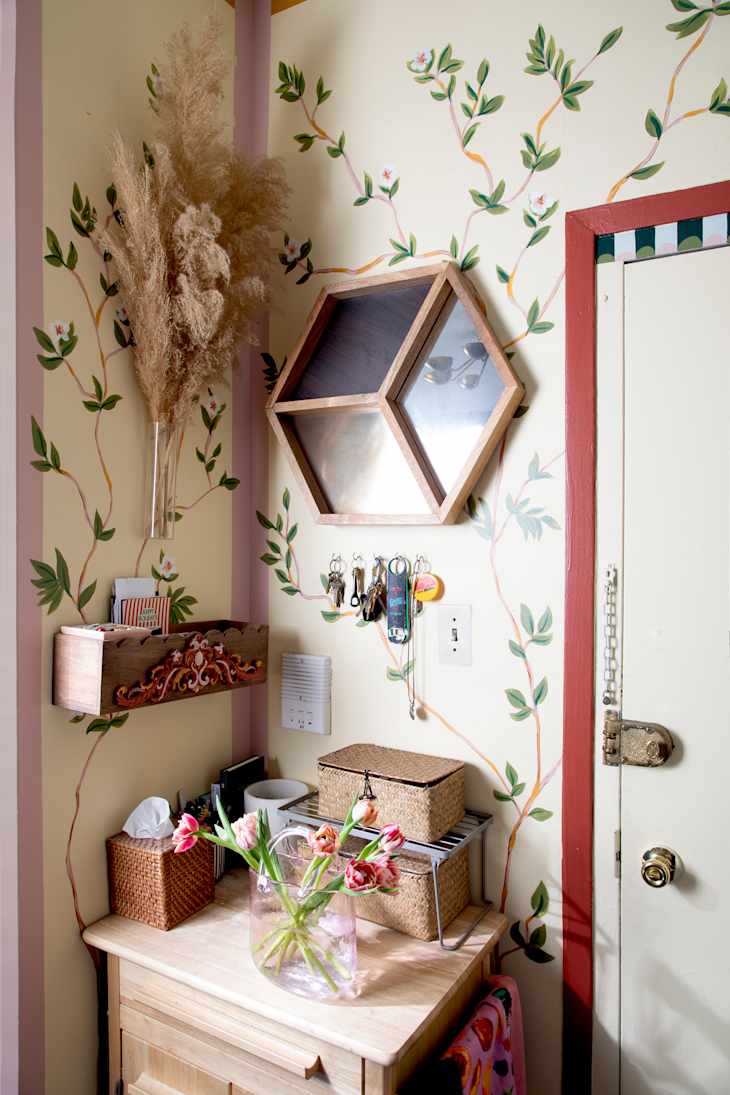
1. Utilize Vertical Wall Space
It’s the easiest thing to do when you’re looking to make your entryway a storage haven but don’t have the floor space for freestanding hutches, shelving, or tables. Turn to your wallspace and use freestanding hooks, mounted shelving, and other up-and-out-of-the-way solutions to organize mail, keys, and more. Even statement decor can be affixed directly to the wall — in this tiny New York City studio apartment, a geometric wall mirror as well as dried florals help to distinguish the entryway from the rest of the space.
Total size of home: 360 square feet.
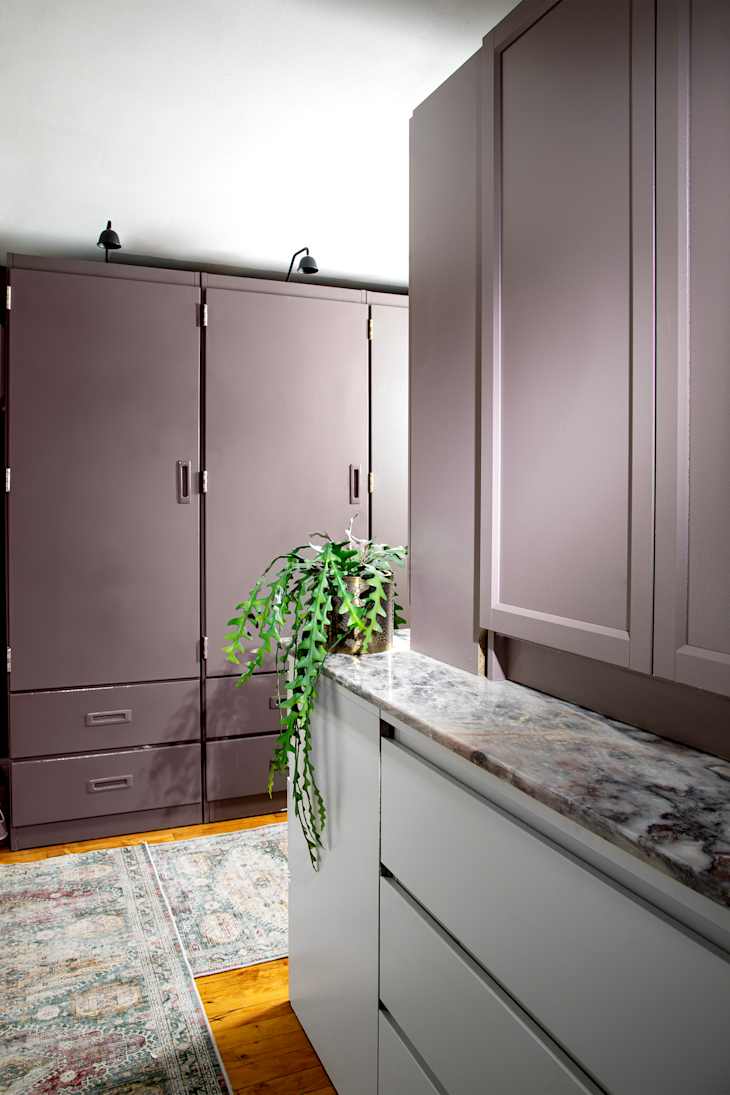
2. Install Additional Storage Units
In a studio apartment where built-in closet space may be missing? Turn the dead space around your front door into a proper closet with the help of freestanding wardrobes, which won’t overwhelm the rest of your living space when they’re tucked next to your front door. In this small Manhattan studio apartment, the renter rescued two sets of modern wardrobes that she placed together right to the left of her entryway — this placement ensured more free-flowing movement near her formal sitting space and bed area where she hosts guests. Because of this particular placement, her guests also don’t have the floor-to-ceiling wardrobes in sight until after they’ve sat down inside (the door conceals them when it swings open).
Total size of home: 580 square feet.
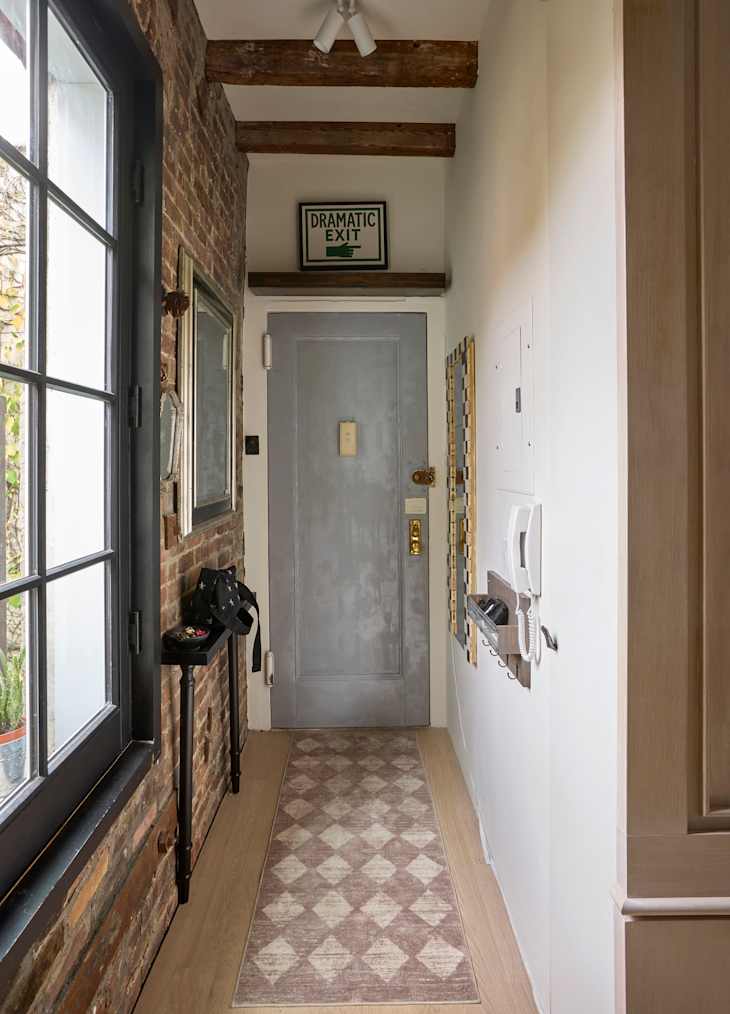
3. Cut a Console Table in Half
Anyone living in a tiny home would tell you that not all furniture is made equally — and sometimes, the best fits for minuscule entryways are custom. The family living in this 1-bedroom Manhattan apartment mounted a skinny wooden shelf to the brick in their skinny gallery hallway entryway, making use of parts of a recycled bedframe. The catchall ledge serves as a place for mail, keys, and other daily must-haves for a busy life on the go.
Total size of home (as pictured): 450 square feet.
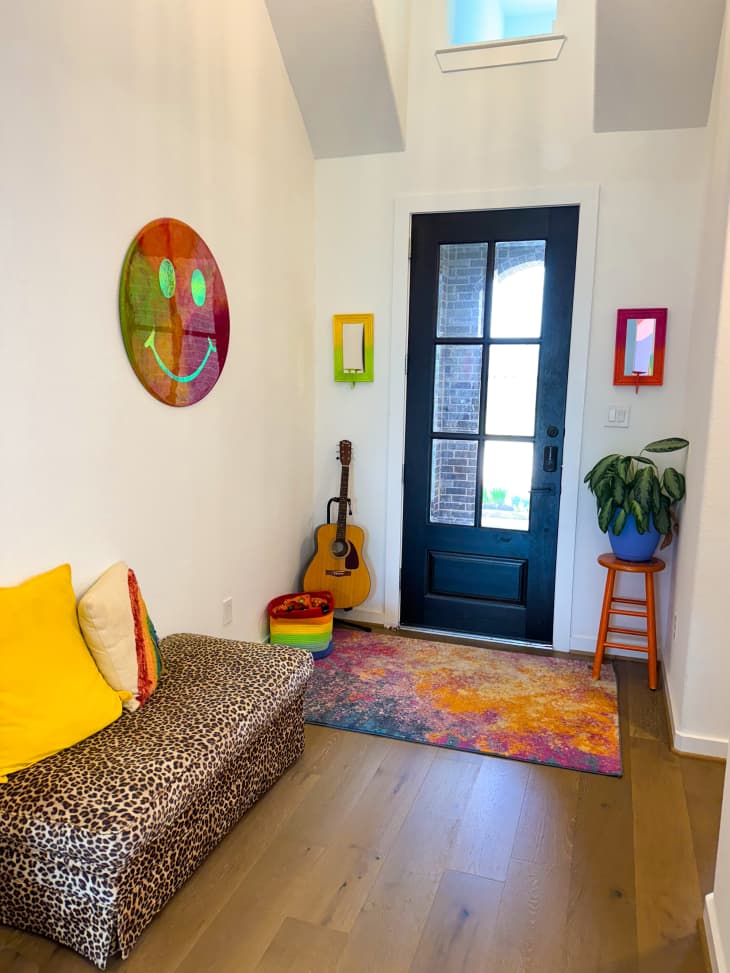
4. Opt for a Storage Bench
The best way to organize clutter? Hide it! The side entrance to this 5-bedroom home in Houston is the family’s most commonly used, and given its downsized nature, they went for a minimal footprint (quite literally). Rather than opt for a clunky shoe rack, this storage ottoman serves a dual purpose; shoes are stored inside and taken out when needed, where the bench also serves as a place to quickly put them on. Style and function in one!
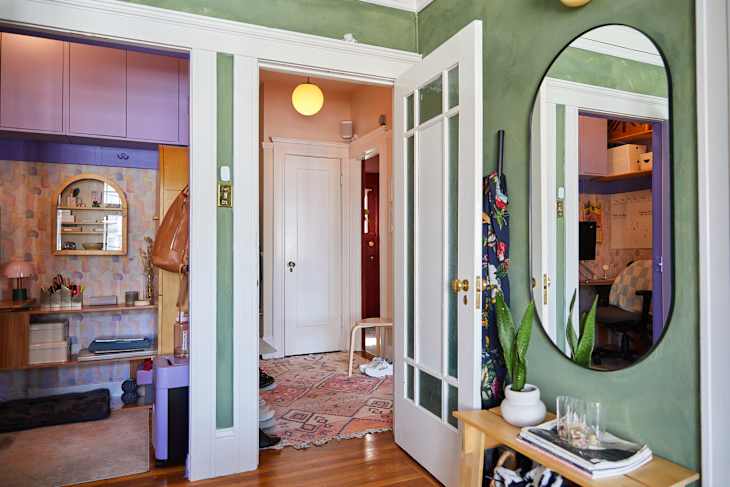
5. Trim a Throw Carpet
When you’re working with a cramped apartment entryway that immediately bleeds into other rooms, as seen above, it’s hard to create definition. Do what the family living in this 2-bedroom San Francisco apartment did — buy a standard 4’x6′ throw rug and cut it down to the size of your doorway entry. This helps establish a formal entryway threshold in tight, micro-sized spaces.
Total size of home: 600 square feet.
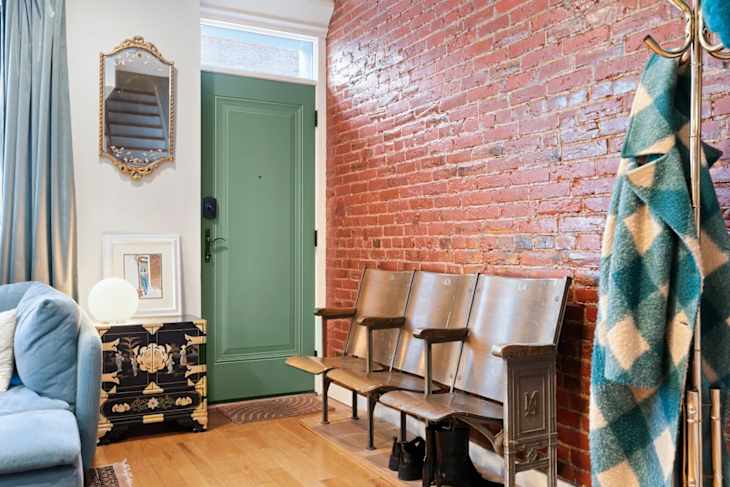
6. Repurpose Antique Furniture
Most Philadelphia homes don’t have formal entryways, says Ana Cvetkovic, interior designer and stager at Rowhome Design — including her own 1,700-square-foot home. She created a distinct yet functional entryway anyway, incorporating key statement pieces such as an antique storage cabinet, a lamp for ambient lighting, and antique theater seats that serve as a spot to sit and remove shoes. In the cold season, she adds more function with a coat rack next to the shoe bench.
Total size of home: 1,700 square feet.
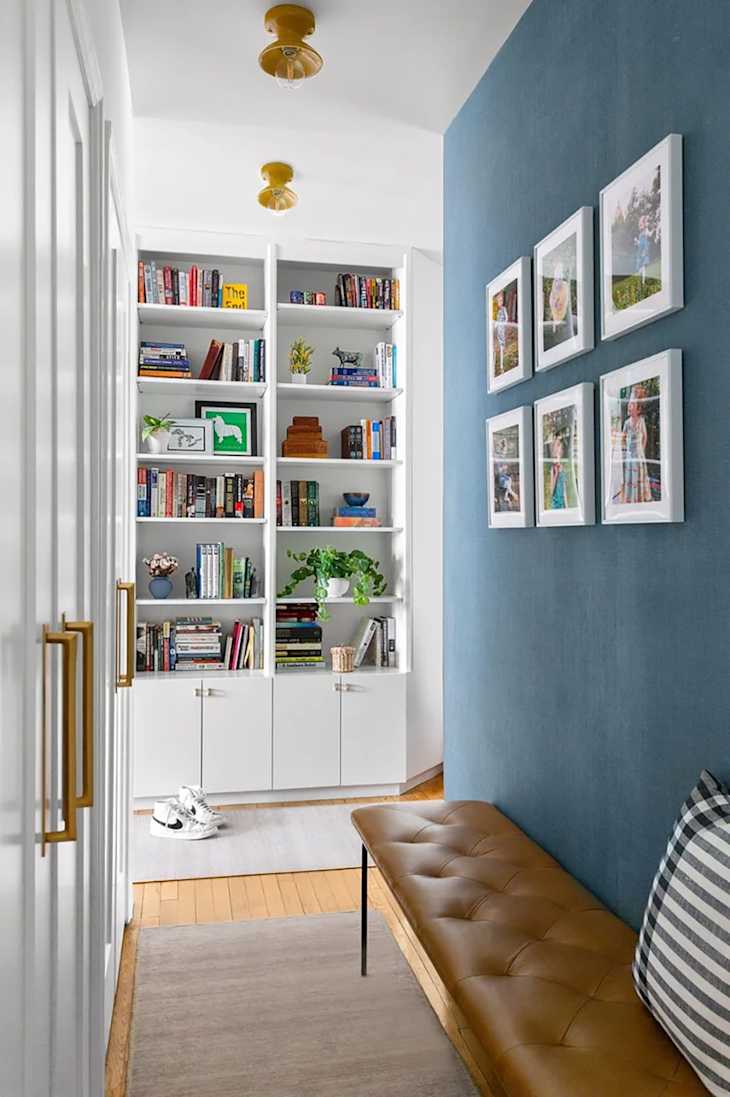
7. Install Custom Lighting
Isabella Patrick of Isabella Patrick Interiors transformed what she calls a “small and awkward” entryway into something functional and beautiful for this Upper West Side apartment in New York. She upgraded the lighting, hung a unique mirror, and installed a beautiful shelf as a drop zone for small items. The blue textured wallpaper in the entryway is also seen throughout the home. “Start creating your color story [in the entry],” she advises.
Total size of home: 800 square feet.
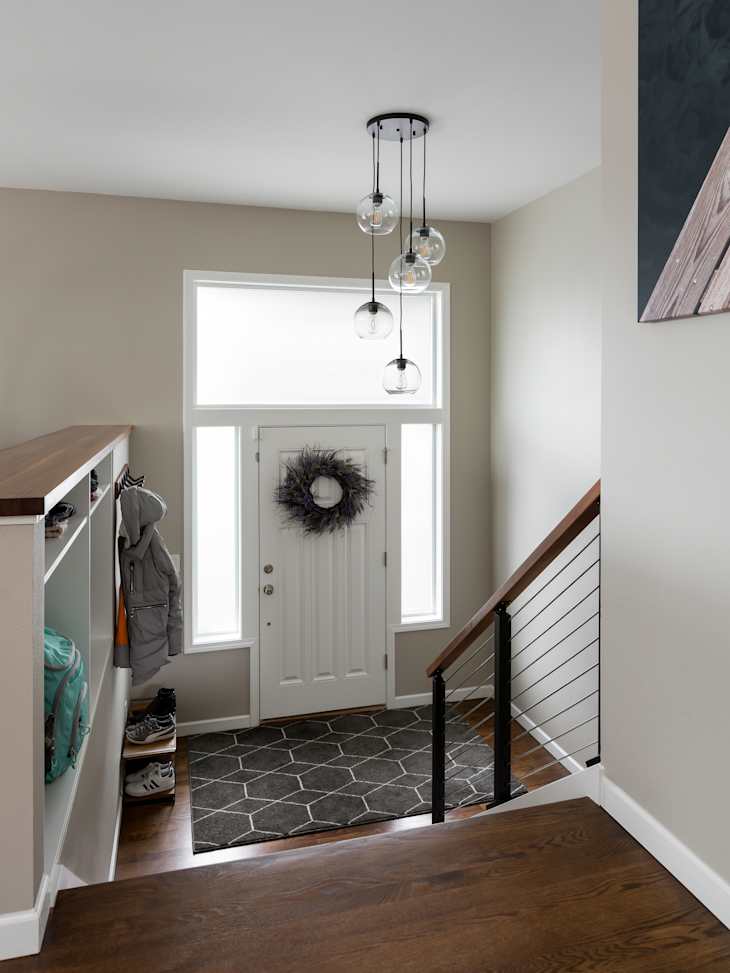
8. Add Hidden Storage Inside Split-Level Entry
Rebecca West, author of Happy Starts at Home and interior designer with Seriously Happy Homes, says that split-level homes “are notorious for having terrible entry storage.” For this home in Seattle, she replaced the spindle railing with a deep pony wall to create storage for shoes, coats, backpacks, and even a charging outlet. “The entry remodel helped them get their gear off the floor and enjoy a more orderly, inviting entryway,” she adds.
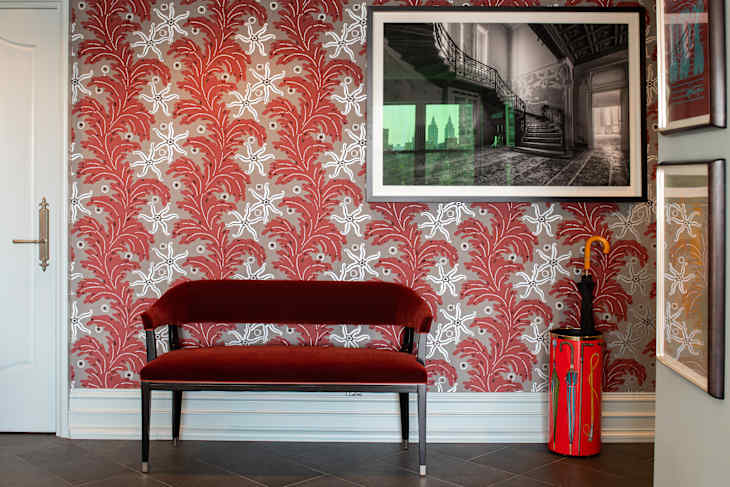
9. Create a Landing Spot
Interior designer James Yarosh says “seamless blending and intermixing of recurring design elements helps” when creating an entryway where none exists. Here in this one-bedroom Manhattan apartment, a bench serves as a “landing spot” against a backdrop of bold wallpaper that complements the dining table (not seen) with a silver Art Deco base and wine-colored surface.
Total size of home: 800 square feet
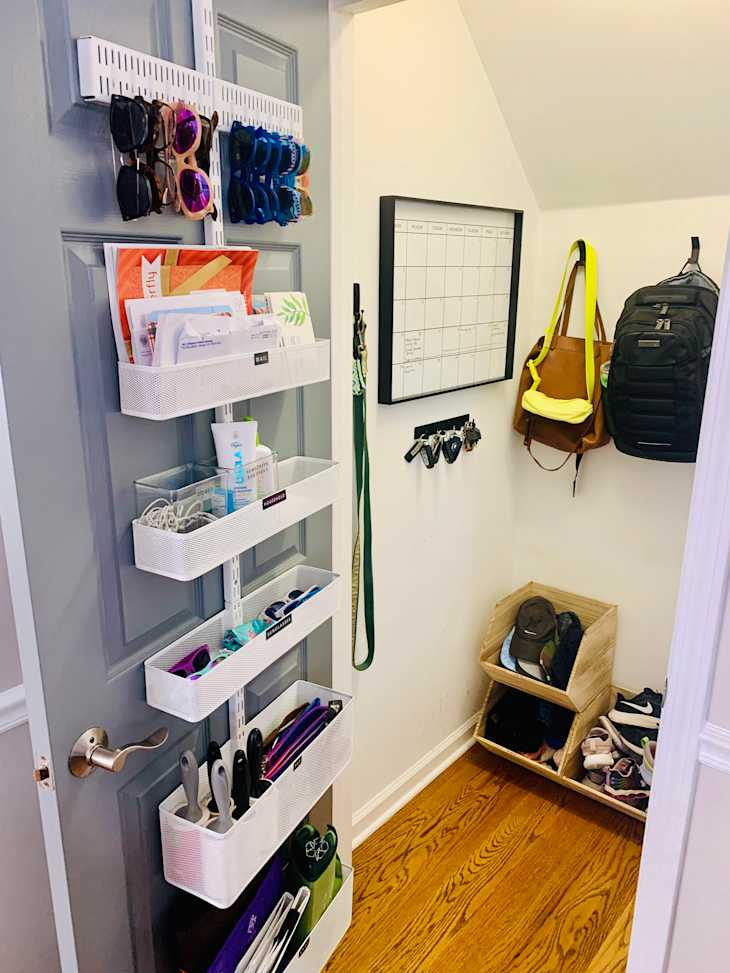
10. Add an Over-the-Door Closet Organizer
If there’s a coat closet right off the front door, make the most of the space with an over-the-door organizing system. “They instantly create extra room for everyday essentials without taking up any floor or wall space. With the location being behind the door, they stay out of sight, keeping the area visually clean and clutter-free,” says Marie Jackson, a professional organizer and owner of Organized Marie in Charlotte, North Carolina.
This spot, which is under 50 square feet in total, has valuable organizational space tucked away behind a door.
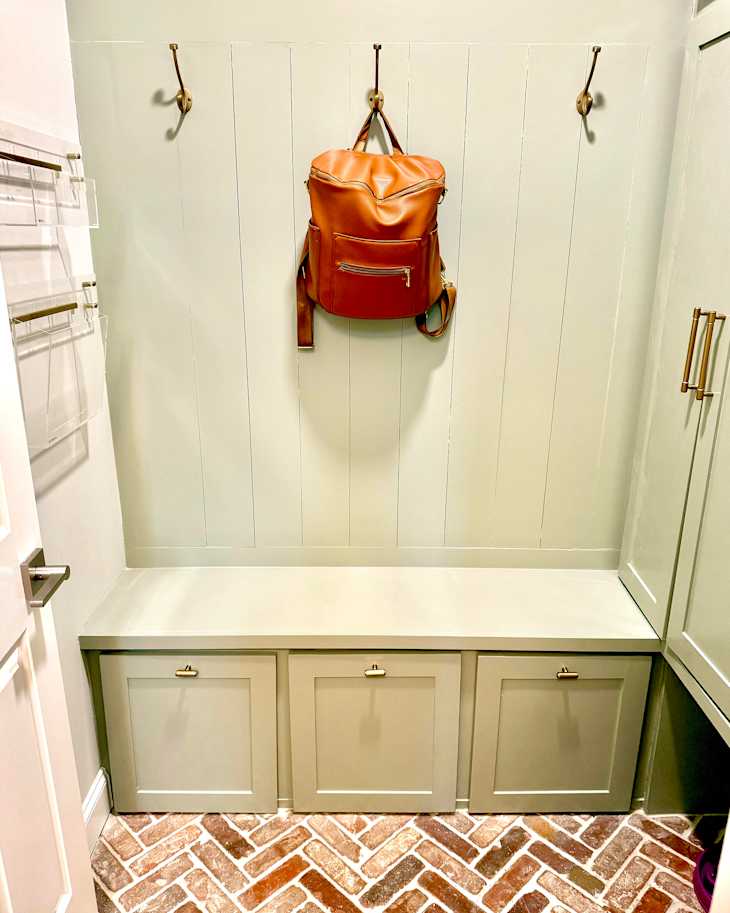
11. Install Storage Hooks
When floor space is at a premium, look up — the wall, that is. Hooks, wall organizers, and track systems that double as decor are one of the best ways to organize every inch of your entryway, Jackson says. “By moving items off the floor and onto the wall, you instantly free up walking space while keeping essentials like bags, jackets, hats, and keys within easy reach,” she adds. Choose attractive ones that enhance your preferred aesthetic.
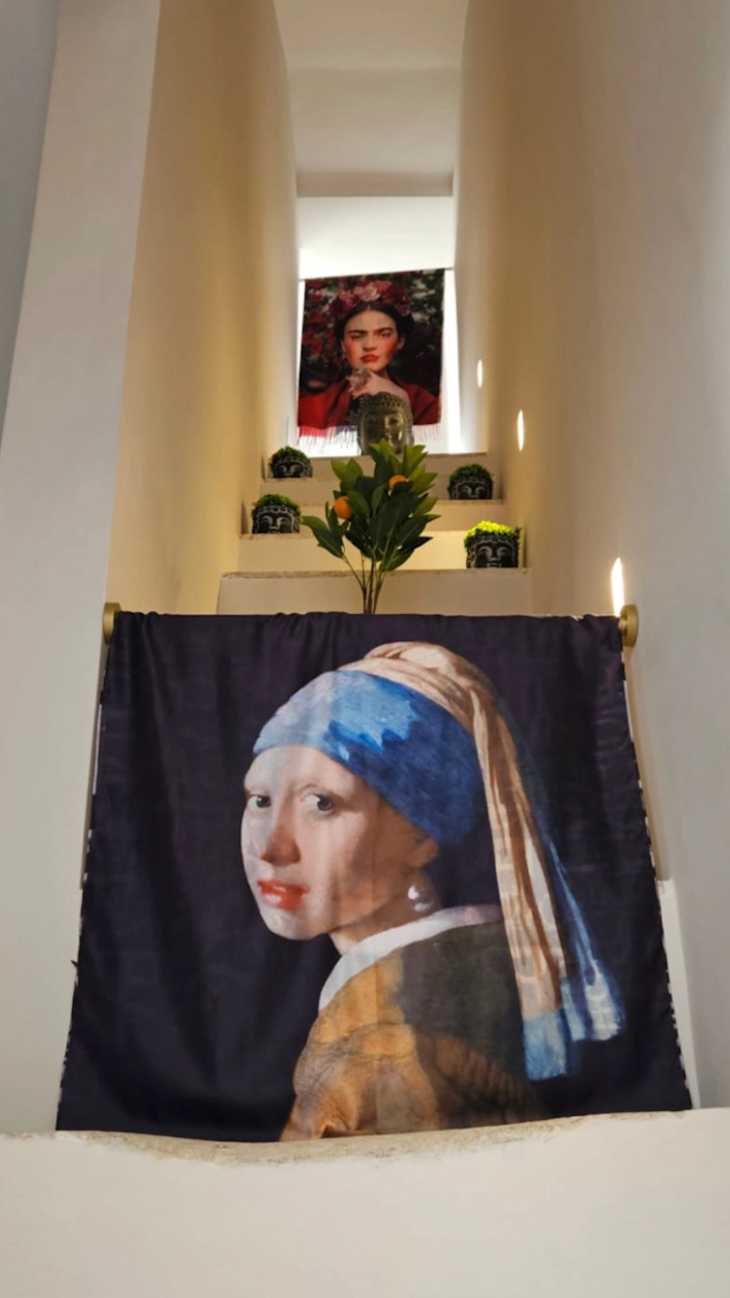
12. Make a Design Statement
Melina Manasse, interior designer at MKubed Designs, faced an entryway design challenge in an 860-square-foot home in Lecce, Italy: The tiny entryway faced a steep staircase, which not only disrupted the flow of the space, but also posed a safety hazard.
She turned the staircase into a statement feature, with two hanging murals and greenery on the steps. A mirror to the right of the door reflects light and makes the space look larger. “The result not only enhanced the aesthetic but also served a functional purpose by subtly blocking off the staircase for safety,” she adds.
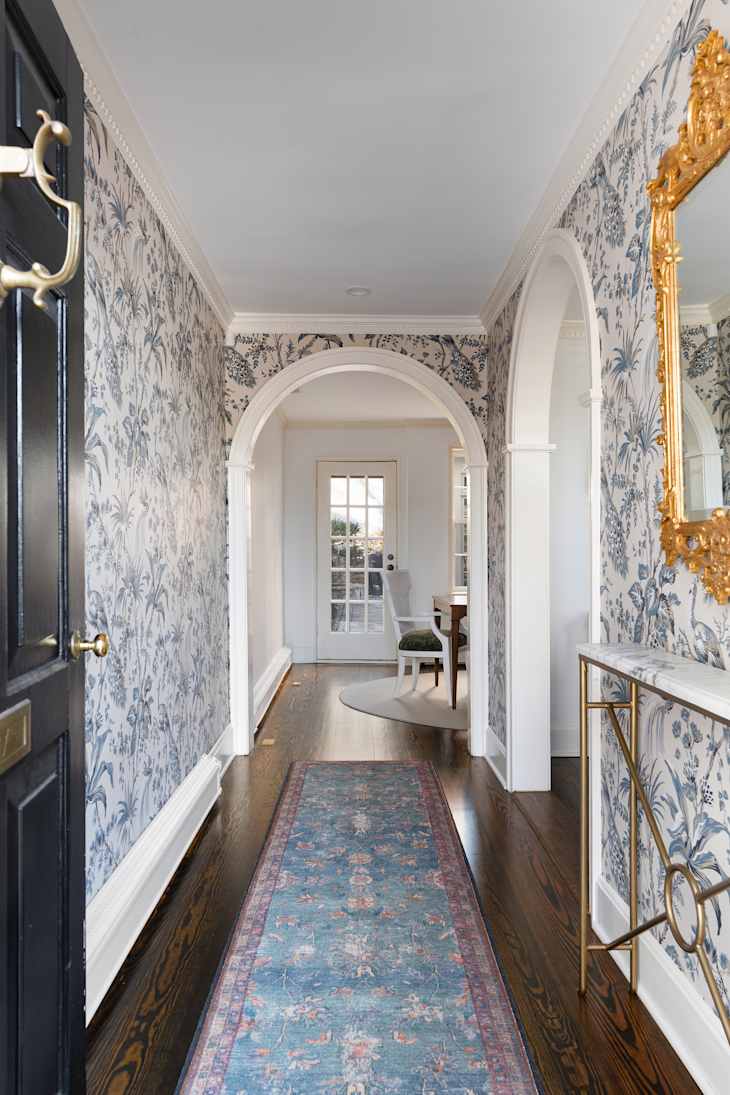
13. Use a Long Carpet Runner
Janet Bertin of Bertin’s Decorating Den designed the entryway of an 1,836-square-foot home in Virginia’s Old Town Alexandria that was built in the 1800s. “Because the footprint of the entryway was limited, we focused on making it both visually inspiring and functional from the moment you step through the door,” she says.
To highlight the architecture, a long runner directs you into the house and draws your eyes up to the graceful arches. The narrow table adds style without taking up too much room, while the statement mirror made it both “a visual anchor and a functional landing zone.” The elegant wallpaper introduced the color palette that will be seen throughout the home, too.
Total size of home: 1,800 square feet.
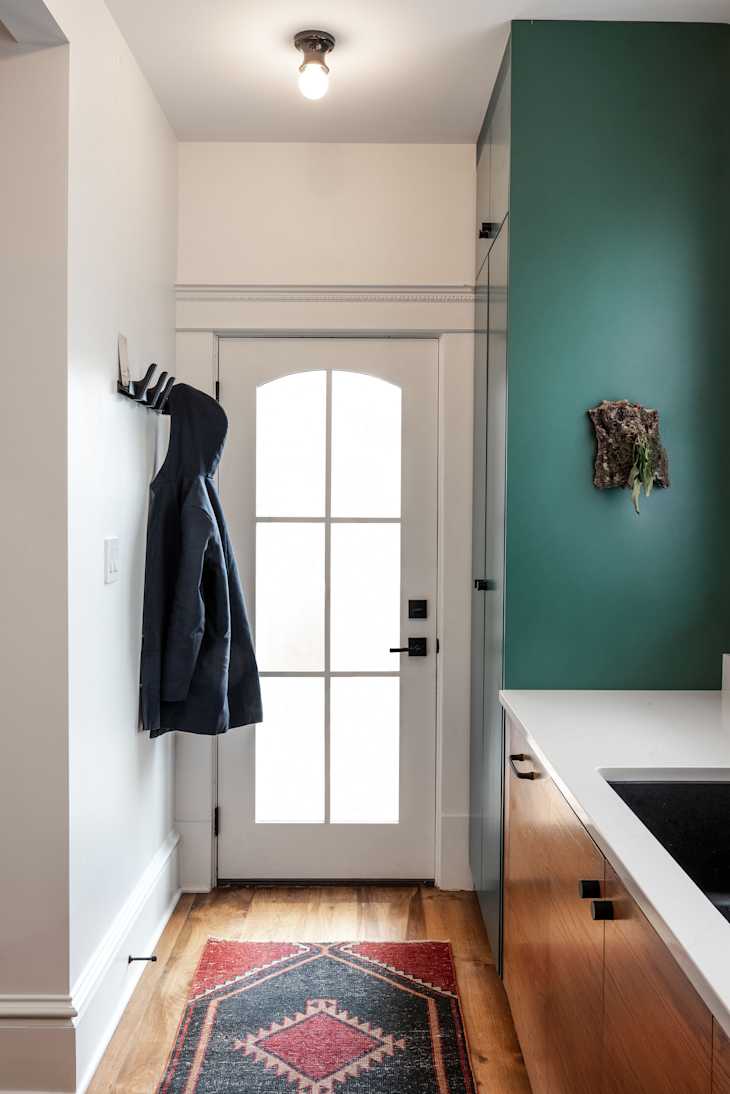
14. Hide a Mudroom in Plain Sight
Even with a 2,000-square-foot home, Dijana Savic-Jambert of MAREDI Design faced a limited footprint at the back entrance, which the family used most often. The challenge: Add function and make the space flow seamlessly into the kitchen renovation the firm was also working on.
The solution was a discreet floor-to-ceiling closet that blended into the kitchen cabinetry to create a mudroom. It looks like a pantry door, but behind it is a pegboard wall that the family can adapt and customize as needed. “It’s the ultimate hidden-in-plain-sight organization, making it every bit as hardworking as it is beautiful,” she says.
Total size of home: 2,000 square feet.
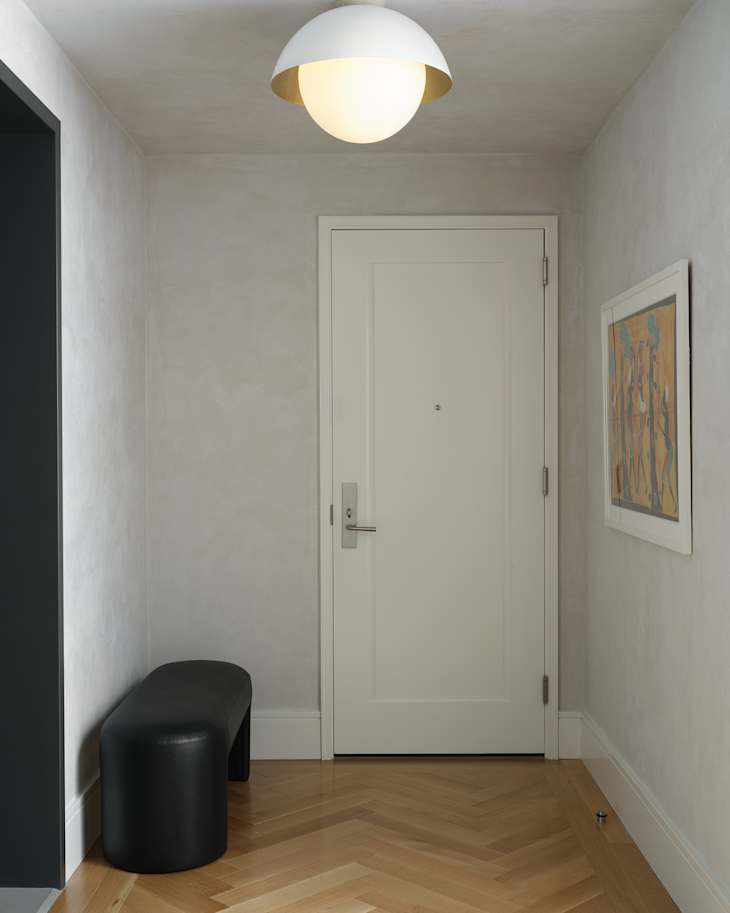
15. Set It Apart with Seating
A modern vinyl leather bench is a stylish yet functional spot to take off one’s shoes in the narrow entryway of this 2,300-square-foot-apartment, designed by Sarah Tract, founder and interior designer at Sarah Tract Interiors in New York. The soft glow of light from the statement dome fixture makes the entryway “feel inviting and intentional,” Tract adds.
Total size of home: 2,300 square feet.
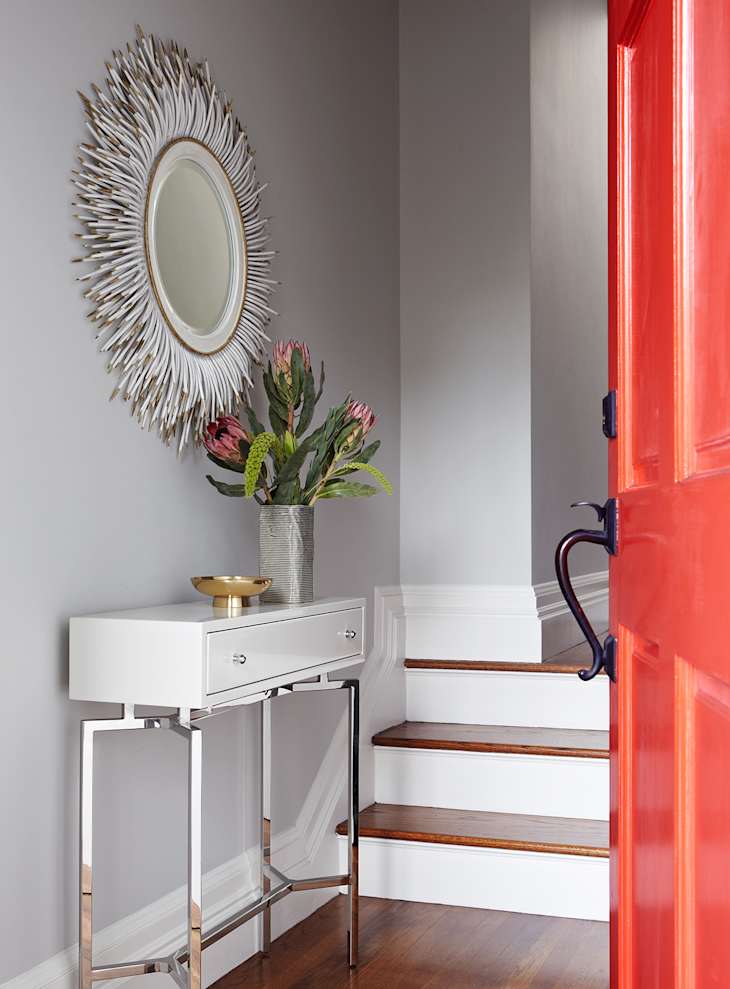
16. Invest in a Statement Mirror
“Designing compact entryways is a balancing act between function and beauty,” says Jennifer Jones, principal designer of San Francisco-based Niche Interiors. In this petite modern foyer of an otherwise spacious 2,800-square-foot San Francisco home, a small, modern console table with a drawer takes care of keys, mail, and other small items. A statement mirror on the wall creates a beautiful aesthetic — not to mention a great place to check your makeup or ensemble before heading out the door.
Total size of home: 2,800 square feet.
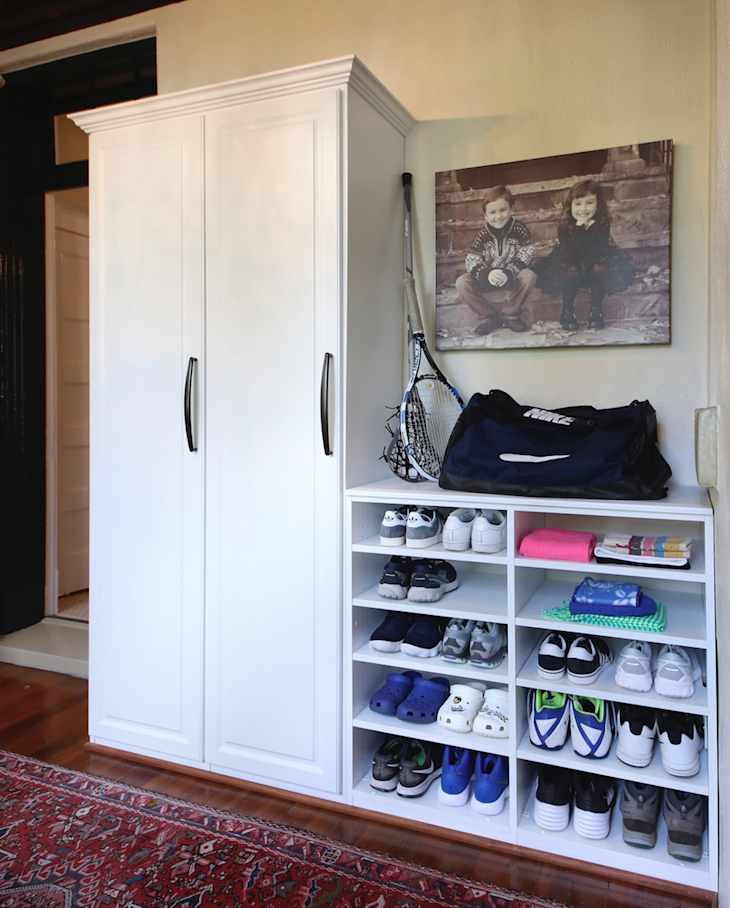
17. Combine Storage Solutions for a Custom Look
This 100-year-old home had 3,000 square feet of space and plenty of charm, but little storage. The owners wanted to use their back porch as the main entry for their two active kiddos, but there was no entry closet to drop gear between games and practices.
Jennifer Q. Williams of Saint Louis Closet Co. built a custom, floor-based system with open cubbies for easy access, maximizing the available space. “The result is a compact yet very functional drop zone that brings modern organization to a century-old space,” she says. “This is proof that even the smallest entries can balance beauty and practicality.”
Total size of home: 3,000 square feet.
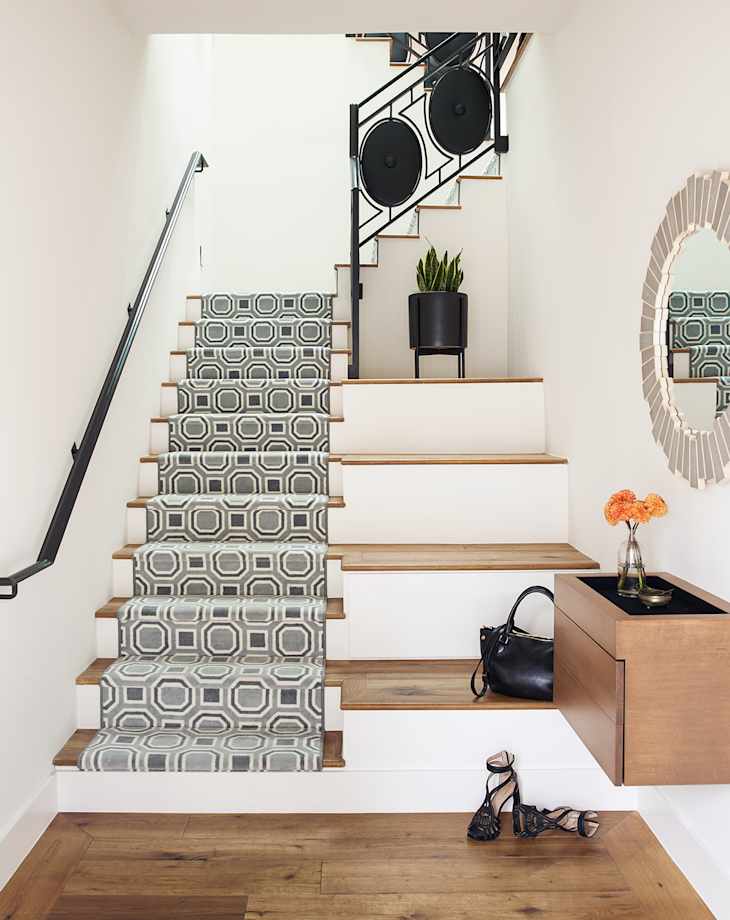
18. Use Every Inch of Available Space
In another Niche Interiors design, the entryway in an otherwise roomy home is mostly dominated by a staircase. A cantilevered cabinet creates storage without taking up much floor space. The custom cabinet features a hidden drawer and a felt-lined top — perfect for storing sunglasses on the way out the door.
Total size of home: 2,500 square feet.
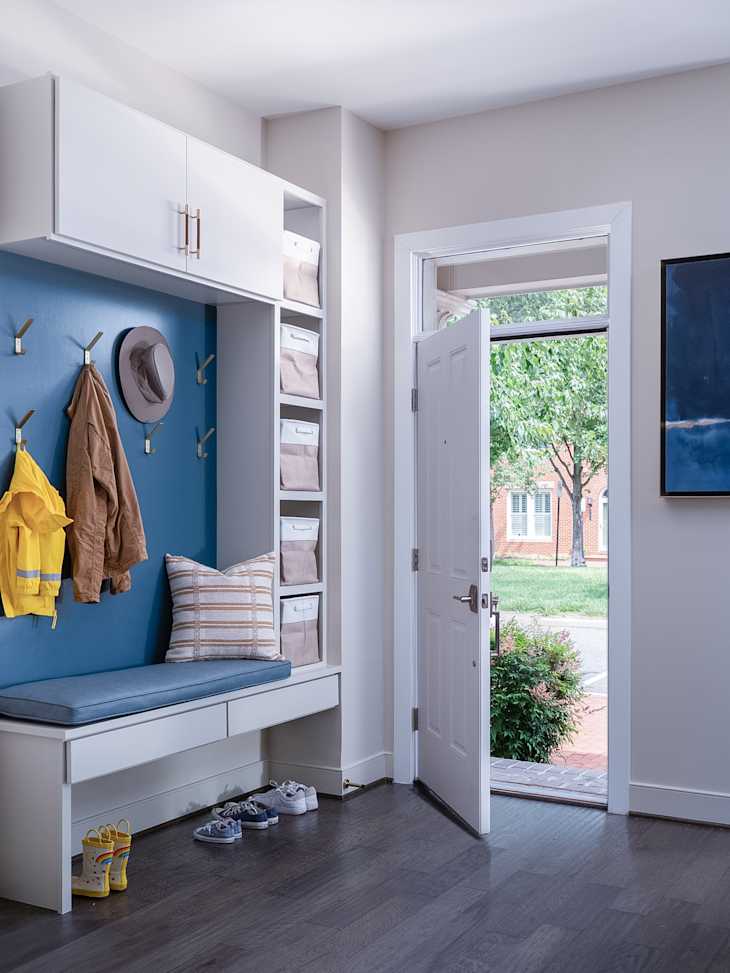
19. Consider Storage Cubbies
The front door opens right into the living room of this 2,800-square-foot, three-story row house in Alexandria, Virginia. Stacey Dobrovolny, founder and principal designer at Two Navy Lane Interiors, designed a “drop zone” for the owners — along with their toddler and dog — that maximized storage. A narrow built-in holds cubbies and baskets, plus a bench with storage beneath for the dog’s leash and plastic bags.
The drawers were touch latched, meaning there’s no hardware to catch on clothes when someone sits. A motion sensor light makes it easy to see where you’re going upon entering the home — plus there’s no harsh light to wake a toddler asleep on someone’s shoulder, Dobrovolny says.
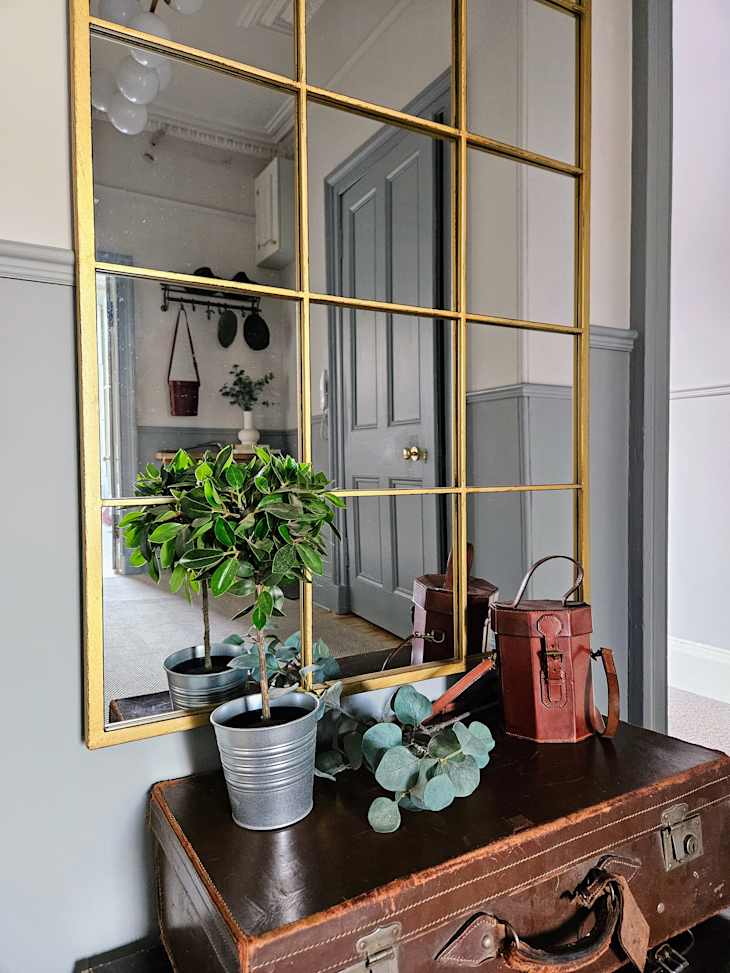
20. Broaden the Space with a Gridded Mirror
In this 1,260-square-foot Edinburgh flat built in the 1860s, a statement mirror makes the entryway appear larger than it actually is. The gold grid frame brightens up the space as well, while the vintage suitcase serves as an interesting console on which to arrange small decor.
Total size of home: 1,200 square feet.
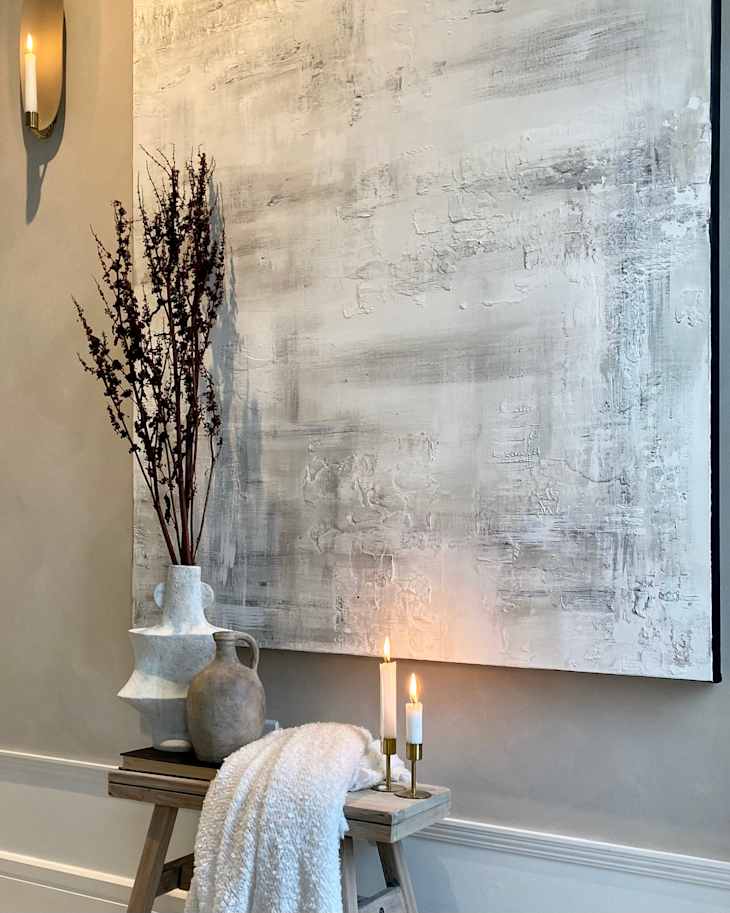
21. Lengthen the Space with Floor-to-Ceiling Wall Art
Gallery walls are fun to curate, but sometimes one huge canvas is what’s needed to liven up a space. Here, this large box canvas painted by this homeowner adds texture and warmth to an otherwise boring and cold entryway in a new build.
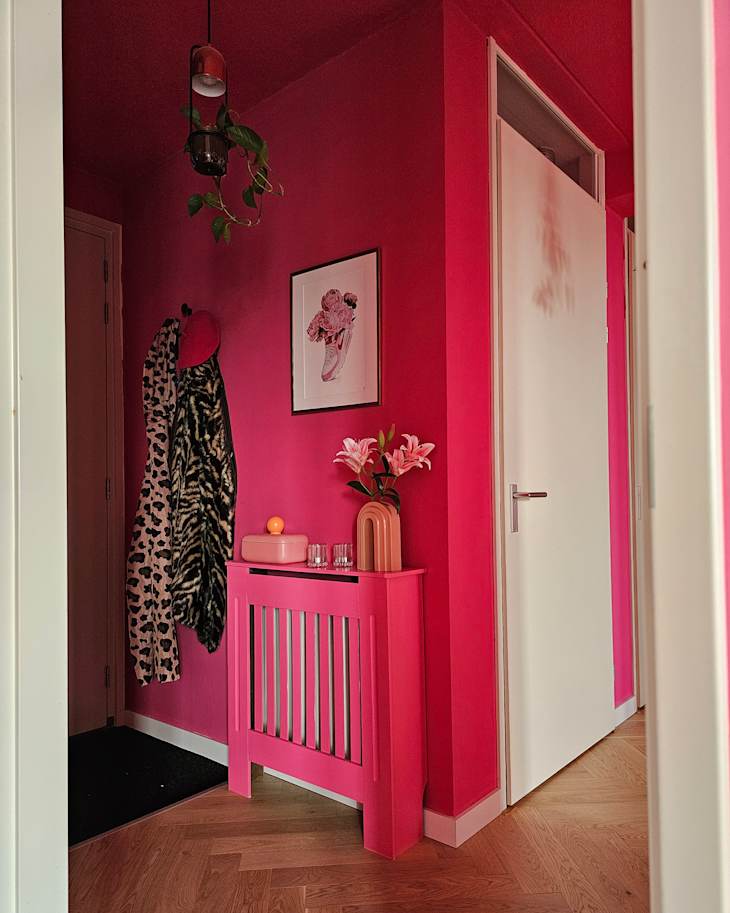
22. Choose a Bold Color Palette
Turn a small entryway (this one is just 60 square feet in size!) into a color-drenched jewel box of a space that welcomes and wows. Hot pink makes a bold and beautiful statement not just at the door, but throughout this 785-square-foot Amsterdam apartment.
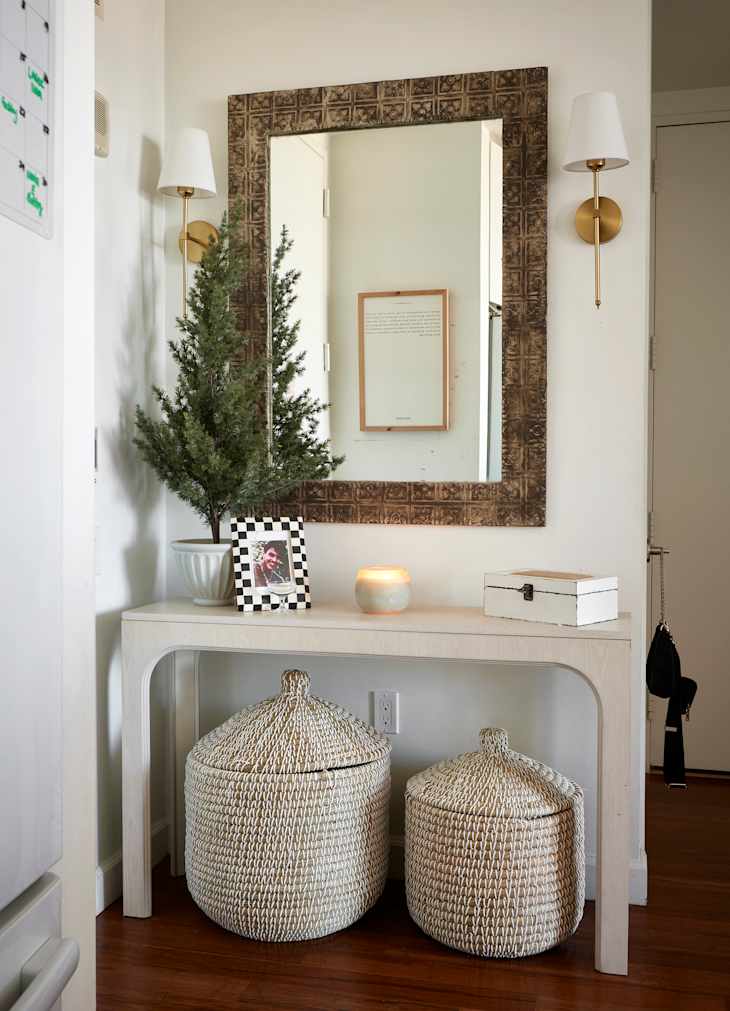
23. Use a Console to Create Storage
A table is the perfect place to anchor a mirror and create a surface for decor, keys, and other small items in the entry of this compact 525-square-foot, one-bedroom apartment. The space beneath the console is filled with decorative baskets to hold shoes.
Total size of home: 525 square feet.
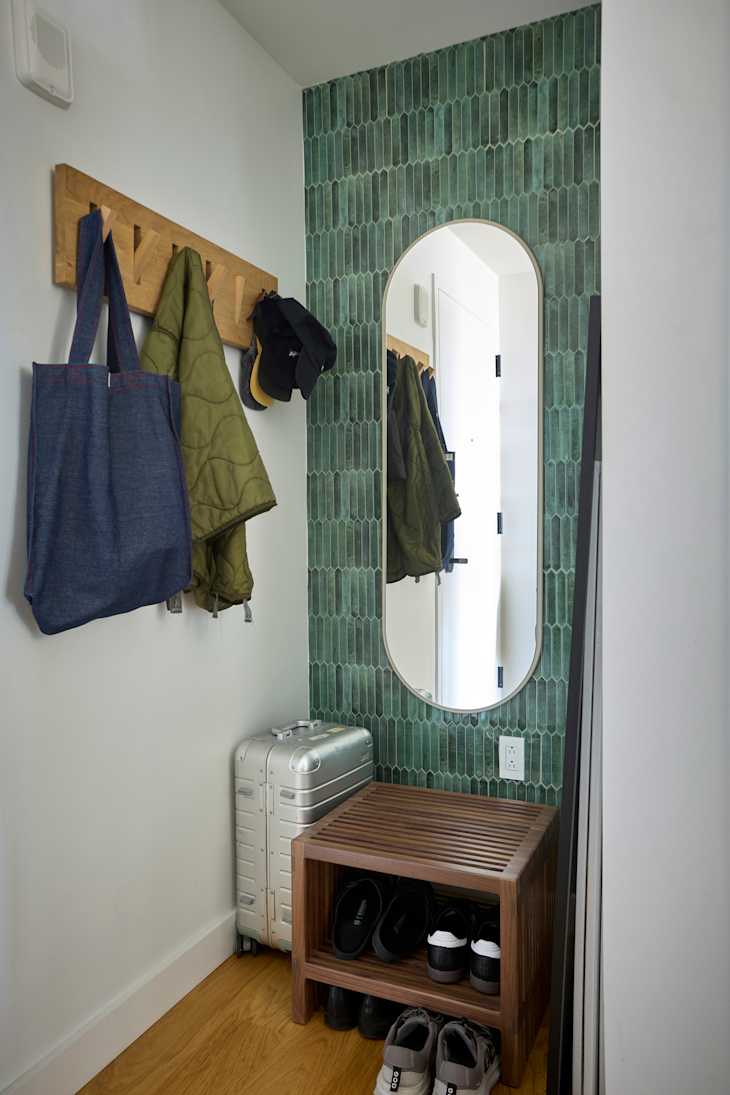
24. Offset an Entry with Tile
Paint and wallpaper aren’t the only ways to add color to a blank wall. Here, a tiled wall in various shades of vibrant green transforms the drab entryway in a bold Brooklyn apartment.
Total size of home: 500 square feet.
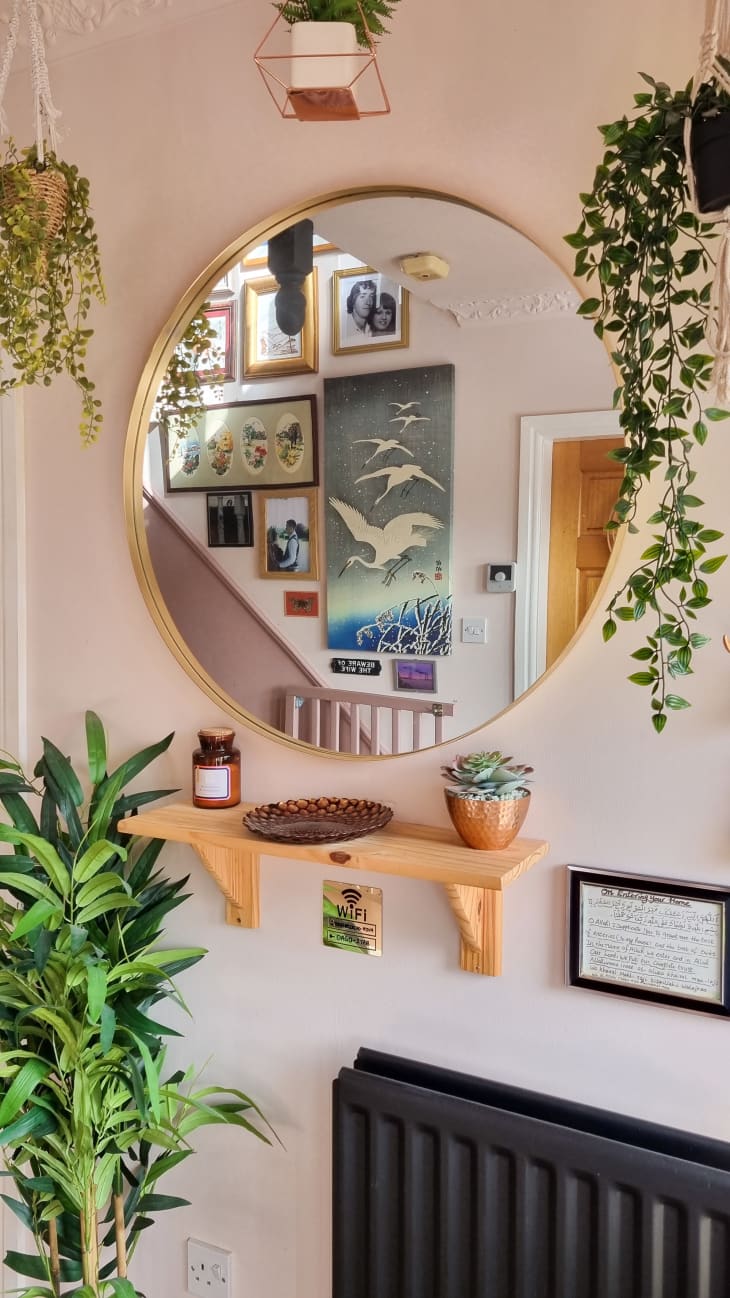
25. Greet Guests with a Gallery Wall
A circular mirror adds form and function as the center of this eclectic gallery wall in a 1,059-square-foot home in Billingham in the United Kingdom. A small unfinished bookshelf serves as a floating console for tiny decor and as a spot for keys.
Total size of home: 1,000 square feet.
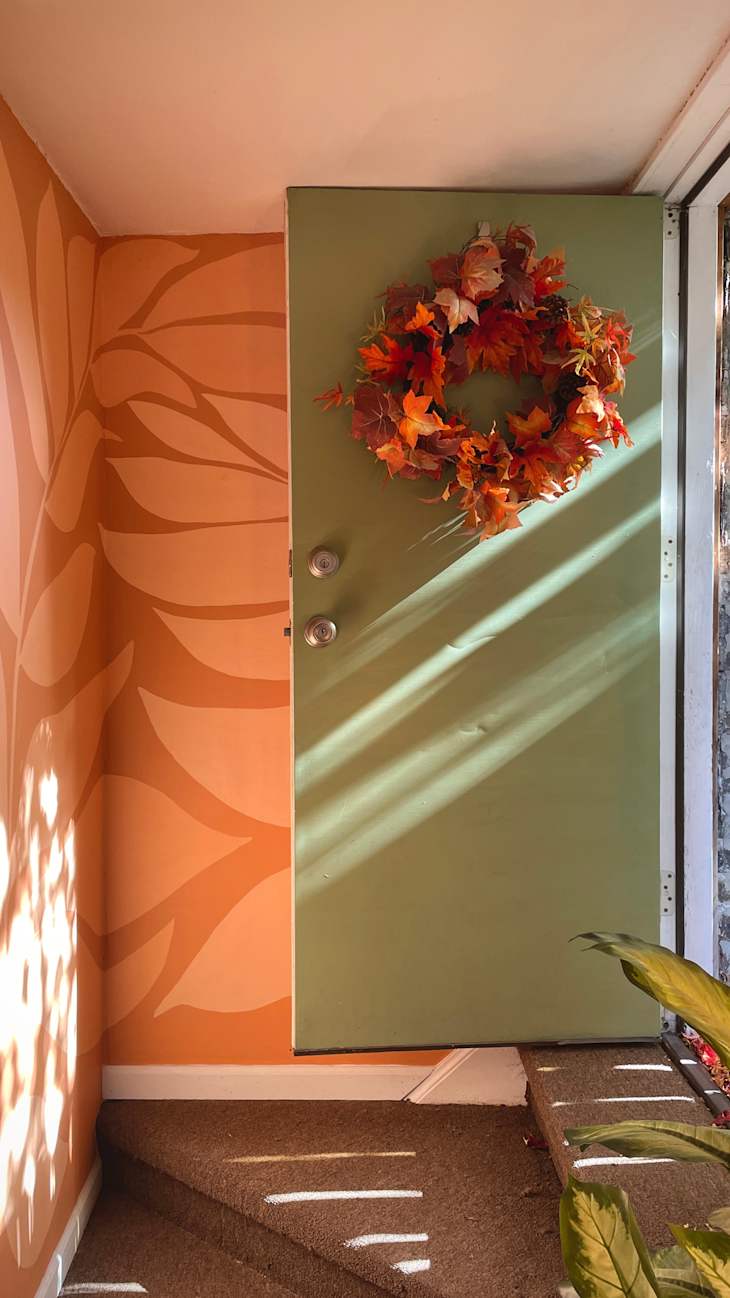
26. Cover Your Entryway in a Custom Mural
Why hang wall art in your entryway when you can treat the entire wall as a canvas? That’s exactly what one artist did in the entryway of this 800-square-foot Chicago apartment. Now, she and her guests are greeted by her unique creation every time they walk in the front door.
Total size of home: 800 square feet.
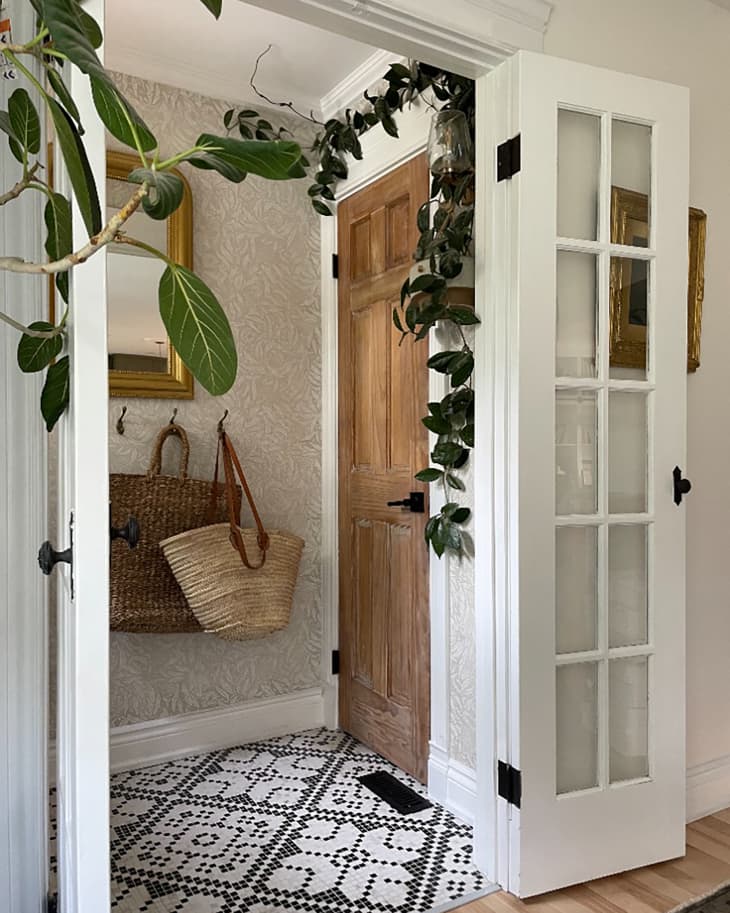
27. Define Your Entrance with Florals
Plants bring life to any space, and they are often seen throughout the rooms of this 1,100-square-foot home in Edmonton, Canada. The natural decor theme starts in the entryway, with lush green leaves framing the door like an indoor arbor.
Total size of home: 1,100 square feet.
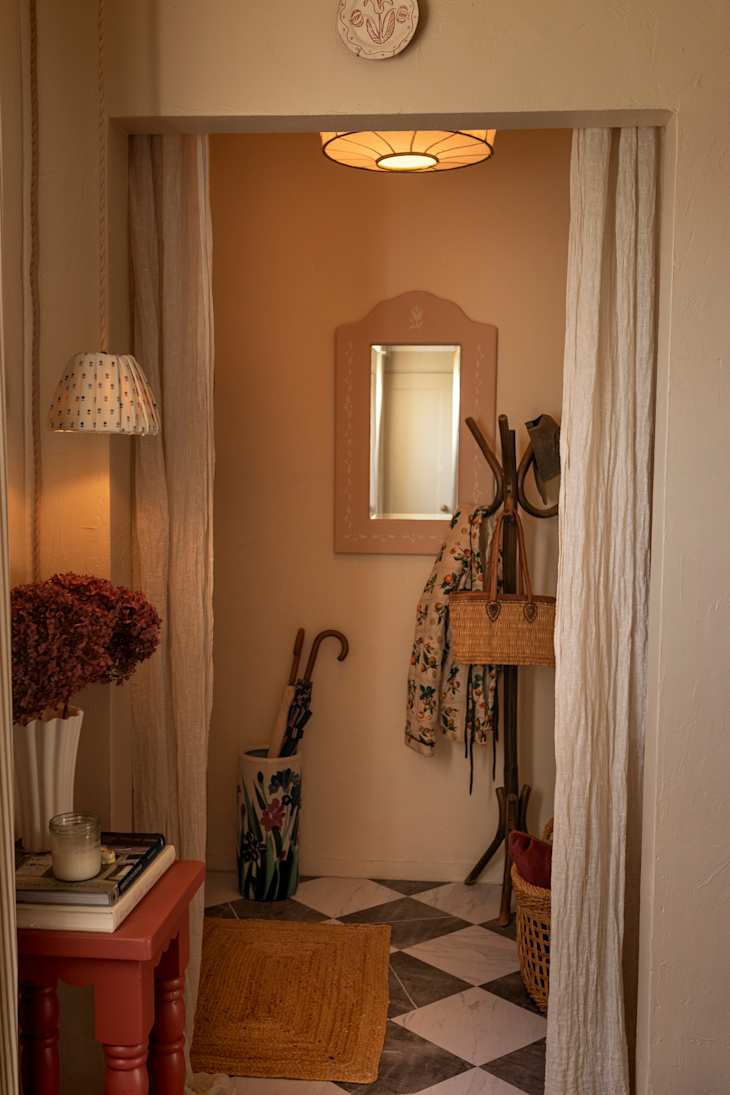
28. Hang Curtains to Create Separation
Long linen curtains that cover the entrance to the living room set the stage for the entry in this 450-square-foot Mesa, Arizona, rental. Although the ivory blends in with the wall, their crinkly texture adds visual interest and frames the entry to the living room.
Total size of home: 450 square feet.
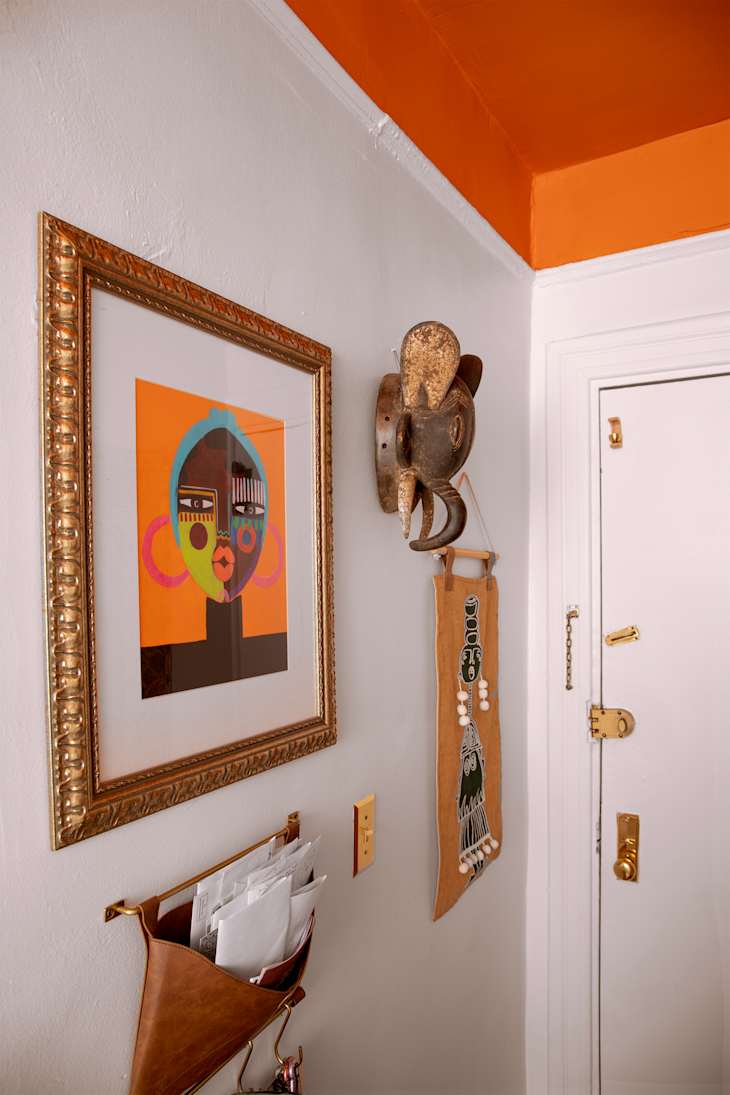
29. Turn the Ceiling into a Canvas
The ceiling is often referred to as the fifth wall, and it’s treated like a colorful canvas in the entryway of this 1,000-square-foot three-bedroom apartment in the Bronx. The bright orange draws the eye up all the way up to the 9-foot ceiling while also complementing the unique and colorful wall art.
Total size of home: 1,000 square feet.
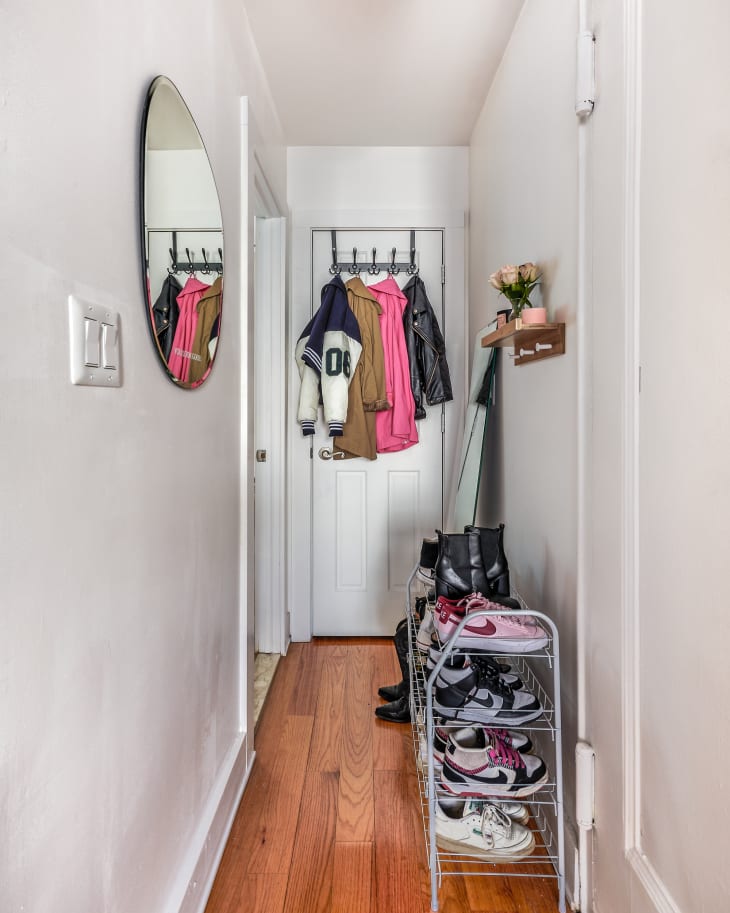
30. Create an Entryway Closet
In a really long, narrow entryway, some of your surfaces have to pull double duty. That’s exactly what you see in this 200-square-foot New York City studio, where the front door is outfitted with an over-the-door rack for coats and scarves.
As long as you have the clearance to be able to close and lock the door, this is a great spot to reclaim for storage space. The setup is rounded out with a freestanding shoe rack and a small hook rail-style shelf.
Total size of home: 200 square feet.
31. Source Shapely Furniture
If you’re really short on entry space, you need to be strategic about your furniture choices. For that reason, consider a demilune table, like what’s in this Paris studio apartment, the entryway equivalent to an ace up your sleeve.
It’s a table that pairs a flat back with a curved front that typically features a drawer for closed storage — all sitting on an airy, leggy base. The semicircle shape won’t overwhelm a tight entry. It’s ideal, actually, since you can push the flat back right up against the wall, and the rounded front is easy to navigate around.
Total size of home: 460 square feet.
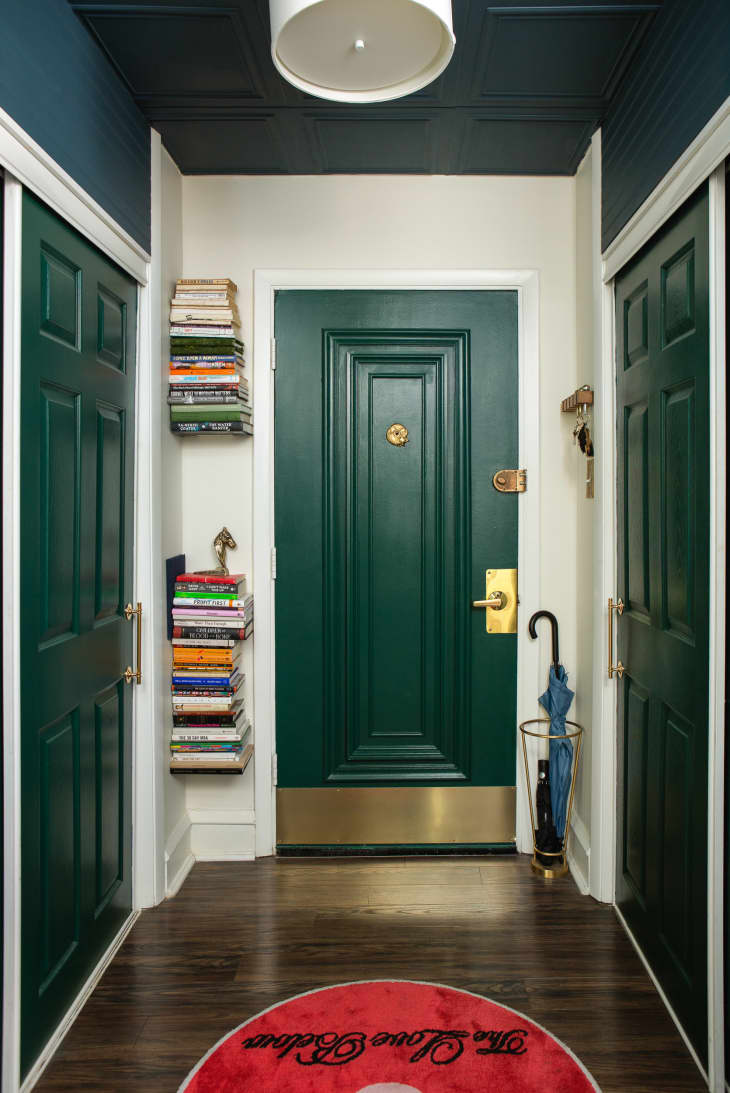
32. Make Magic with an Invisible Bookshelf
The small entryway in this 700-square-foot Chicago rental may be tight, but it’s got plenty of style (and storage). We love the books on the invisible shelving and vintage umbrella stand next to the beautifully moody dark green door. Plus, the wall-mounted key rack will ensure you never misplace yours.
Total size of home: 700 square feet.
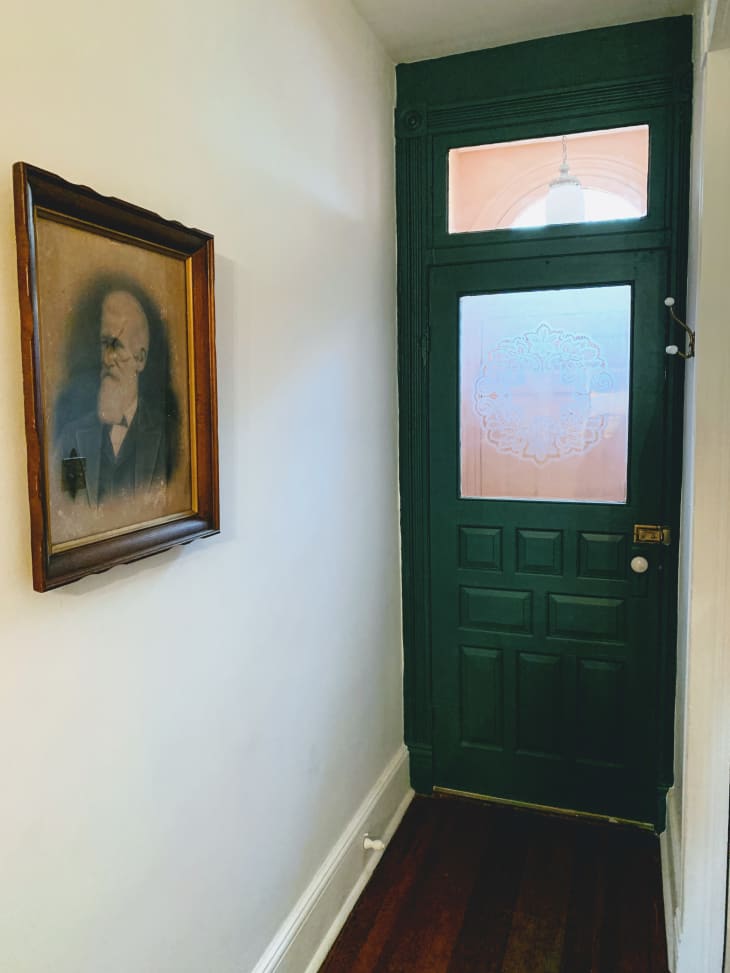
33. Let in Natural Light with Frosted Windows
Small entryways can be dark and drab, especially without proper lighting. Brighten things up with frosted windows on your entryway door, as seen in this historic Maryland home. The natural light opens the space up and makes the entire space feel roomy.
Total size of home: 1,700 square feet.
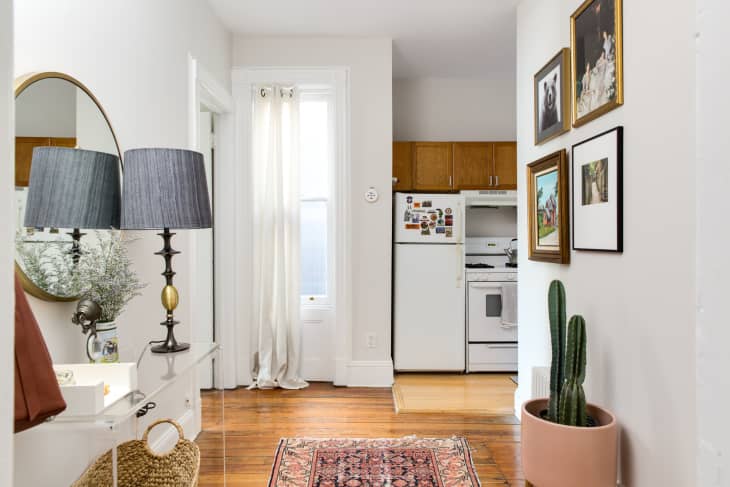
34. Go with a Lucite Console Table
When you’re working with a small space, a clear piece of furniture allows for maximum design possibilities without looking cluttered or overdone. The CB2 console table used in this 500-square-foot Brooklyn Heights apartment is actually pretty sizable, allowing this renter to add a large basket underneath for shoes.
Total size of home: 500 square feet.
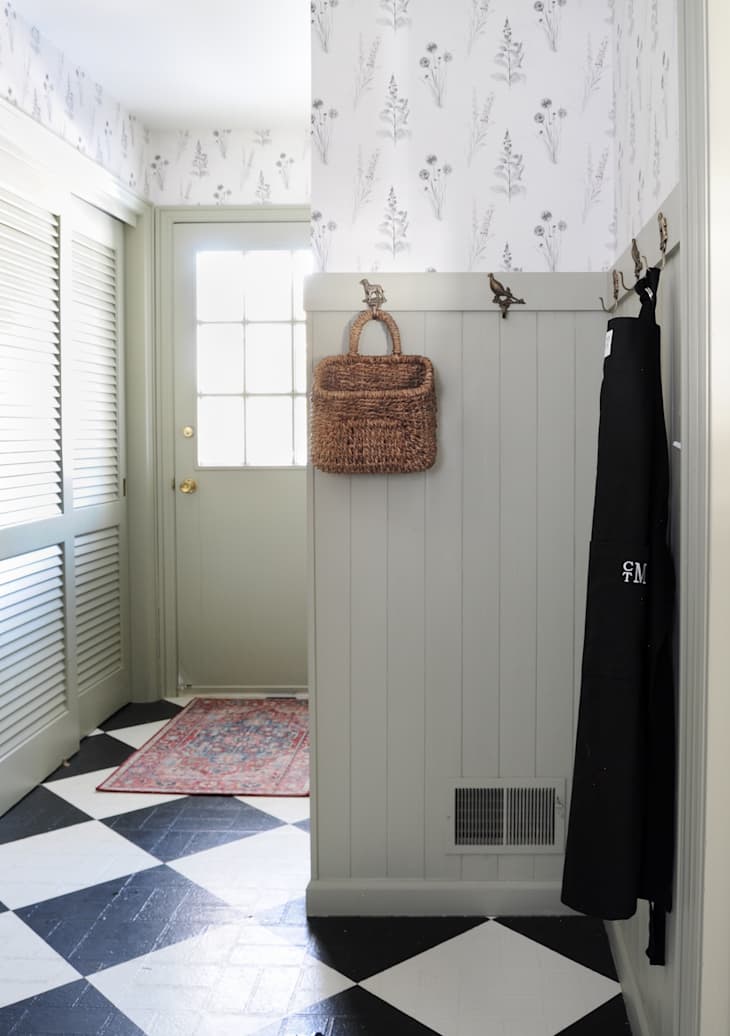
35. Hang Hooks That Double as Decor
Apart from the gorgeous sage green paint and botanical wallpaper, this charming entryway pops with animal brass hooks. They add to its whimsical feel while offering storage for jackets, hats, and bags.
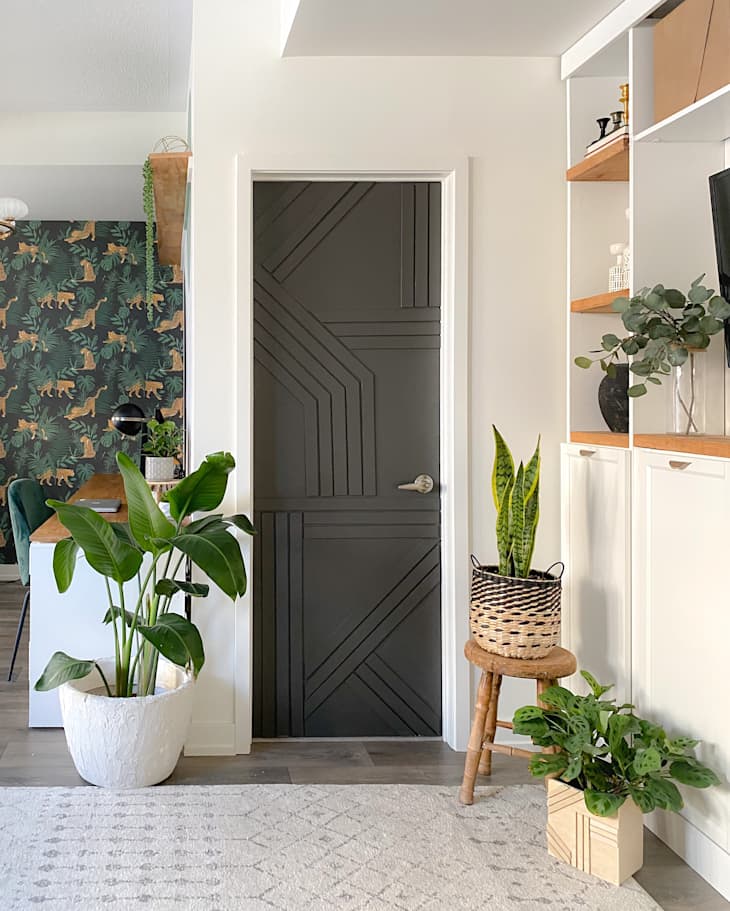
36. Deck Out the Door
If you truly have no entryway at all, then work with what you’ve got. This DIY geometric-print door is an awesome way to make a statement. And then you can make the space more welcoming with leafy green plants housed in beautiful pots.
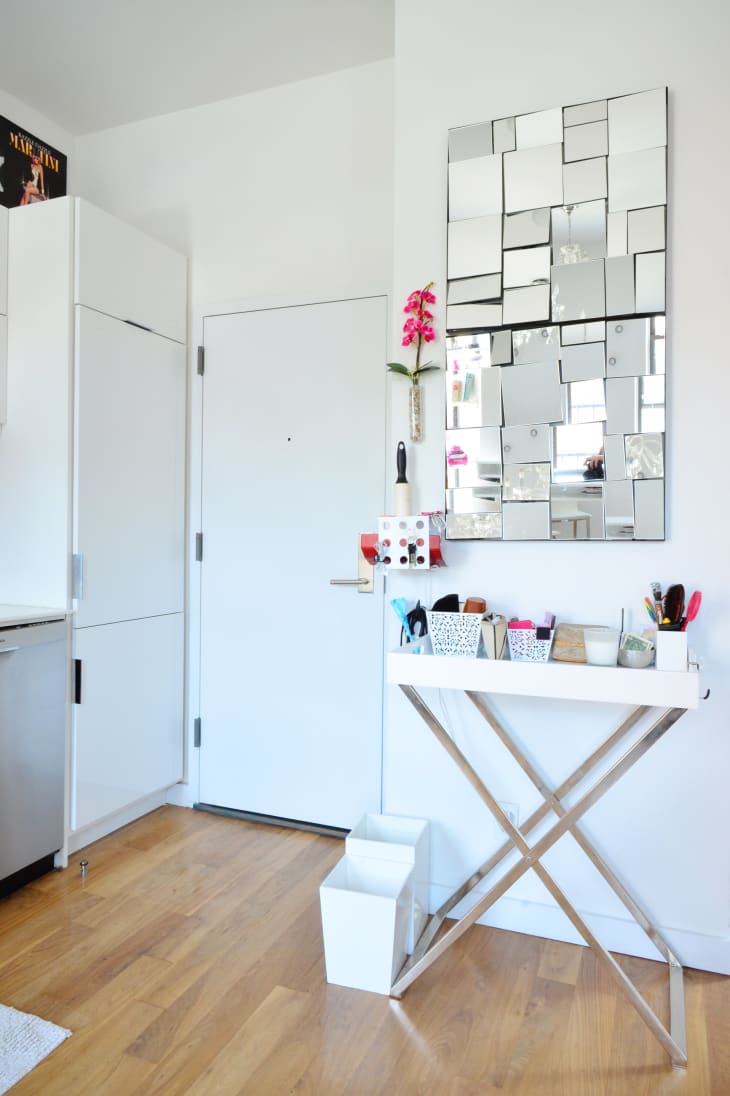
37. Create a Mail Center
Even if you aren’t working with a lot of space, having a proper place to put your mail is crucial to organizing both your life and your entryway. An acrylic tray table in this 500-square-foot West Village apartment provides enough room for a letter tray or two. Now you’ll be sure to remember your electric bill and maybe even your sunglasses.
Total size of home: 500 square feet.
Design Defined
Never miss the style inspo and recommendations you crave with Design Defined. Follow along each week as our Home Director Danielle shares the best style advice, latest trends, and popular decor finds you just can't miss.